

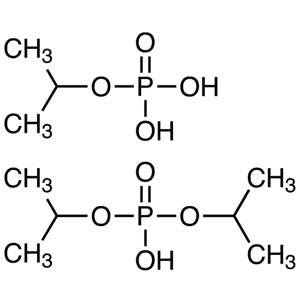
Isopropyl Phosphate (Mono- and Di-Ester mixture) is a chemical compound commonly used in various synthetic reactions within laboratory settings. This material is a mixture of mono- and di-ester forms of isopropyl phosphate, which exhibits unique chemical properties that make it suitable for use as a reagent or intermediate in organic synthesis. Its versatility allows it to participate in a range of chemical transformations, making it an essential component in many research applications. Due to its reactivity and functional group compatibility, it is widely utilized in both organic and inorganic chemistry experiments.
The chemical properties of Isopropyl Phosphate (Mono- and Di-Ester mixture) make it a preferred choice for laboratory use. It is chemically stable under certain conditions but highly sensitive to moisture and air exposure, which necessitates careful handling and storage. Its ability to interact with a variety of reagents in a controlled environment enhances its utility in complex molecular synthesis. Additionally, its high purity and cleanliness contribute to its reliability in experiments requiring precision and accuracy. These characteristics make it a valuable tool for researchers working in both academic and industrial laboratory environments.
In Indonesian laboratories, Isopropyl Phosphate (Mono- and Di-Ester mixture) is frequently used in organic chemistry research and synthesis processes. Its role in creating complex molecular structures is particularly important in the development of new compounds and materials. Due to its reactivity and stability under controlled conditions, it is a preferred choice for experiments that require both high reactivity and controlled chemical behavior. Its use is widespread in both academic and industrial research settings across Indonesia.
Related TCI products
- TCI P0273 1330-78-5 Tricresyl Phosphate (mixture of isomers)
- TCI P0267 107-66-4 Dibutyl Phosphate (Mono- and Di- Ester mixture)
- TCI P0262 52932-95-3 Methyl Phosphate (Mono- and Di- Ester mixture)
- TCI P0261 12645-31-7 2-Ethylhexyl Phosphate (Mono- and Di- Ester mixture)
- TCI O0146 37310-83-1 Oleyl Phosphate (Mono- and Di- Ester mixture)
- TCI E0236 37203-76-2 Ethyl Phosphate (Mono- and Di- Ester mixture)
- Organic Synthesis: This compound is ideal for organic synthesis due to its reactivity and ability to participate in esterification and substitution reactions.
- Intermediate Reagent: It serves as a versatile intermediate in the synthesis of various organic and inorganic compounds.
- Molecular Structure Building: It is used to construct complex molecular structures, especially in the development of new chemical compounds.
- Research and Development: Its stability and reactivity make it suitable for research and development in both academic and industrial laboratories.
- Analytical Chemistry: It can be used in analytical procedures where precise chemical interactions are required for accurate results.
| Brand | TCI |
|---|---|
| CAS number | — |
| Molecular formula | — |
| Purity | — |
| Category | Chemistry > Building Blocks > Non-Heterocyclic Building Blocks |
| Pack sizes | As per supplier specifications |
| Physical form | Liquid |
| Storage | Store in a cool, dry place away from moisture and air exposure. |
Isopropyl Phosphate (Mono- and Di-Ester mixture) should be stored in a cool, dry environment to prevent moisture and air exposure, which can affect its stability. It is recommended to use airtight containers made of glass or polyethylene to minimize contamination and degradation. Due to its sensitivity, it should be handled with care, using appropriate personal protective equipment such as gloves and goggles. In laboratory settings, it should be stored away from incompatible substances to ensure safety. Regular monitoring of storage conditions is essential to maintain its chemical integrity and effectiveness for research applications.
—
Produk Terkait
-
TricresylPhosphate(mixtureofisomers) TCI P0273
Regular price Rp 477.750,00Regular price -
DibutylPhosphate(Mono-andDi-Estermixture) TCI P0267
Regular price From Rp 505.050,00Regular price -
MethylPhosphate(Mono-andDi-Estermixture) TCI P0262
Regular price Rp 1.167.600,00Regular price -
2-EthylhexylPhosphate(Mono-andDi-Estermixture) TCI P0261
Regular price From Rp 664.650,00Regular price -
OleylPhosphate(Mono-andDi-Estermixture) TCI O0146
Regular price From Rp 584.850,00Regular price -
EthylPhosphate(Mono-andDi-Estermixture) TCI E0236
Regular price From Rp 1.008.000,00Regular price -
IsopropylCitrate(mixture) TCI C1030
Regular price Rp 2.625.000,00Regular price -
TripropylPhosphate TCI T4247
Regular price From Rp 1.644.300,00Regular price


