

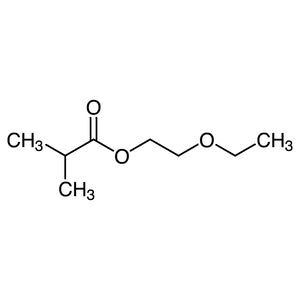
2-Ethoxyethyl Isobutyrate is a chemical compound widely used in laboratory settings for constructing complex molecular structures through various chemical reactions. As a key building block in organic chemistry, it plays a crucial role in the synthesis of ester compounds, which are essential in the development of numerous chemical products. This compound is commonly utilized in both industrial and research environments, particularly in the creation of organic compounds with specific functional properties. Its versatility makes it a valuable tool for chemists and researchers working on diverse chemical projects.
The compound is known for its stable molecular structure and moderate reactivity, which allows it to participate effectively in a range of chemical reactions. These characteristics make it a preferred choice for laboratory applications where controlled chemical transformations are required. Its consistent chemical and physical properties ensure reliable performance under various experimental conditions, enhancing the reproducibility of results. The liquid form of the compound also facilitates easy handling and use in both small and large-scale laboratory operations.
In Indonesian laboratories, 2-Ethoxyethyl Isobutyrate is frequently employed in chemical research, the development of new chemical materials, and the synthesis of organic compounds. Its favorable properties make it a primary choice for researchers and technicians involved in scientific experiments and applications. The compound's reliability and effectiveness contribute to its widespread use in both academic and industrial research settings across Indonesia.
Related TCI products
- TCI I0405 25265-77-4 3-Hydroxy-2,2,4-trimethylpentyl Isobutyrate (contains ca 40% 2,2,4-Trimethyl-1,3-pentanediol 3-Monoisobutyrate)
- TCI E0049 111-15-9 2-Ethoxyethyl Acetate
- TCI I0316 97-85-8 Isobutyl Isobutyrate
- TCI B0955 5451-72-9 2-Ethoxyethyl Benzoate
- TCI T2208 52698-46-1 Trimethyl Orthoisobutyrate
- TCI I0676 2050-01-3 Isoamyl Isobutyrate
- Ester Synthesis in Organic Chemistry: This compound is ideal for creating ester functional groups, which are fundamental in organic synthesis for building complex molecular structures.
- Development of Organic Compounds: Its reactivity and stability make it suitable for the synthesis of various organic compounds with specific chemical properties.
- Research in Chemical Innovation: It supports research efforts aimed at developing new chemical materials and pharmaceutical intermediates.
- Industrial Chemical Production: Used in the production of specialty chemicals and industrial materials requiring ester functionalities.
- Educational and Academic Research: Widely used in academic settings for teaching and research in organic chemistry and chemical engineering.
| Brand | TCI |
|---|---|
| CAS number | 54396-97-3 |
| Molecular formula | — |
| Purity | — |
| Category | Chemistry > Building Blocks > Non-Heterocyclic Building Blocks |
| Pack sizes | Available in various quantities as per supplier specifications |
| Physical form | Liquid |
| Storage | Store in a cool, dry place away from direct sunlight and incompatible materials |
This compound should be stored in a cool, dry environment, away from direct sunlight and sources of heat. It is recommended to use sealed containers made of materials compatible with organic solvents to prevent contamination and evaporation. Proper ventilation is essential when handling the compound to minimize exposure to vapors. Due to its chemical nature, it should be kept away from strong oxidizing agents and reactive materials. Always follow standard laboratory safety protocols, including the use of personal protective equipment such as gloves and safety goggles when handling or transferring the compound.
—
Produk Terkait
-
3-Hydroxy-2,2,4-trimethylpentylIsobutyrate(containsca40%2,2,4-Trimethyl-1,3-pentanediol3-Monoisobutyrate) TCI I0405
Regular price From Rp 505.050,00Regular price -
2-EthoxyethylAcetate TCI E0049
Regular price From Rp 477.750,00Regular price -
IsobutylIsobutyrate TCI I0316
Regular price From Rp 477.750,00Regular price -
2-EthoxyethylBenzoate TCI B0955
Regular price Rp 1.538.250,00Regular price -
TrimethylOrthoisobutyrate TCI T2208
Regular price Rp 2.411.850,00Regular price -
IsoamylIsobutyrate TCI I0676
Regular price From Rp 610.050,00Regular price -
PhenylIsobutyrate TCI I0482
Regular price Rp 2.625.000,00Regular price -
BenzylIsobutyrate TCI I0424
Regular price Rp 477.750,00Regular price


