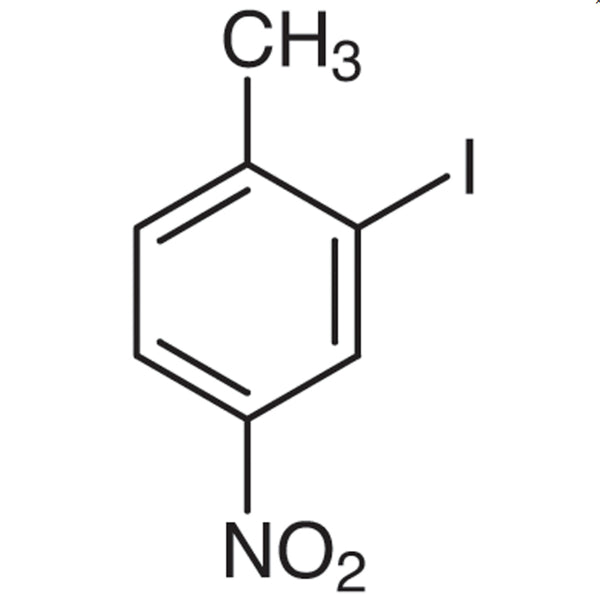
TCI I0706 2-Iodo-4-nitrotoluene is a halogenated aromatic compound that carries three useful functional groups on a single benzene ring: an iodine atom, a nitro group, and a methyl group. In organic synthesis laboratories, this material serves as a non-heterocyclic building block that brings together the reactivity of the carbon–iodine bond with the electron-withdrawing character of the nitro group. That combination makes it an efficient starting material for constructing polysubstituted aromatic frameworks, particularly when researchers are designing target compounds that require controlled substitution patterns at the ortho and para positions.
The property that makes this material a frequent choice is the advantage aryl iodides hold in cross-coupling reactions. The C–I bond is the most readily susceptible to oxidative addition at palladium or copper catalysts compared with aryl bromides or aryl chlorides, so Suzuki, Sonogashira, Heck, and Buchwald–Hartwig reactions can proceed under milder conditions. The nitro group, meanwhile, plays a dual role: it activates the ring toward nucleophilic aromatic substitution while also acting as a masked amine group that can be reduced to an aniline at a later stage. The methyl group completes the substitution pattern and offers a further handle for downstream transformation.
In Indonesian laboratories, this building block is typically used in university and institutional research groups working on organic synthesis, medicinal chemistry, and materials chemistry. It is generally handled at bench scale for route development and multi-step sequences, where a reliable, well-characterised aryl iodide shortens the path to a substituted aromatic intermediate. Researchers in graduate programmes and government research centres commonly draw on reagents of this type when preparing intermediates that would otherwise require several additional preparative steps.
- Suzuki–Miyaura cross-coupling: the reactive C–I bond undergoes oxidative addition readily at palladium, allowing biaryl construction with boronic acids under milder thermal conditions than the corresponding bromide.
- Sonogashira coupling: the aryl iodide couples efficiently with terminal alkynes under palladium–copper catalysis, giving access to arylalkyne intermediates useful in conjugated and pharmaceutical scaffolds.
- Heck reaction: coupling with alkenes proceeds through the same favourable oxidative addition step, letting researchers install vinyl substituents on a nitro-activated aromatic ring selectively.
- Buchwald–Hartwig amination: the iodine position serves as the coupling site for carbon–nitrogen bond formation, building arylamine motifs frequently required in medicinal chemistry programmes.
- Nitro reduction to aniline intermediates: the nitro group functions as a masked amine, reduced in a later step to reveal an aniline for subsequent diazotisation, acylation, or heterocycle formation.
| Brand | TCI (Tokyo Chemical Industry) |
|---|---|
| CAS number | 7745-92-8 |
| Molecular formula | — |
| Purity | — |
| Category | Chemistry > Building Blocks > Non-Heterocyclic Building Blocks |
| Pack sizes | available in standard TCI research-scale packaging; please confirm the size required when ordering |
| Physical form | — |
| Storage | keep in a cool, dark place in a tightly closed container |
- Chemical class: halogenated nitroaromatic, non-heterocyclic building block
Store the container tightly closed in a cool, dark, well-ventilated area away from light, heat, and sources of ignition, and keep it separated from strong oxidising and reducing agents. Amber glass or the original manufacturer packaging is suitable; reseal promptly after each use to limit exposure to moisture and air. Handle the compound inside a fume hood while wearing a laboratory coat, chemical-resistant gloves, and safety goggles, and avoid the generation of dust as well as direct skin or eye contact. Aryl iodides and nitroaromatic compounds should be weighed carefully, and all residues and contaminated consumables collected as chemical waste for disposal in line with institutional procedures. Always consult the manufacturer's Safety Data Sheet before first use.
—
Produk Terkait
-
2-Iodo-3-nitrotoluene TCI I0799
Regular price From Rp 2.650.200,00Regular price -
2-Bromo-3-nitrotoluene TCI B3712
Regular price Rp 1.565.550,00Regular price -
2-Bromo-6-nitrotoluene TCI B1878
Regular price From Rp 1.008.000,00Regular price -
2-Bromo-5-nitrotoluene TCI B1853
Regular price From Rp 848.400,00Regular price -
4-Bromo-2-nitrotoluene TCI B1843
Regular price From Rp 769.650,00Regular price -
4-tert-Butyl-3-methoxy-2,6-dinitrotoluene TCI B1379
Regular price From Rp 875.700,00Regular price -
2-Bromo-4-nitrotoluene TCI B1262
Regular price Rp 477.750,00Regular price -
2-Methoxy-4-nitrotoluene TCI M1681
Regular price From Rp 1.140.300,00Regular price