

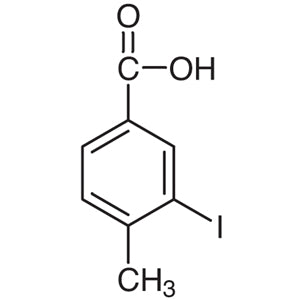
TCI I0707 3-Iodo-p-toluic Acid, also known as 3-iodo-4-methylbenzoic acid, is an aromatic building block that combines a carboxylic acid group, an iodine atom, and a methyl group on a single benzene framework. In synthetic laboratories this compound is valued because it provides two complementary reaction points that can be addressed in sequence: the carboxyl group for amide or ester formation, and the carbon–iodine bond for cross-coupling chemistry. Materials of this kind frequently serve as the backbone of stepwise molecular assembly in medicinal chemistry programmes and organic materials research.
The characteristic that makes this compound sought after is the orthogonality of the reactivity of its two functional groups. The carboxylate is readily activated to an acid chloride or an active ester, or coupled directly with amines using standard activating reagents, while the iodo position remains untouched. Conversely, the weak C–I bond allows oxidative addition to proceed at moderate temperatures, so Suzuki, Sonogashira, or metal-catalysed amination reactions can be carried out without disturbing the acid group. The meta-iodo substitution pattern relative to the carboxyl, with a methyl group at the para position, also provides a framework with a well-defined geometry for building substituted aromatic scaffolds.
In Indonesian laboratories, building blocks of this type are typically found in university organic synthesis groups, pharmaceutical research units, and institutional research centres working on new active compounds or functional organic materials. They are generally ordered in small quantities for multi-step route development, method optimisation, and the preparation of intermediates for further study, where reproducible reactivity from a recognised supplier matters more than bulk volume.
TCI brochures (PDF)
- Iodinated Phenol/Benzoic Acid/Benzaldehyde Building Blocks 2024-11-15 · p. 2
- Suzuki–Miyaura cross-coupling: the carbon–iodine bond undergoes oxidative addition under mild conditions, allowing biaryl construction with boronic acids while the carboxylic acid group is left intact for later elaboration.
- Sonogashira coupling: the reactive aryl iodide position readily accepts terminal alkynes under palladium–copper catalysis, giving access to rigid conjugated intermediates useful in organic materials and probe synthesis.
- Amide bond formation: the carboxyl group can be coupled directly with amines using standard activating reagents, producing benzamide intermediates that retain the iodine handle for a subsequent coupling step.
- Esterification and carboxyl protection: converting the acid to an ester or acid chloride masks that position during metal-catalysed steps, supporting the orthogonal, stepwise synthetic sequences these building blocks are chosen for.
- Metal-catalysed amination: the aryl iodide participates in catalytic carbon–nitrogen bond formation at moderate temperatures, enabling substituted aniline-type scaffolds to be built onto the toluic acid framework.
| Brand | TCI (Tokyo Chemical Industry) |
|---|---|
| CAS number | 82998-57-0 |
| Molecular formula | — |
| Purity | — |
| Category | Chemistry > Building Blocks > Non-Heterocyclic Building Blocks |
| Pack sizes | available in standard TCI research-scale packaging; please confirm the available sizes when ordering |
| Physical form | — |
| Storage | keep in a cool, dry place in the tightly closed original container |
- Chemical name: 3-Iodo-p-toluic Acid (3-iodo-4-methylbenzoic acid)
- Catalogue number: I0707
Store the container tightly closed in a cool, dry, well-ventilated area, away from direct sunlight, moisture, and incompatible materials such as strong oxidising agents and strong bases. The original supplier packaging is the most suitable container; if transfer is necessary, use clean, dry, chemically compatible glass or approved plastic vessels with secure closures and clear labelling. Handle in a fume hood using safety glasses, gloves, and a laboratory coat, and avoid generating dust or inhaling the material. Allow cold containers to reach room temperature before opening to prevent moisture condensation, and always consult the manufacturer's Safety Data Sheet before use and for disposal guidance.
—
Produk Terkait
-
p-ToluicAcid TCI T0293
Regular price From Rp 477.750,00Regular price -
o-ToluicAcid TCI T0292
Regular price From Rp 505.050,00Regular price -
m-ToluicAcid TCI T0291
Regular price From Rp 955.500,00Regular price -
5-Iodo-o-toluicAcid TCI I0916
Regular price From Rp 823.200,00Regular price


