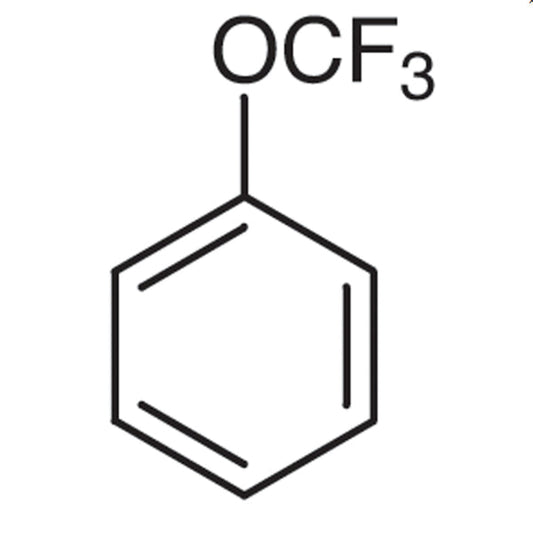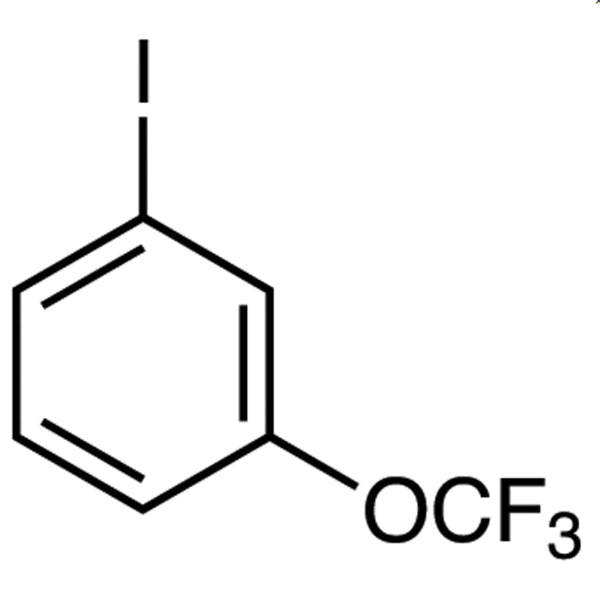
TCI I0813 1-Iodo-3-(trifluoromethoxy)benzene, CAS number 198206-33-6, is a fluorinated building block that combines two high-value functional groups on a single benzene ring: an iodine atom serving as the reactive coupling point, and a trifluoromethoxy group positioned meta to it. In the laboratory, this compound acts as a starting material for constructing more complex molecules, particularly through transition-metal-catalysed cross-coupling reactions. The carbon–iodine bond is the most readily activated among the aryl halides, which makes this compound the substrate of choice when a reaction must proceed at low temperature or with a small catalyst loading.
The property that drives the selection of this material is the character of the trifluoromethoxy group. This group is strongly lipophilic — more so than either a trifluoromethyl group or an ordinary methoxy group — so its incorporation into a drug candidate can improve membrane penetration. The group is also strongly electron-withdrawing and highly resistant to oxidative metabolism, two characteristics that have made it sought after in modern medicinal chemistry and agrochemical research. Because introducing a trifluoromethoxy group directly at a late stage of a synthesis is difficult, chemists prefer to start from a ring that already carries it.
In Indonesian laboratories, this building block is typically found in university and institutional research groups working on organic synthesis, medicinal chemistry, and materials chemistry, as well as in industrial R&D units developing fluorinated active ingredients. It is generally purchased in small research quantities for exploratory route development rather than in bulk, and is handled within standard synthetic chemistry workflows where cross-coupling and further functionalisation steps are routine.
TCI brochures (PDF)
- Fluorination Reagents, Fluorinated Building Blocks 2026-03-18 · p. 43
Related TCI products
- TCI T2155 713-65-5 1-Nitro-4-(trifluoromethoxy)benzene
- TCI T2153 103962-05-6 1-Iodo-4-(trifluoromethoxy)benzene
- TCI T2152 175278-00-9 1-Iodo-2-(trifluoromethoxy)benzene
- TCI T2149 461-81-4 1-Chloro-4-(trifluoromethoxy)benzene
- TCI T2147 64115-88-4 1-Bromo-2-(trifluoromethoxy)benzene
- TCI T1617 456-55-3 (Trifluoromethoxy)benzene
- Suzuki–Miyaura cross-coupling: the easily activated carbon–iodine bond allows coupling with boronic acids under mild conditions, installing the trifluoromethoxyphenyl unit into a larger scaffold in one step.
- Medicinal chemistry scaffold construction: the meta-trifluoromethoxy ring raises lipophilicity and metabolic stability of a candidate molecule, properties that are difficult to introduce late in a synthetic route.
- Sonogashira and other palladium-catalysed couplings: the aryl iodide reacts at low catalyst loading and low temperature, useful when sensitive partners cannot tolerate forcing reaction conditions.
- Agrochemical research and discovery synthesis: the electron-withdrawing, oxidation-resistant trifluoromethoxy group is a recurring motif in modern crop protection agents built from prefunctionalised aromatic starting materials.
- Metalation and further functionalisation studies: the iodine atom serves as a defined handle for halogen exchange or organometallic chemistry, giving access to derivatives that retain the meta-substituted fluorinated ring.
| Brand | TCI (Tokyo Chemical Industry) |
|---|---|
| CAS number | 198206-33-6 |
| Molecular formula | — |
| Purity | — |
| Category | Chemistry > Building Blocks > Fluorinated Building Blocks |
| Pack sizes | available in standard research-scale TCI catalogue pack sizes; confirm the required size when ordering |
| Physical form | — |
| Storage | keep in the tightly closed original container, protected from light, in a cool and well-ventilated area |
- Chemical name: 1-Iodo-3-(trifluoromethoxy)benzene
Store the material in its tightly closed original container in a cool, dry, well-ventilated area away from direct sunlight and heat sources. Aryl iodides are generally light-sensitive, so amber glass or light-protected containers are preferred, and the container should be returned to storage promptly after use. Handle all transfers in a fume hood using appropriate personal protective equipment, including safety glasses, chemically resistant gloves, and a laboratory coat. Keep away from strong oxidising agents and ignition sources, avoid inhalation of vapours and contact with skin or eyes, and consult the manufacturer's safety data sheet before use. Dispose of residues and contaminated materials through the laboratory's designated chemical waste stream in accordance with applicable regulations.
—
Produk Terkait
-
1-Nitro-4-(trifluoromethoxy)benzene TCI T2155
Regular price From Rp 769.650,00Regular price -
1-Iodo-4-(trifluoromethoxy)benzene TCI T2153
Regular price From Rp 1.167.600,00Regular price -
1-Iodo-2-(trifluoromethoxy)benzene TCI T2152
Regular price Rp 1.405.950,00Regular price -
1-Chloro-4-(trifluoromethoxy)benzene TCI T2149
Regular price Rp 848.400,00Regular price -
1-Bromo-2-(trifluoromethoxy)benzene TCI T2147
Regular price From Rp 637.350,00Regular price -
(Trifluoromethoxy)benzene TCI T1617
Regular price Rp 1.220.100,00Regular price -
5-Bromo-1,3-difluoro-2-(trifluoromethoxy)benzene TCI B5057
Regular price From Rp 1.087.800,00Regular price -
1-Bromo-3-fluoro-4-(trifluoromethoxy)benzene TCI B3808
Regular price From Rp 689.850,00Regular price