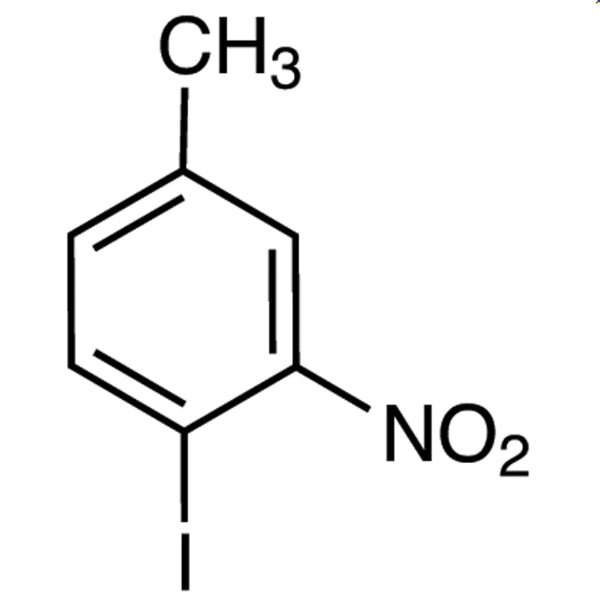
4-Iodo-3-nitrotoluene is a chemical compound widely used in organic reactions as a building block or intermediate. It plays a crucial role in laboratory settings where the synthesis of complex molecules is required. This compound is particularly valuable in the fields of organic chemistry and pharmaceutical research due to its unique functional groups. The presence of both an iodine and a nitro group contributes to its reactivity and versatility, making it a key component in various synthetic pathways.
The chemical properties of 4-Iodo-3-nitrotoluene, including its reactivity and sensitivity to heat and UV light, make it a preferred choice for specific chemical reactions. Its ability to participate in substitution and electrophilic reactions allows it to be utilized in the development of new compounds with potential applications in medicine and industry. The combination of these functional groups provides a high degree of chemical reactivity, which is essential for advanced synthetic processes.
In Indonesian laboratories, 4-Iodo-3-nitrotoluene is commonly used in organic chemistry research, especially by higher education institutions. Its role in the synthesis of complex molecules and its significance in pharmaceutical studies make it a valuable reagent. Researchers rely on its unique properties to achieve desired chemical transformations, contributing to scientific advancements in various fields.
- Organic synthesis applications benefit from 4-Iodo-3-nitrotoluene due to its reactivity and functional groups, enabling the creation of complex molecular structures.
- Pharmaceutical research utilizes this compound as an intermediate in the development of new drug compounds, leveraging its chemical versatility.
- Chemical reaction testing often incorporates 4-Iodo-3-nitrotoluene to study substitution and electrophilic reactions under controlled laboratory conditions.
- Industrial chemical processes may use this compound as a building block for the production of specialized chemicals with specific functional properties.
- Academic research in Indonesian universities frequently employs 4-Iodo-3-nitrotoluene to explore new synthetic methods and chemical transformations.
| Brand | TCI |
|---|---|
| CAS number | 5326-39-6 |
| Molecular formula | — |
| Purity | — |
| Category | Chemistry > Building Blocks > Non-Heterocyclic Building Blocks |
| Pack sizes | Available in various quantities as per supplier specifications |
| Physical form | Solid |
| Storage | Store in a cool, dark place away from heat and direct sunlight |
4-Iodo-3-nitrotoluene should be stored in a cool, dark environment to prevent degradation due to heat and UV exposure. It is recommended to use airtight containers made of materials that resist chemical reactions, such as glass or high-density polyethylene. Due to its reactivity, it should be handled with care, using appropriate personal protective equipment. Avoid exposure to high temperatures and direct sunlight to maintain its chemical stability. Proper labeling and storage conditions are essential to ensure safety in laboratory environments. Always follow standard chemical handling protocols to minimize risks associated with its sensitivity and potential environmental impact.
—
Produk Terkait
-
2-Iodo-3-nitrotoluene TCI I0799
Regular price From Rp 2.650.200,00Regular price -
2-Bromo-3-nitrotoluene TCI B3712
Regular price Rp 1.565.550,00Regular price -
2-Bromo-6-nitrotoluene TCI B1878
Regular price From Rp 1.008.000,00Regular price -
2-Bromo-5-nitrotoluene TCI B1853
Regular price From Rp 848.400,00Regular price -
4-Bromo-2-nitrotoluene TCI B1843
Regular price From Rp 769.650,00Regular price -
4-tert-Butyl-3-methoxy-2,6-dinitrotoluene TCI B1379
Regular price From Rp 875.700,00Regular price -
2-Bromo-4-nitrotoluene TCI B1262
Regular price Rp 477.750,00Regular price -
2-Methoxy-4-nitrotoluene TCI M1681
Regular price From Rp 1.140.300,00Regular price