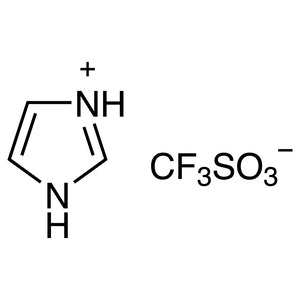
1H-Imidazol-3-ium Trifluoromethanesulfonate is a chemical compound widely used in laboratory settings for its versatile applications in chemical and biochemical research. This compound is an ionic substance composed of an imidazole ion and a trifluoromethanesulfonate ion, making it a valuable reagent in various synthetic and analytical processes. It plays a crucial role in organic synthesis and molecular modification, particularly in reactions that require acidic or basic catalytic conditions. Its stability and controlled reactivity make it a reliable choice for researchers working in nucleic acid chemistry and related fields.
The compound's stability under normal conditions and its ability to interact with a wide range of chemical substrates contribute to its popularity in laboratory environments. Its solubility in organic solvents facilitates mixing and heating processes, which are essential in many chemical reactions. Additionally, the compound's predictable behavior in different reaction conditions ensures consistent results, making it a preferred option for both academic and industrial research. Its compatibility with various reagents and its ability to function as a catalyst or a co-solvent enhance its utility in complex chemical systems.
In Indonesian laboratories, 1H-Imidazol-3-ium Trifluoromethanesulfonate is commonly used in chemical and biochemical research, particularly in organic synthesis, DNA modification, and drug development. Its availability and reliability make it a staple in laboratories focused on molecular biology and pharmaceutical studies. Researchers in Indonesia rely on this compound for its consistent performance and adaptability in diverse experimental setups, supporting advancements in both basic and applied research.
- Organic synthesis experiments benefit from this compound due to its role as a catalyst and its ability to stabilize reaction intermediates.
- Nucleic acid modification processes utilize it for its compatibility with DNA and RNA structures, aiding in molecular biology research.
- Drug development laboratories use it as a reagent in the synthesis of pharmaceutical compounds due to its chemical stability and reactivity.
- Analytical chemistry applications incorporate it as a standard for ion chromatography and other analytical techniques.
- Biochemical assays take advantage of its ionic properties to study enzyme activity and molecular interactions in biological systems.
| Brand | TCI |
|---|---|
| CAS number | 29727-06-8 |
| Molecular formula | — |
| Purity | — |
| Category | Chemistry > Chemical Biology > Nucleic Acid Chemistry |
| Pack sizes | 50g, 250g, 1kg |
| Physical form | White crystalline powder |
| Storage | Store in a cool, dry place away from moisture and direct sunlight |
This compound should be stored in a cool, dry environment to maintain its chemical stability and prevent degradation. It is recommended to use airtight containers to protect it from moisture and humidity, which can affect its performance. Due to its ionic nature, it is important to handle it with care to avoid contamination. Laboratory personnel should wear appropriate personal protective equipment, such as gloves and safety goggles, when handling this material. It should be kept away from incompatible substances, such as strong bases, to ensure safe storage. Proper labeling of containers is essential to prevent accidental exposure and ensure safe handling in laboratory settings.
—
Produk Terkait
-
TCI B5774 5,10-Bis(4,4,5,5-tetramethyl-1,3,2-dioxaborolan-2-yl)naphtho[1,2-c:5,6-c']bis([1,2,5]oxadiazole)
Regular price Rp 10.255.350,00Regular price -
Dihydroiodide TCI B6569
Regular price From Rp 1.936.200,00Regular price -
Trifluoromethanesulfonate TCI B7003
Regular price From Rp 1.936.200,00Regular price
![5,10-Bis(4,4,5,5-tetramethyl-1,3,2-dioxaborolan-2-yl)naphtho[1,2-c:5,6-c']bis([1,2,5]oxadiazole) - TCI B5774 - AMI Scientific](http://amiscientific.com/cdn/shop/files/TCI2510B5774.jpg?v=1769180228&width=533)