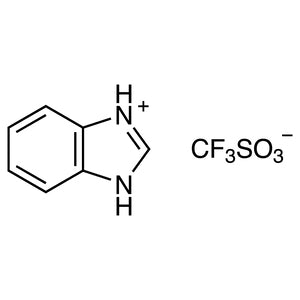
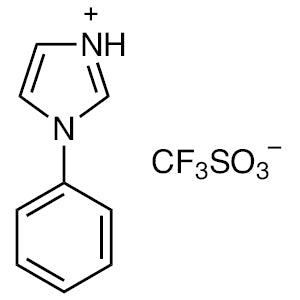
1-Methyl-1H-benzimidazol-3-ium Trifluoromethanesulfonate is a chemical compound widely used in laboratory settings for its unique chemical properties and versatility in various biochemical applications. This compound is particularly valuable in nucleic acid chemistry, where it plays a crucial role in DNA and RNA modification processes. Its ability to participate in ionization reactions makes it an essential reagent for molecular biology experiments. As a key component in chemical synthesis, it supports the development of new compounds and the refinement of existing ones.
The compound’s polar nature and high reactivity make it a preferred choice for researchers seeking reliable and efficient chemical reactions. Its stability under controlled laboratory conditions ensures consistent results, which is vital in scientific research. The compound’s ability to interact with a wide range of substrates and reagents enhances its applicability in diverse chemical processes. Additionally, its solubility in organic solvents simplifies its handling and use in various experimental setups.
In Indonesian laboratories, this compound is commonly used in research focused on nucleic acid chemistry. It is often employed in the preparation of modified nucleotides and in the study of molecular interactions. Its stability and reactivity make it a go-to choice for scientists working in biochemistry and chemical biology. The compound’s role in supporting precise and reproducible experiments is critical in maintaining the integrity of scientific research.
TCI brochures (PDF)
- Coupling Activators for Oligonucleotide Synthesis 2025-06-30 · p. 1
- Oligonucleotide Synthesis Reagents 2025-07-24 · p. 1
- Nucleosides, Nucleotides, Nucleic Acids and Related Reagents 2026-03-23 · p. 15
Related TCI products
- TCI N1214 574704-91-9 5-Nitro-1H-benzimidazol-3-ium Trifluoromethanesulfonate
- TCI B6330 99257-95-1 1H-Benzimidazol-3-ium Trifluoromethanesulfonate
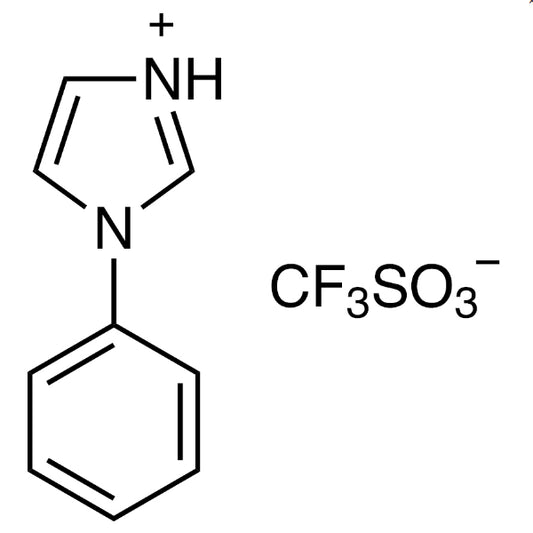
- TCI P2822 361447-81-6 1-Phenyl-1H-imidazol-3-ium Trifluoromethanesulfonate
- TCI M3214 99257-94-0 1-Methylimidazole Trifluoromethanesulfonate
- TCI I1157 29727-06-8 1H-Imidazol-3-ium Trifluoromethanesulfonate
- TCI T3537 192198-85-9 1,3,5-Tris(1-phenyl-1H-benzimidazol-2-yl)benzene
- Nucleic Acid Modification: This compound is ideal for modifying DNA and RNA molecules, enabling the study of genetic material in various biological processes.
- Ionization Reactions: Its ability to act as an ionizing agent makes it suitable for chemical reactions requiring active ionization, enhancing reaction efficiency.
- Molecular Biology Research: It supports research in molecular biology by facilitating the synthesis and analysis of nucleic acid structures.
- Chemical Synthesis: The compound is used in the synthesis of complex organic molecules, contributing to the development of new chemical compounds.
- Biochemical Assays: Its reactivity and stability make it a valuable reagent in biochemical assays that require precise chemical interactions.
| Brand | TCI |
|---|---|
| CAS number | 361447-89-4 |
| Molecular formula | — |
| Purity | — |
| Category | Chemistry > Chemical Biology > Nucleic Acid Chemistry |
| Pack sizes | Available in various quantities as per supplier specifications |
| Physical form | Solid or powder, depending on the specific product variant |
| Storage | Store in a cool, dry place away from moisture and direct sunlight |
This compound should be stored in a cool, dry environment to maintain its chemical stability. It is recommended to keep it in a sealed container to prevent exposure to moisture and air. Due to its reactivity, it should be handled with care, using appropriate personal protective equipment such as gloves and safety goggles. Avoid contact with incompatible substances to ensure safe laboratory practices. Proper ventilation is essential when working with this compound to minimize exposure risks. Always follow standard laboratory safety protocols to ensure a secure working environment.
—
Product Categories
Produk Terkait
-
5-Nitro-1H-benzimidazol-3-iumTrifluoromethanesulfonate TCI N1214
Regular price From Rp 1.273.650,00Regular price -
1H-Benzimidazol-3-iumTrifluoromethanesulfonate TCI B6330
Regular price From Rp 1.298.850,00Regular price -
1-Phenyl-1H-imidazol-3-iumTrifluoromethanesulfonate TCI P2822
Regular price From Rp 3.763.200,00Regular price -
1-MethylimidazoleTrifluoromethanesulfonate TCI M3214
Regular price From Rp 2.332.050,00Regular price -
1H-Imidazol-3-iumTrifluoromethanesulfonate TCI I1157
Regular price From Rp 1.353.450,00Regular price -
1,3,5-Tris(1-phenyl-1H-benzimidazol-2-yl)benzene TCI T3537
Regular price From Rp 2.068.500,00Regular price -
4-(2-Phenyl-1H-benzimidazol-1-yl)phenylboronicAcid(containsvaryingamountsofAnhydride) TCI P2282
Regular price Rp 2.625.000,00Regular price -
4-(1-Phenyl-1H-benzimidazol-2-yl)phenylboronicAcid(containsvaryingamountsofAnhydride) TCI P2158
Regular price From Rp 1.298.850,00Regular price