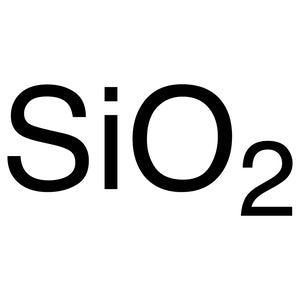
Silicon(IV) Oxide, AEROSIL® 200, is a finely powdered chemical compound widely used in laboratory settings, particularly in catalysis and inorganic chemistry. This amorphous form of silicon dioxide is known for its high surface area and porous structure, which make it highly reactive and effective in various chemical processes. Its ability to adsorb small molecules and provide a reactive surface makes it a versatile material for numerous experimental applications. In the laboratory, it is commonly used as a catalyst, adsorbent, or additive in synthesis and purification procedures, offering reliable performance across a range of chemical reactions.
The properties of AEROSIL® 200 make it a preferred choice for laboratory use. It is chemically stable and inert, ensuring predictable behavior in reactions without introducing unwanted side effects. Its high surface area and porosity allow for efficient interaction with other substances, enhancing the effectiveness of catalytic processes. The material is non-toxic and free from hazardous components, making it safe for use in laboratory environments. Additionally, it exhibits good resistance to moisture and moderate temperature changes, which simplifies storage and handling in various conditions.
In Indonesian laboratories, AEROSIL® 200 is commonly used in research and development projects involving chemical synthesis, material science, and environmental analysis. Its versatility and reliability make it a standard material in both academic and industrial laboratory settings. It is often employed in experiments requiring controlled reactivity and high surface interaction, supporting a wide range of scientific investigations.
Advantages (TCI brochure)
- The standard type of fumed silica, most widely used for thickening, reinforcing and thixotropic applications
- Adjusts viscosity and improves fluidity of liquids with only a small addition
- Dispersing effect prevents re-agglomeration and sedimentation of pigments and other particles
TCI brochures (PDF)
- Functional Inorganic Particles Produced by Gas Phase Method AEROSIL® and AEROXIDE® Series 2025-03-07 · p. 1
- Metallic Salts 2025-11-06 · p. 6
- Please inquire for pricing and availability of listed products to our local sales representatives. Si Si Et 2026-07-16 · p. 19
Related TCI products
- Catalytic reactions benefit from AEROSIL® 200 due to its high surface area and adsorption capacity, enhancing reaction efficiency and selectivity.
- Adsorption processes utilize this material for its ability to trap small molecules, making it ideal for purification and separation techniques.
- Composite material synthesis relies on AEROSIL® 200 as a reinforcing agent, improving mechanical and thermal properties of the final product.
- Environmental analysis employs this material for its inertness and stability, ensuring accurate and reproducible results in sample preparation.
- Coating and surface modification applications take advantage of its porous structure, allowing for uniform and controlled surface treatments.
From the TCI brochure
- Thickening
- Reinforcing
- Thixotropic applications
| Brand | TCI |
|---|---|
| CAS number | 7631-86-9 |
| Molecular formula | — |
| Purity | — |
| Category | Chemistry > Catalysis and Inorganic Chemistry > Metallic Salts [Catalysis and Inorganic Chemistry] |
| Pack sizes | Available in various quantities as per standard laboratory supply |
| Physical form | Fine powder |
| Storage | Store in a cool, dry place away from moisture and direct sunlight |
Data from the TCI brochure
| Specific surface area | 175 - 225 m2/g (BET) |
|---|---|
| Average particle size | 12 nm (ref. value) |
Source: TCI brochure FF200 (2025-03-07)
AEROSIL® 200 should be stored in a cool, dry environment to maintain its chemical stability and prevent moisture absorption. It is recommended to use sealed containers to avoid contamination and ensure the material remains in optimal condition. Due to its fine powder form, it should be handled with care to prevent inhalation and skin contact. In laboratory settings, it is advisable to use appropriate personal protective equipment, such as gloves and safety goggles, when working with this substance. The material is non-hazardous, but proper handling procedures should still be followed to ensure a safe and controlled working environment.
—
Produk Terkait
-
Silicon(IV)Oxide,AEROSIL(regR)130 TCI I1316
Regular price Rp 1.220.100,00Regular priceRp 852.600,00Sale price Rp 1.220.100,00 -
Titanium(IV)Oxide,AEROXIDE(regR)P25 TCI T4118
Regular price Rp 1.220.100,00Regular priceRp 852.600,00Sale price Rp 1.220.100,00 -
Aluminum(III)Oxide,AEROXIDE(regR)AluC TCI A3546
Regular price Rp 1.220.100,00Regular priceRp 852.600,00Sale price Rp 1.220.100,00 -
Zirconium(IV)Oxide TCI Z0049
Regular price From Rp 848.400,00Regular priceRp 593.250,00Sale price From Rp 848.400,00 -
Ytterbium(III)Oxide TCI Y0008
Regular price From Rp 557.550,00Regular priceRp 405.300,00Sale price From Rp 557.550,00 -
Yttrium(III)Oxide TCI Y0007
Regular price From Rp 1.008.000,00Regular priceRp 720.300,00Sale price From Rp 1.008.000,00 -
Vanadium(IV)Oxide TCI V0177
Regular price From Rp 1.803.900,00Regular priceRp 1.261.050,00Sale price From Rp 1.803.900,00 -
Vanadium(III)Oxide TCI V0170
Regular price From Rp 1.167.600,00Regular priceRp 815.850,00Sale price From Rp 1.167.600,00