

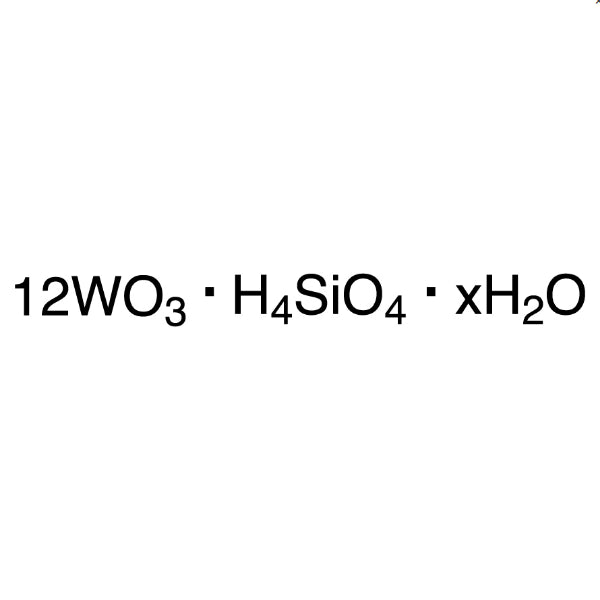
Tungstosilicic Acid Hydrate is a chemical compound widely used in laboratory settings, particularly in catalysis and inorganic chemistry. It plays a crucial role in accelerating chemical reactions without being consumed in the process. This compound is especially valuable in thermal or chemical activation processes, where it helps facilitate reactions that would otherwise be slow or difficult to initiate. Its presence in the lab allows researchers to explore complex chemical transformations with greater efficiency and control.
One of the key properties that make Tungstosilicic Acid Hydrate a preferred choice is its stability under various experimental conditions. It is soluble in water, which makes it easy to handle and incorporate into different reaction systems. Its ability to interact with a wide range of substrates also enhances its versatility in catalytic applications. Additionally, its chemical stability ensures that it remains effective throughout the duration of an experiment, providing consistent results.
In Indonesian laboratories, Tungstosilicic Acid Hydrate is commonly used in chemical research, especially in catalysis and inorganic chemistry. Its role in accelerating reactions and maintaining chemical stability makes it an essential component in many experimental setups. Researchers in Indonesia rely on this compound for its reliability and effectiveness in a variety of chemical processes, supporting both academic and industrial research efforts.
TCI brochures (PDF)
- Transition Metal Catalysts 2026-04-10 · p. 6
- Catalytic Reactions: Tungstosilicic Acid Hydrate is ideal for catalytic applications due to its ability to activate chemical reactions without being consumed, making it suitable for repeated use in various reaction systems.
- Inorganic Chemistry Experiments: This compound is frequently used in inorganic chemistry to facilitate reactions involving transition metals, where its stability and reactivity are highly beneficial.
- Thermal Activation Processes: Its effectiveness in thermal activation makes it a preferred choice for experiments that require heat-induced chemical transformations.
- Substrate Interaction Studies: The compound's ability to interact with a wide range of substrates makes it valuable in studies focused on catalytic mechanisms and reaction pathways.
- Chemical Stability Testing: Due to its chemical stability under different conditions, it is used in experiments that require consistent performance over time.
| Brand | TCI |
|---|---|
| CAS number | 12027-43-9 |
| Molecular formula | — |
| Purity | — |
| Category | Chemistry > Catalysis and Inorganic Chemistry > Transition Elements |
| Pack sizes | Available in various quantities as per standard laboratory supply formats |
| Physical form | Hydrate form, typically a solid |
| Storage | Store in a cool, dry place away from moisture and direct sunlight |
Tungstosilicic Acid Hydrate should be stored in a cool, dry environment to maintain its chemical stability and prevent degradation. It is recommended to keep the compound in airtight containers to minimize exposure to moisture, which can affect its performance. Laboratory personnel should handle the material with care, using appropriate personal protective equipment such as gloves and safety goggles. Due to its chemical nature, it should be stored away from incompatible substances to avoid any potential reactions. Regular monitoring of storage conditions ensures the compound remains effective for use in various experimental applications. Proper labeling of storage containers is essential to ensure safe handling and accessibility.
—
Produk Terkait
-
Tungsten(IV)Oxide TCI T4005
Regular price From Rp 1.458.450,00Regular priceRp 1.019.550,00Sale price From Rp 1.458.450,00 -
PhosphotungsticAcidHydrate TCI P3008
Regular price From Rp 637.350,00Regular priceRp 445.200,00Sale price From Rp 637.350,00


