

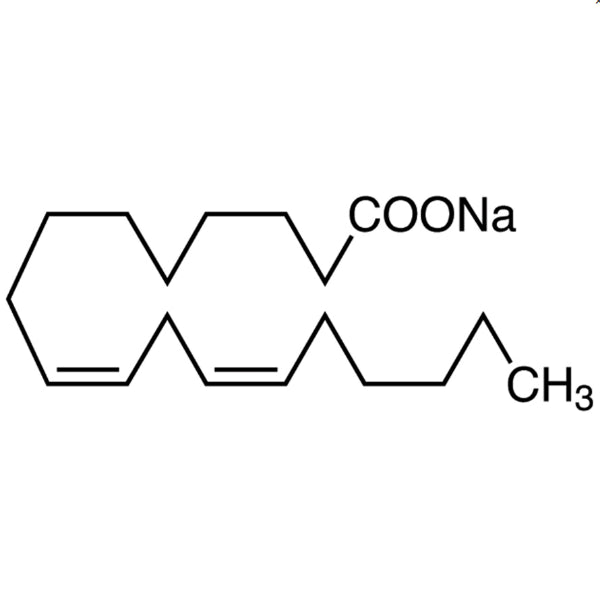
Sodium Linoleate is the sodium salt of linoleic acid, the ionized form of the omega-6 polyunsaturated fatty acid that is widely recognized in lipid biochemistry. Unlike its free acid counterpart, which presents as an oily liquid, this compound is supplied as a solid that is considerably easier to weigh accurately and to disperse in aqueous media. In the laboratory it serves an important role as a readily soluble lipid substrate, as a biochemical reagent, and simultaneously as an anionic surfactant for experiments that require fatty acid handling in the water phase.
The principal advantage of Sodium Linoleate lies in its strongly amphiphilic character. The carboxylate group, neutralized to form the sodium salt, provides a highly hydrophilic head, while the unsaturated hydrocarbon chain remains hydrophobic, so the molecule spontaneously forms micelles above a certain concentration. Its solid form makes precise weighing straightforward when preparing stock solutions of clearly defined concentration, a task that is far more troublesome when working with free fatty acids. The two double bonds retain the biological reactivity required in enzymatic assays.
In Indonesia, this compound is used extensively in laboratories working on lipid biochemistry and related life science research. Its solid presentation suits routine bench workflows where reproducible weighing and straightforward dispersion in aqueous buffers matter more than handling convenience of an oil. Research groups, teaching laboratories, and analytical facilities that require a defined fatty acid source in water-based systems find it a practical working format for day-to-day experimental use.
TCI brochures (PDF)
- Lipids 2025-12-17 · p. 6
- Lipid biochemistry research, where the ionized fatty acid form allows direct introduction of linoleate into aqueous experimental systems without the dispersion problems of the free oily acid.
- Enzymatic assay work, because the two retained double bonds preserve the biological reactivity that enzyme substrate studies on polyunsaturated fatty acids depend upon for meaningful results.
- Preparation of defined stock solutions, since the solid form permits precise gravimetric weighing and yields clearly defined concentrations that are difficult to achieve with free fatty acids.
- Anionic surfactant applications, where the hydrophilic carboxylate head and hydrophobic unsaturated chain give the reliable micelle-forming behaviour needed above the relevant concentration threshold.
- General biochemical reagent use in life science laboratories requiring a water-dispersible lipid substrate for experiments that demand fatty acid handling in the aqueous phase.
| Brand | TCI |
|---|---|
| CAS number | 822-17-3 |
| Molecular formula | — |
| Purity | — |
| Category | Life Science > Biochemicals and Reagents > Lipids |
| Pack sizes | available in standard laboratory pack sizes; please confirm the current options when ordering |
| Physical form | solid, suitable for precise weighing and aqueous dispersion |
| Storage | store according to the manufacturer's instructions on the product label |
- Catalogue number: L0056
Store Sodium Linoleate in its original tightly closed container, following the storage conditions stated by the manufacturer on the product label. Keep the container well sealed to limit exposure to air and moisture, as the unsaturated chains of polyunsaturated fatty acid salts are sensitive to oxidation. Use clean, dry spatulas and glassware when weighing to avoid contamination of the remaining stock. Handle the material in a well-ventilated area, wearing a laboratory coat, safety glasses, and suitable gloves. Prepare aqueous stock solutions fresh where the experimental design allows, label all prepared solutions clearly, and consult the manufacturer's safety data sheet before first use.
—
Product Categories
Produk Terkait
-
IsopropylLinoleate TCI L0139
Regular price From Rp 477.750,00Regular price -
EthylLinoleate TCI L0135
Regular price From Rp 2.227.050,00Regular price -
MethylLinoleate TCI L0078
Regular price From Rp 1.724.100,00Regular price -
CholesterolLinoleate TCI C0321
Regular price Rp 4.479.300,00Regular price -
MethylLinoleate[StandardMaterialforGC] TCI S0325
Regular price From Rp 1.035.300,00Regular price


![112-63-0 Methyl Linoleate [Standard Material for GC] - AMI Scientific](http://amiscientific.com/cdn/shop/files/TCI2510S0325.jpg?v=1768363005&width=533)
![112-63-0 Methyl Linoleate [Standard Material for GC] - AMI Scientific](http://amiscientific.com/cdn/shop/files/TCI2510S0325_b825a144-cd4c-4cec-b650-3eb6238726e6.jpg?v=1769057670&width=533)