

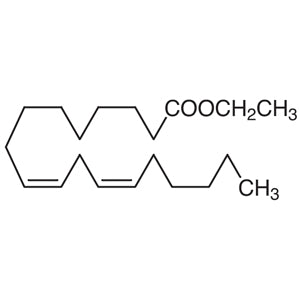
Ethyl Linoleate is a chemical compound widely used as a foundational material in various chemical reactions and product formulations. It serves as a key building block in the synthesis of complex organic compounds, playing a vital role in laboratory research and development. This compound is particularly valuable in organic chemistry due to its unsaturated carbon chain structure, which allows it to participate in multiple reaction types such as hydrolysis, esterification, and oxidation. Its versatility makes it an essential component for scientists working on both theoretical and applied research projects.
Ethyl Linoleate is preferred for its non-polar nature and excellent solubility in organic solvents like ethyl acetate and chloroform. These properties make it easy to handle and incorporate into experimental setups, enhancing its usability in laboratory settings. Its stability under specific conditions also ensures that it remains effective for repeated use without significant degradation. This reliability is crucial for maintaining consistent results in chemical experiments and analyses. Additionally, its chemical characteristics facilitate efficient separation and purification processes, which are common in analytical chemistry.
In Indonesian laboratories, Ethyl Linoleate is commonly used in scientific research, especially in the fields of organic chemistry and material technology. Its presence supports the development of new chemical materials and the study of organic compound properties. Researchers rely on this compound for its predictable behavior and compatibility with various experimental techniques, making it a staple in both academic and industrial research environments.
TCI brochures (PDF)
- Lipids 2025-12-17 · p. 10
- Organic synthesis applications benefit from Ethyl Linoleate due to its reactivity and compatibility with various reaction mechanisms.
- It is ideal for analytical chemistry as it aids in the separation and identification of organic compounds through chromatographic techniques.
- In material science research, Ethyl Linoleate is used to develop new polymers and coatings due to its chemical stability and functional group versatility.
- Its solubility in organic solvents makes it suitable for formulation processes in pharmaceutical and cosmetic industries.
- It supports the study of physical and chemical properties of organic compounds, aiding in the design of new chemical structures and applications.
| Brand | TCI |
|---|---|
| CAS number | 544-35-4 |
| Molecular formula | — |
| Purity | — |
| Category | Chemistry > Building Blocks > Non-Heterocyclic Building Blocks |
| Pack sizes | Available in standard laboratory quantities |
| Physical form | Liquid |
| Storage | Store in a cool, dry place away from direct sunlight |
Ethyl Linoleate should be stored in a cool, dry environment to maintain its chemical stability and prevent degradation. It is recommended to keep the compound in a tightly sealed container to avoid exposure to air and moisture, which could affect its properties. Suitable storage containers include glass or high-density polyethylene (HDPE) bottles to ensure chemical compatibility and prevent contamination. Laboratory personnel should handle the compound with care, using appropriate personal protective equipment such as gloves and safety goggles. Ethyl Linoleate is non-hazardous under normal conditions but should be handled in a well-ventilated area to minimize any potential risks. Proper storage and handling practices ensure the compound remains effective and safe for use in various experimental applications.
—
Produk Terkait
-
IsopropylLinoleate TCI L0139
Regular price From Rp 477.750,00Regular price -
MethylLinoleate TCI L0078
Regular price From Rp 1.724.100,00Regular price -
SodiumLinoleate TCI L0056
Regular price From Rp 1.776.600,00Regular price -
CholesterolLinoleate TCI C0321
Regular price Rp 4.479.300,00Regular price -
MethylLinoleate[StandardMaterialforGC] TCI S0325
Regular price From Rp 1.035.300,00Regular price


![112-63-0 Methyl Linoleate [Standard Material for GC] - AMI Scientific](http://amiscientific.com/cdn/shop/files/TCI2510S0325.jpg?v=1768363005&width=533)
![112-63-0 Methyl Linoleate [Standard Material for GC] - AMI Scientific](http://amiscientific.com/cdn/shop/files/TCI2510S0325_b825a144-cd4c-4cec-b650-3eb6238726e6.jpg?v=1769057670&width=533)