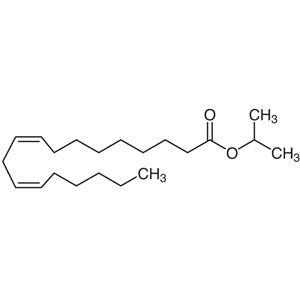
Isopropyl Linoleate is the isopropyl ester of linoleic acid, a polyunsaturated fatty acid abundant in vegetable oils. Replacing the free acid group with an isopropyl ester group yields an oily liquid that is more neutral in character, more stable within formulations, and easier to measure accurately in the laboratory. Its roles include serving as a model substance for lipid studies, a comparison compound in fatty acid ester analysis, and an emollient component used in research on topical preparations and oil-based carrier systems.
The properties that underlie its selection are low polarity, relatively light viscosity, and good spreading behaviour across surfaces, so it imparts a non-heavy feel to experimental formulations. The branched isopropyl chain hinders orderly chain packing, so this ester tends to remain liquid at room temperature and mixes readily with oils and non-polar organic solvents. As with other linoleate derivatives, its two double bonds make the compound sensitive to oxygen, light, and heat, so its stability depends closely on how it is stored and handled.
In Indonesian laboratories, this material is widely used in cosmetics research, topical pharmaceutical work, and related formulation technology. It appears in academic and industrial settings where oil-based vehicles, emollient behaviour, and fatty acid ester reference work are studied. Because it is supplied as a defined single ester rather than a natural oil mixture, it gives researchers a consistent starting point when comparing results between experimental batches and across different preparation methods.
TCI brochures (PDF)
- Lipids 2025-12-17 · p. 13
- Lipid model studies: the compound provides a single, well-defined unsaturated ester instead of a variable natural oil mixture, giving reproducible behaviour across repeated experimental runs.
- Fatty acid ester analysis: it serves as a comparison compound when identifying or characterising linoleate esters, supporting consistent interpretation of analytical results between samples.
- Topical preparation research: its emollient character and good surface spreading make it useful when studying the feel, distribution, and behaviour of experimental topical formulations.
- Oil-based carrier system development: low polarity and ready miscibility with oils and non-polar organic solvents allow it to function as a liquid vehicle component in carrier studies.
- Formulation stability investigations: the two double bonds make it a practical subject for examining how oxygen, light, and heat exposure affect unsaturated ester stability in laboratory preparations.
| Brand | TCI |
|---|---|
| CAS number | 22882-95-7 |
| Molecular formula | — |
| Purity | — |
| Category | Chemistry > Building Blocks > Non-Heterocyclic Building Blocks |
| Pack sizes | available in the standard laboratory pack sizes listed for this catalogue item |
| Physical form | oily liquid, generally liquid at room temperature |
| Storage | keep protected from oxygen, light, and heat |
- Catalogue number: L0139
Store the container tightly closed in a cool, dark place, away from heat sources and direct sunlight, since the unsaturated ester structure is sensitive to oxygen, light, and heat. Amber glass or other light-protective, chemically compatible containers are suitable, and headspace should be kept to a minimum to limit air contact; blanketing with an inert gas after use helps preserve quality over time. Handle in a well-ventilated area or fume hood, wear gloves, safety glasses, and a laboratory coat, and avoid contact with skin and eyes. Allow refrigerated material to reach room temperature before opening to prevent moisture condensation, and always consult the supplier safety data sheet before use.
—
Produk Terkait
-
EthylLinoleate TCI L0135
Regular price From Rp 2.227.050,00Regular price -
IsopropylPalmitate TCI P0005
Regular price From Rp 505.050,00Regular price -
Isopropyln-Octanoate TCI O0157
Regular price Rp 955.500,00Regular price -
IsopropylMyristate TCI M0481
Regular price From Rp 477.750,00Regular price -
IsopropylDodecanoate TCI I1169
Regular price From Rp 3.048.150,00Regular price -
MethylLinoleate TCI L0078
Regular price From Rp 1.724.100,00Regular price -
SodiumLinoleate TCI L0056
Regular price From Rp 1.776.600,00Regular price -
CholesterolLinoleate TCI C0321
Regular price Rp 4.479.300,00Regular price