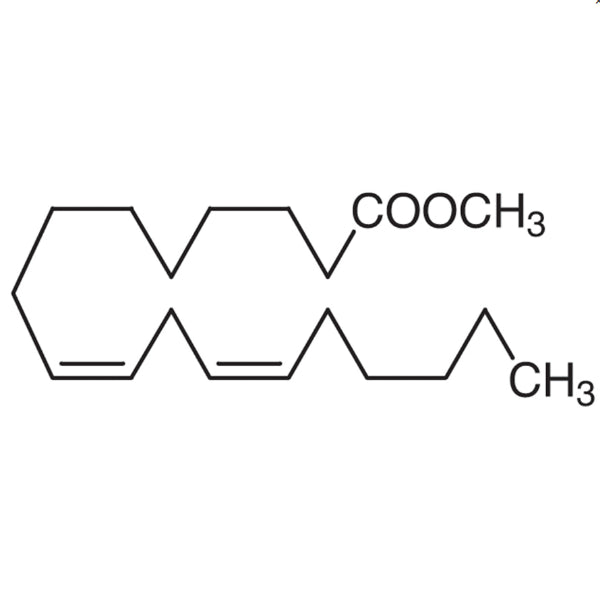
Methyl Linoleate is the methyl ester of linoleic acid, an eighteen-carbon polyunsaturated fatty acid that occurs widely in vegetable oils. In the laboratory, this compound serves as one of the key members of the fatty acid methyl ester (FAME) group that forms the backbone of lipid profiling analysis. Researchers use it as a reference compound for identifying chromatographic peaks, as a model substrate in lipid oxidation studies, and as a starting material in the synthesis of more complex fatty acid derivatives. Supplied by TCI, it falls under the Life Science category, specifically Biochemicals and Reagents for lipid work.
The characteristic that makes this material a frequent choice is the presence of two non-conjugated double bonds along its hydrocarbon chain, which renders it highly reactive toward oxygen and light. It is precisely this property that makes it an ideal model for autoxidation reactions, lipid peroxidation, and antioxidant efficacy testing. Its liquid form at room temperature simplifies volumetric measurement and dissolution in nonpolar organic solvents, while the methyl ester group provides volatility suited to gas chromatography-based separation without the need for additional derivatization.
In Indonesian laboratories, Methyl Linoleate is used across academic research institutions, university teaching laboratories, and quality control facilities that handle edible oil and lipid analysis. It commonly appears in work involving FAME standards for chromatographic calibration, in oxidative stability studies of vegetable oil products, and in food and nutrition research programs where fatty acid composition must be characterized reliably and reproducibly.
- Gas chromatography reference standard: the methyl ester group gives the compound the volatility required for GC separation, allowing analysts to assign retention times and identify linoleate peaks in complex FAME mixtures without additional derivatization steps.
- Lipid peroxidation model studies: the two double bonds in the hydrocarbon chain make the molecule readily attacked by oxygen, providing a reproducible and well-characterized substrate for tracking peroxidation pathways under controlled laboratory conditions.
- Antioxidant efficacy testing: because the material oxidizes predictably, researchers use it as the oxidizable target against which the protective performance of candidate antioxidant compounds and natural extracts can be measured and compared.
- Autoxidation reaction research: its high reactivity toward oxygen and light allows investigators to study the initiation, propagation, and termination stages of autoxidation using a single, chemically defined fatty acid ester substrate.
- Synthesis of fatty acid derivatives: the compound serves as a starting material for preparing more complex fatty acid derivatives, with its liquid form at room temperature easing volumetric dosing and dissolution in nonpolar organic solvents.
| Brand | TCI |
|---|---|
| CAS number | 112-63-0 |
| Molecular formula | — |
| Purity | — |
| Category | Life Science > Biochemicals and Reagents > Lipids |
| Pack sizes | available in standard laboratory pack sizes; please confirm the currently offered options when ordering |
| Physical form | liquid at room temperature |
| Storage | keep protected from light and oxygen exposure, in line with the reactive nature of the polyunsaturated chain |
Because this material is highly reactive toward oxygen and light, store it in tightly closed, light-protecting containers such as amber glass bottles, and keep the headspace minimal to limit contact with air. Where laboratory practice requires it, blanketing the container with inert gas after each use helps preserve sample integrity for oxidation-sensitive work. Handle the liquid in a well-ventilated area or fume hood, use appropriate personal protective equipment including gloves and eye protection, and keep the material away from heat sources and open flame. Transfer with clean, dry glassware to avoid contamination, reseal the container promptly after dispensing, and always consult the manufacturer's safety data sheet before use.
—
Produk Terkait
-
TCI B5774 5,10-Bis(4,4,5,5-tetramethyl-1,3,2-dioxaborolan-2-yl)naphtho[1,2-c:5,6-c']bis([1,2,5]oxadiazole)
Regular price Rp 10.255.350,00Regular price -
Dihydroiodide TCI B6569
Regular price From Rp 1.936.200,00Regular price -
Trifluoromethanesulfonate TCI B7003
Regular price From Rp 1.936.200,00Regular price
![5,10-Bis(4,4,5,5-tetramethyl-1,3,2-dioxaborolan-2-yl)naphtho[1,2-c:5,6-c']bis([1,2,5]oxadiazole) - TCI B5774 - AMI Scientific](http://amiscientific.com/cdn/shop/files/TCI2510B5774.jpg?v=1769180228&width=533)