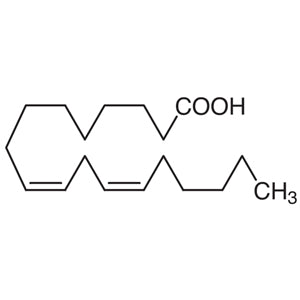
TCI O0180 Oleic Acid (CAS 112-80-1) is a monounsaturated fatty acid with an eighteen-carbon chain. It has a single cis double bond in the middle of the chain and a carboxylic acid group at one end. Oleic acid is one of the most abundant fatty acids in nature and occurs mainly in vegetable oils. In the laboratory it is used as a reagent, a lipid standard, a surfactant and a surface ligand. Its amphiphilic structure, with a polar head group and a long hydrophobic tail, makes it useful in many fields, from biochemistry to nanomaterial synthesis. TCI lists it among its non-heterocyclic building blocks for organic and materials chemistry.
Researchers choose this material for its physicochemical properties. The cis double bond puts a bend in the carbon chain, so oleic acid is a liquid at room temperature, while saturated stearic acid is a solid. This makes it easy to measure and mix into reaction systems. The carboxylic acid group can bind to metal and metal oxide surfaces, and the hydrocarbon tail keeps it stable in nonpolar solvents. The double bond can also be modified further by epoxidation, hydrogenation or oxidative cleavage. This makes it a flexible starting point for synthesis and for making functional derivatives.
Indonesia is the world's largest palm oil producer, and oleochemical research is growing quickly in its universities, research institutes and industrial laboratories. Oleic acid is a common reference compound and starting material in this work. It is used in studies of fatty acid derivatives, in the characterisation of vegetable oils and in the development of bio-based products. Materials science groups also use it as a capping agent in nanoparticle synthesis, and biochemistry laboratories use it in lipid research and analytical method development.
Advantages (TCI brochure)
- Long alkyl chain capping ligand with high dispersibility
- Often used during the QD synthesis step
TCI brochures (PDF)
- Antioxidants for Research and Experimental Use 2026-07-29 · p. 2
- Colloidal Quantum Dot (QD) Research Reagents 2026-05-21 · p. 4
- Lipids 2025-12-17 · p. 5
- Reagents for Biological Research 2025-03-11 · p. 41
- Nanoparticle synthesis: the carboxylic acid group binds to metal and metal oxide surfaces, and the long hydrophobic tail keeps the particles stable and dispersed in nonpolar solvents.
- Lipid standard in analysis: oleic acid is one of the most abundant natural fatty acids, so it is a practical reference compound when characterising vegetable oils and lipid mixtures.
- Organic synthesis building block: the cis double bond can be epoxidised, hydrogenated or oxidatively cleaved to make a range of derivatives for further synthesis.
- Surfactant and emulsion studies: its polar head group and long hydrophobic tail make it suitable for work on interfacial behaviour, emulsification and self-assembled systems.
- Oleochemical and biochemical research: it is a relevant model compound for studies of palm oil and other vegetable oil derivatives, and for biochemical work on unsaturated fatty acids.
From the TCI brochure
- Capping ligand during colloidal QD synthesis
| Brand | TCI (product code O0180) |
|---|---|
| CAS number | 112-80-1 |
| Molecular formula | — |
| Purity | — |
| Category | Chemistry > Building Blocks > Non-Heterocyclic Building Blocks |
| Pack sizes | available in TCI's standard pack sizes; please contact AMI Scientific for current options |
| Physical form | liquid at room temperature |
| Storage | follow the conditions on the TCI label and Safety Data Sheet |
Store oleic acid in its original tightly closed container, in a cool, dry and well-ventilated place away from direct sunlight, heat sources and strong oxidising agents. The double bond in the chain can react with oxygen over time. After opening, reseal the container promptly and keep headspace exposure to a minimum to help preserve the material's quality. Use glass or other chemically compatible containers when transferring or aliquoting. Follow standard laboratory practice: wear safety glasses, gloves and a lab coat, avoid contact with skin and eyes, and work in a well-ventilated area. Always read the product label and TCI Safety Data Sheet for specific storage conditions, hazard information and disposal requirements before use.
—
Product Categories
Produk Terkait
-
OleicAcid TCI O0011
Regular price Rp 477.750,00Regular priceRp 333.900,00Sale price Rp 477.750,00 -
LinoleicAcid TCI L0124
Regular price Rp 1.881.600,00Regular priceRp 1.331.400,00Sale price Rp 1.881.600,00 -
ArachidonicAcid TCI A0781
Regular price Rp 2.384.550,00Regular priceRp 1.683.150,00Sale price Rp 2.384.550,00 -
gamma-LinolenicAcid TCI L0152
Regular price Rp 1.988.700,00Regular priceRp 1.405.950,00Sale price Rp 1.988.700,00 -
LinoleicAcid TCI L0053
Regular price Rp 1.538.250,00Regular priceRp 1.090.950,00Sale price Rp 1.538.250,00 -
PalmiticAcid TCI P1145
Regular price Rp 2.704.800,00Regular priceRp 1.891.050,00Sale price Rp 2.704.800,00 -
PalmiticAcid TCI P0002
Regular price Rp 505.050,00Regular priceRp 352.800,00Sale price Rp 505.050,00 -
trans-FerulicAcid TCI H0267
Regular price Rp 1.934.100,00Regular priceRp 1.368.150,00Sale price Rp 1.934.100,00