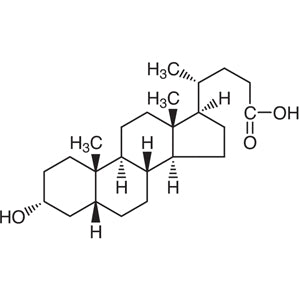
Lithocholic Acid is a secondary bile acid formed in the large intestine through the dehydroxylation of primary bile acids by gastrointestinal microbiota. The compound carries the characteristic steroid skeleton of bile acids, featuring a single hydroxyl group on the nucleus and a side chain terminating in a carboxylate function. In the laboratory, it plays an important role as an analytical standard in bile acid profiling, as a ligand for nuclear receptors and certain cell-surface receptors, and as a building block in supramolecular chemistry thanks to its curved, amphiphilic molecular shape.
The characteristic that leads researchers to select this compound is its hydrophobicity, which is the most pronounced among the common bile acids because the steroid nucleus bears only one hydroxyl group. This property makes Lithocholic Acid an important tool for studying the relationship between bile acid hydrophobicity and cytotoxicity, as well as hepatocellular damage. The rigid and chiral steroid framework also makes it attractive as a building unit for molecular gels, host–guest compounds, and organocatalysts. It is supplied as a stable solid that is easy to weigh out accurately, which supports reproducible preparation of stock solutions and reference standards.
In Indonesian laboratories, Lithocholic Acid is used by biomedical research groups working on bile acid metabolism, gut microbiota interactions, and liver cell biology. It is typically handled in university research laboratories, hospital-affiliated research units, and analytical laboratories that develop and validate methods for bile acid determination. Its stable solid form and consistent behaviour on weighing make it practical for laboratories that prepare their own calibration standards and working solutions.
TCI brochures (PDF)
- Steroids 2026-07-28 · p. 7
- Bile acid profiling as an analytical standard: the well-defined steroid structure and stable solid form allow accurate weighing for calibration curves and reference solutions in chromatographic bile acid determination.
- Nuclear receptor ligand studies: Lithocholic Acid acts as a ligand for nuclear receptors, making it suitable for investigating receptor activation, downstream signalling pathways, and transcriptional responses in cultured cell systems.
- Cell-surface receptor research: as a ligand for certain cell-surface receptors, it supports experiments examining how bile acids are sensed by cells and how that sensing shapes cellular responses.
- Hydrophobicity and cytotoxicity investigations: because it is the most hydrophobic of the common bile acids, it serves as a reference compound for correlating bile acid hydrophobicity with cytotoxicity and liver cell damage.
- Supramolecular chemistry building block: the rigid, chiral, curved steroid framework makes it a valuable unit for constructing molecular gels, host–guest systems, and organocatalysts in synthetic laboratories.
| Brand | TCI |
|---|---|
| CAS number | 434-13-9 |
| Molecular formula | — |
| Purity | — |
| Category | Life Science > Biochemicals and Reagents > Steroids |
| Pack sizes | available in standard TCI research pack sizes; please confirm the currently offered options when ordering |
| Physical form | solid, stable and convenient for accurate weighing |
| Storage | store under the conditions stated on the manufacturer's label and product documentation |
- Product code: L0089
Store Lithocholic Acid in its original tightly closed container, kept in a cool, dry place away from direct sunlight, moisture, and sources of heat or ignition, and follow the storage conditions given on the manufacturer's label and safety data sheet. Amber glass or the supplied container is appropriate for long-term storage; transfer portions using clean, dry spatulas to avoid contamination of the bulk material. Handle the solid in a well-ventilated area or fume hood to minimise dust formation, and wear a laboratory coat, safety glasses, and suitable gloves. Allow sealed containers to reach room temperature before opening if they have been refrigerated, so that condensation does not affect the material. Dispose of residues and contaminated consumables in accordance with institutional chemical waste procedures.
—
Product Categories
- Biochemicals and ReagentsSteroidsCholanes (Bile Acids) [Steroids]
- Cell BiologyCancer ResearchTumor Growth Regulation [Cancer Research]
- Cell BiologyCell Signaling and NeuroscienceCytokines, Growth Factors and Hormones
- MicrobiologyBacterial Spore (Endospore) ResearchBacterial Spore Germination Inhibitiors
Produk Terkait
-
UrsodeoxycholicAcid TCI U0030
Regular price Rp 1.167.600,00Regular priceRp 831.600,00Sale price Rp 1.167.600,00 -
Progesterone TCI P0478
Regular price From Rp 1.113.000,00Regular priceRp 793.800,00Sale price From Rp 1.113.000,00 -
Mifepristone TCI M1732
Regular price From Rp 4.691.400,00Regular priceRp 3.295.950,00Sale price From Rp 4.691.400,00 -
Dehydroepiandrosterone TCI D0044
Regular price From Rp 742.350,00Regular priceRp 534.450,00Sale price From Rp 742.350,00 -
DeoxycholicAcid TCI C0315
Regular price From Rp 1.670.550,00Regular priceRp 1.183.350,00Sale price From Rp 1.670.550,00 -
Prednisone TCI P1276
Regular price From Rp 1.643.250,00Regular priceRp 1.164.450,00Sale price From Rp 1.643.250,00 -
beta-Estradiol TCI E0025
Regular price From Rp 1.087.800,00Regular priceRp 775.950,00Sale price From Rp 1.087.800,00 -
21-Hydroxyprogesterone TCI D6119
Regular price Rp 2.227.050,00Regular priceRp 1.572.900,00Sale price Rp 2.227.050,00