

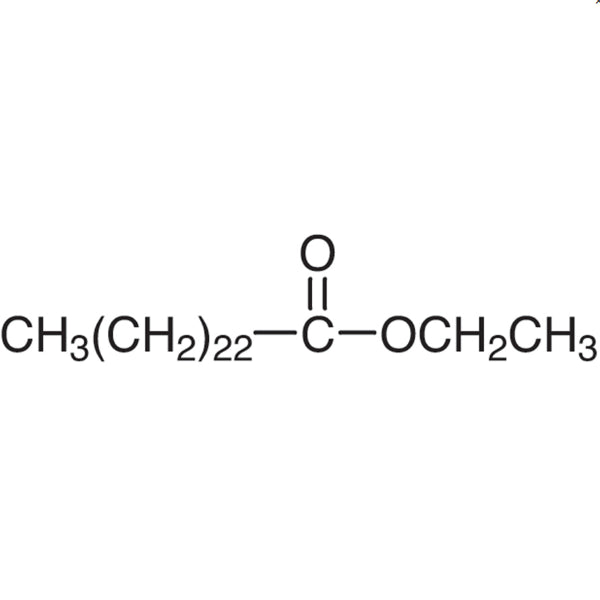
Ethyl Lignocerate is the ethyl ester of lignoceric acid, a saturated very long chain fatty acid containing twenty-four carbon atoms. Within lipid classification, this compound belongs to the very long chain fatty acid esters, or VLCFA esters, a group that carries particular significance in clinical biochemistry and membrane biology. In the laboratory, the material serves primarily as an analytical standard for gas chromatography, helping researchers confirm the identity and quantity of long chain fatty acid esters in biological samples as well as in complex vegetable oil samples.
The properties that make Ethyl Lignocerate a preferred standard are its stability and its distinctive chromatographic behaviour. The long straight saturated chain produces a far and highly characteristic retention time on gas chromatography columns, so its peak separates cleanly from the esters of shorter chain fatty acids. As a waxy solid that is not readily volatile at room temperature, the compound is stable in storage and is not prone to oxidation because it carries no double bonds. Its high hydrophobicity requires the use of warm nonpolar solvents during stock solution preparation so that dissolution is complete.
Laboratories in Indonesia typically encounter this material in lipid profiling and fatty acid composition work, where a very long chain reference point is needed to anchor the upper end of a chromatographic series. It is used in academic research laboratories, in laboratories analysing vegetable oils and derived products, and in biochemistry groups studying membrane lipids. Typical workflows involve preparing a stock solution in a nonpolar solvent, then diluting it to build calibration series alongside shorter chain fatty acid ester standards.
TCI brochures (PDF)
- Lipids 2025-12-17 · p. 11
Related TCI products
- Gas chromatography calibration: the long saturated chain gives a distinctive late retention time, allowing analysts to anchor the very long chain end of a calibration series with confidence.
- Fatty acid ester identification in biological samples: the compound provides a known reference peak so that unknown very long chain esters in a sample chromatogram can be assigned reliably.
- Vegetable oil composition analysis: complex oil matrices contain many fatty acid esters, and this standard separates cleanly from shorter chain components so quantification remains unambiguous.
- VLCFA studies in clinical biochemistry research: as a twenty-four carbon ester, it represents the very long chain fatty acid class that carries specific significance in clinical biochemical investigation.
- Membrane lipid research: biologists studying membrane composition use this saturated very long chain ester as a defined reference material when characterising lipid extracts from biological systems.
| Brand | TCI |
|---|---|
| CAS number | 24634-95-5 |
| Molecular formula | — |
| Purity | — |
| Category | Life Science > Biochemicals and Reagents > Lipids |
| Pack sizes | available in standard TCI catalogue pack sizes; please confirm the required size when ordering |
| Physical form | waxy solid at room temperature, not readily volatile |
| Storage | stable under normal storage conditions; keep containers tightly closed and protected from moisture |
Store Ethyl Lignocerate in a tightly closed container in a cool, dry place away from direct sunlight and sources of heat. Amber glass bottles or glass vials with chemically resistant caps are suitable, since the compound is handled in nonpolar organic solvents that may attack some plastics. Because the material is highly hydrophobic, stock solutions should be prepared in warm nonpolar solvent and allowed to dissolve fully before use; solutions should be kept sealed to prevent solvent evaporation and concentration drift. Handle in a well ventilated area or fume hood when organic solvents are in use, wear gloves, safety glasses, and a laboratory coat, and follow standard laboratory practice for chemical handling and waste disposal. Allow refrigerated containers to reach room temperature before opening to avoid moisture condensation.
—
Product Categories
Produk Terkait
-
MethylLignocerate TCI L0112
Regular price From Rp 2.625.000,00Regular price -
LignocericAcid TCI T0076
Regular price From Rp 2.094.750,00Regular price

