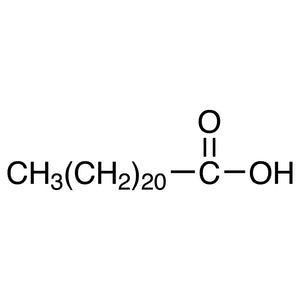
Lignoceric Acid from TCI, also known as tetracosanoic acid, is a very long-chain saturated fatty acid with twenty-four carbon atoms. TCI classifies this material under its colloidal quantum dot (QD) research reagents, because long-chain fatty acids are commonly used as surface ligands for semiconductor nanocrystals. Lignoceric acid is also important in lipid biochemistry, where it serves as a reference compound for very long-chain fatty acids (VLCFA) and as a component of sphingolipids. This gives it a role in both materials science and life science laboratories.
Researchers choose this material because it combines a carboxylate group that can bind to metal atoms on nanocrystal surfaces with a very long, hydrophobic saturated alkyl chain. The carboxylate group anchors the ligand to the particle surface. The long chain provides steric stabilization, which keeps nanoparticles dispersed in nonpolar solvents. Ligand chain length also affects growth rate, final particle size, and interparticle spacing. This makes lignoceric acid useful for comparing chain-length effects against other ligands such as oleic acid or stearic acid in controlled experiments.
In Indonesian laboratories, this material is relevant to nanomaterials and optoelectronics research groups developing quantum dots for advanced device applications. University research teams, government research institutes, and industrial R&D laboratories working on colloidal synthesis can use it to study how ligand structure affects nanocrystal properties. Biochemistry and lipid research laboratories can also use it as a reference standard for very long-chain fatty acids. AMI Scientific supplies this TCI product to support these research activities across Indonesia.
TCI brochures (PDF)
- Colloidal Quantum Dot (QD) Research Reagents 2026-05-21 · p. 3
- Lipids 2025-12-17 · p. 4
- Building Blocks for Organic Semiconductor 2026-03-24 · p. 43
- Colloidal quantum dot synthesis: the carboxylate group binds to metal atoms on nanocrystal surfaces, while the long saturated chain keeps particles dispersed in nonpolar solvents.
- Ligand chain-length studies: its twenty-four-carbon chain lets researchers compare growth rate, particle size, and interparticle spacing against shorter ligands such as oleic acid or stearic acid.
- Nanocrystal surface stabilization: the very long hydrophobic alkyl chain provides strong steric stabilization, which helps prevent aggregation of semiconductor nanoparticles during and after synthesis.
- Lipid biochemistry reference work: as a well-defined very long-chain fatty acid (VLCFA), it serves as a reference compound for identifying and comparing fatty acids in lipid analyses.
- Sphingolipid research: lignoceric acid is a known component of sphingolipids, so it is a relevant model compound for studying their structure and the role of fatty acids within them.
| Brand | TCI (product code T0076) |
|---|---|
| CAS number | 557-59-5 |
| Molecular formula | — |
| Purity | — |
| Category | Materials Science > Electronic Materials > Colloidal Quantum Dot (QD) Research Reagents |
| Pack sizes | available in TCI's standard pack sizes; please contact AMI Scientific for current options |
| Physical form | — |
| Storage | keep tightly closed in a cool, dry place; follow the TCI label and Safety Data Sheet |
- Synonym: Tetracosanoic acid
Store Lignoceric Acid in its original, tightly sealed TCI container in a cool, dry, well-ventilated area, away from direct sunlight, heat sources, and strong oxidizing agents. Reseal containers promptly after use to limit moisture uptake and contamination, especially when the material will be used for sensitive nanocrystal synthesis. Wear standard laboratory protective equipment, including gloves, safety glasses, and a lab coat. Avoid creating or inhaling dust, and weigh the material in a well-ventilated area or fume hood. Always consult the TCI Safety Data Sheet for specific hazard, storage, and disposal information before use.
—
Product Categories
Produk Terkait
-
BehenicAcid TCI B1747
Regular price Rp 4.028.850,00Regular priceRp 2.832.900,00Sale price Rp 4.028.850,00 -
StearicAcid TCI S0163
Regular price From Rp 477.750,00Regular priceRp 333.900,00Sale price From Rp 477.750,00 -
ArachidicAcid TCI E0006
Regular price From Rp 980.700,00Regular priceRp 701.400,00Sale price From Rp 980.700,00 -
BehenicAcid TCI D0963
Regular price From Rp 530.250,00Regular priceRp 386.400,00Sale price From Rp 530.250,00 -
ValericAcid TCI V0003
Regular price From Rp 610.050,00Regular priceRp 426.300,00Sale price From Rp 610.050,00 -
UndecanoicAcid TCI U0004
Regular price From Rp 1.008.000,00Regular priceRp 720.300,00Sale price From Rp 1.008.000,00 -
cis-15-TetracosenoicAcid TCI T1642
Regular price Rp 6.784.050,00Regular priceRp 4.759.650,00Sale price Rp 6.784.050,00 -
BehenicAcid TCI B1248
Regular price From Rp 848.400,00Regular priceRp 609.000,00Sale price From Rp 848.400,00