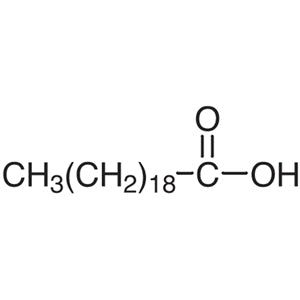
Behenic Acid (TCI B1747, CAS 112-85-6) is a fundamental chemical compound widely used in laboratory experiments across various scientific disciplines. As a non-heterocyclic building block, it plays a crucial role in organic synthesis, offering a simple yet versatile molecular structure that supports the creation of more complex chemical compounds. Its applications span multiple areas, including esterification, saponification, and surfactant production, making it an essential component in chemical research and development.
The chemical stability and inert nature of Behenic Acid make it a preferred choice for laboratory use. It does not readily react with other chemicals, ensuring consistent and reliable results in experimental processes. Its solid, white, and odorless physical form further enhances its usability, as it is easy to handle and store. The high purity of this compound ensures accuracy and reproducibility in experiments, which is vital for scientific research and quality control in various industries.
In Indonesian laboratories, Behenic Acid is commonly used in chemical, pharmaceutical, and food technology research. It is a key material for the synthesis of organic compounds and is frequently included in the standard inventory of research facilities. Its reliability and versatility make it a go-to choice for scientists and researchers seeking a dependable building block for their experiments.
TCI brochures (PDF)
- Colloidal Quantum Dot (QD) Research Reagents 2026-05-21 · p. 3
- Lipids 2025-12-17 · p. 4
- Building Blocks for Organic Semiconductor 2026-03-24 · p. 43
- Organic synthesis is a primary application where Behenic Acid serves as a building block for creating complex molecules due to its stable and predictable chemical behavior.
- Cosmetic formulation benefits from Behenic Acid as it is used in the development of emollients and surfactants, contributing to the texture and stability of products.
- Food technology research utilizes this compound in the production of emulsifiers and stabilizers, enhancing the quality and shelf life of food products.
- Pharmaceutical research incorporates Behenic Acid in the synthesis of drug compounds, leveraging its chemical properties for controlled reactions.
- Industrial chemical processes rely on Behenic Acid for its role in esterification and saponification reactions, supporting the manufacturing of various chemical derivatives.
| Brand | TCI |
|---|---|
| CAS number | 112-85-6 |
| Molecular formula | — |
| Purity | — |
| Category | Chemistry > Building Blocks > Non-Heterocyclic Building Blocks |
| Pack sizes | Available in various quantities as per standard laboratory supply |
| Physical form | Solid, white, odorless powder |
| Storage | Store in a cool, dry place away from direct sunlight and moisture |
Behenic Acid should be stored in a cool, dry environment to maintain its chemical stability and prevent degradation. It is recommended to use airtight containers to protect it from moisture and contaminants. As a solid material, it is easy to handle but should be kept away from heat sources to avoid any potential risk of melting or decomposition. In laboratory settings, proper personal protective equipment should be worn when handling this compound to ensure safety. Regular inspection of storage conditions is advised to maintain the integrity of the material and ensure it remains suitable for use in experiments.
—
Product Categories
Produk Terkait
-
BehenicAcid TCI D0963
Regular price From Rp 530.250,00Regular priceRp 386.400,00Sale price From Rp 530.250,00 -
BehenicAcid TCI B1248
Regular price From Rp 848.400,00Regular priceRp 609.000,00Sale price From Rp 848.400,00 -
StearicAcid TCI S0163
Regular price From Rp 477.750,00Regular priceRp 333.900,00Sale price From Rp 477.750,00 -
ArachidicAcid TCI E0006
Regular price From Rp 980.700,00Regular priceRp 701.400,00Sale price From Rp 980.700,00 -
ValericAcid TCI V0003
Regular price From Rp 610.050,00Regular priceRp 426.300,00Sale price From Rp 610.050,00 -
UndecanoicAcid TCI U0004
Regular price From Rp 1.008.000,00Regular priceRp 720.300,00Sale price From Rp 1.008.000,00 -
ButyricAcid TCI B0754
Regular price From Rp 477.750,00Regular priceRp 333.900,00Sale price From Rp 477.750,00 -
ArachidonicAcid TCI A0781
Regular price From Rp 2.384.550,00Regular priceRp 1.683.150,00Sale price From Rp 2.384.550,00