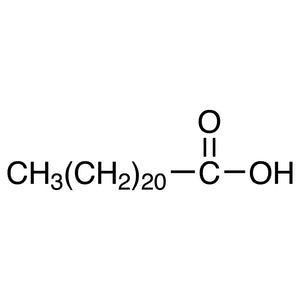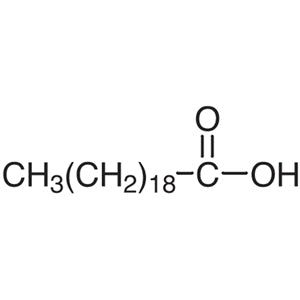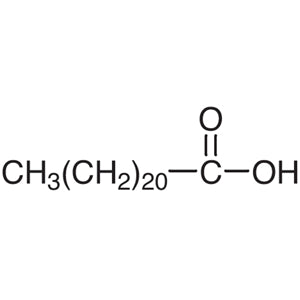
Behenic Acid, also known as docosanoic acid, is a straight-chain saturated fatty acid with 22 carbon atoms, supplied by TCI. It occurs naturally in several plant oils, including moringa seed oil (Moringa oleifera), a plant that also grows widely in Indonesia. In the laboratory, behenic acid serves as a building block for synthesizing long-chain esters, amides, and metal salts. It is also used as a standard in lipid analysis and as a model material in thin-film studies and research on fat-based materials.
Its long, saturated alkyl chain makes behenic acid highly hydrophobic. It is a waxy solid at room temperature, and it resists oxidation better than unsaturated fatty acids. Its carboxylic acid group stays reactive, so researchers can use it for esterification, amidation, and salt formation. The molecule combines a polar head group with a long nonpolar tail, which lets it form ordered monolayers at the air–water interface. Researchers rely on this property in Langmuir–Blodgett film studies and in work on modified surfaces, where a well-defined amphiphilic molecule is essential.
Behenic acid is useful for oleochemical, cosmetic, food, and materials research in Indonesian laboratories. This is especially relevant because Indonesia has a large palm oil industry and a growing range of palm-derived products. University research groups, industrial R&D teams, and quality control laboratories can use it as a reference compound when they characterize fatty acid profiles. It also gives them a dependable starting material for developing new lipid-based formulations, surfactants, and functional materials for local applications.
TCI brochures (PDF)
- Colloidal Quantum Dot (QD) Research Reagents 2026-05-21 · p. 3
- Lipids 2025-12-17 · p. 4
- Building Blocks for Organic Semiconductor 2026-03-24 · p. 43
- Synthesis of long-chain esters and amides: the reactive carboxylic acid group and the saturated 22-carbon chain make behenic acid a convenient building block for preparing hydrophobic derivatives.
- Preparation of long-chain metal salts: behenic acid readily forms salts through its carboxylate group, so researchers can use it to prepare metal soaps for materials and formulation studies.
- Reference standard in lipid analysis: as a well-defined saturated fatty acid, it serves as a standard when researchers identify and compare fatty acid profiles in natural oils and oleochemical samples.
- Langmuir–Blodgett films and monolayer research: its polar head and long nonpolar tail produce ordered monolayers at the air–water interface, which makes it a suitable model amphiphile for thin-film studies.
- Oleochemical, cosmetic, and food research: its hydrophobicity, waxy solid form, and oxidative stability make it a useful model compound for studying fat-based materials and lipid formulations.
| Brand | TCI (product code D0963) |
|---|---|
| CAS number | 112-85-6 |
| Molecular formula | — |
| Purity | — |
| Category | Chemistry > Building Blocks > Non-Heterocyclic Building Blocks |
| Pack sizes | please refer to the options listed on the product page |
| Physical form | waxy solid at room temperature |
| Storage | keep in a tightly closed container in a cool, dry place |
Store behenic acid in its original, tightly sealed container in a cool, dry, well-ventilated area, away from direct sunlight, heat sources, and strong oxidizing agents. Although it resists oxidation better than unsaturated fatty acids, reclose the container promptly after each use to limit moisture and contamination. Use clean spatulas when you dispense the solid, and avoid generating dust. Follow standard laboratory practice: wear safety glasses, gloves, and a lab coat, work in a well-ventilated area, and wash your hands after handling. Always check the manufacturer's Safety Data Sheet for detailed hazard, first-aid, and disposal information before use.
—
Product Categories
Produk Terkait
-
BehenicAcid TCI B1747
Regular price Rp 4.028.850,00Regular priceRp 2.832.900,00Sale price Rp 4.028.850,00 -
BehenicAcid TCI B1248
Regular price From Rp 848.400,00Regular priceRp 609.000,00Sale price From Rp 848.400,00 -
StearicAcid TCI S0163
Regular price From Rp 477.750,00Regular priceRp 333.900,00Sale price From Rp 477.750,00 -
ArachidicAcid TCI E0006
Regular price From Rp 980.700,00Regular priceRp 701.400,00Sale price From Rp 980.700,00 -
ValericAcid TCI V0003
Regular price From Rp 610.050,00Regular priceRp 426.300,00Sale price From Rp 610.050,00 -
UndecanoicAcid TCI U0004
Regular price From Rp 1.008.000,00Regular priceRp 720.300,00Sale price From Rp 1.008.000,00 -
ButyricAcid TCI B0754
Regular price From Rp 477.750,00Regular priceRp 333.900,00Sale price From Rp 477.750,00 -
ArachidonicAcid TCI A0781
Regular price From Rp 2.384.550,00Regular priceRp 1.683.150,00Sale price From Rp 2.384.550,00