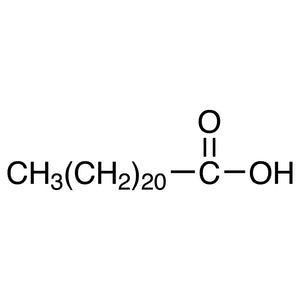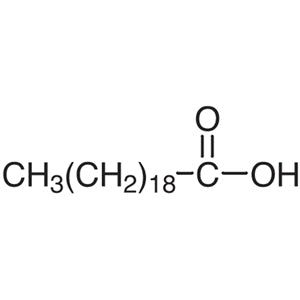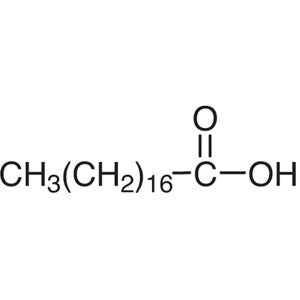
TCI Stearic Acid is a straight-chain saturated fatty acid with eighteen carbon atoms. It is one of the most common fatty acids in nature, found mainly in animal fats and in vegetable oils such as palm oil and cocoa butter. In the laboratory, stearic acid is a versatile non-heterocyclic building block. It is used as a starting material for synthesising esters, amides and metal salts, as a reference standard in lipid analysis, and as a surface agent in materials science and nanotechnology research.
Researchers choose stearic acid because its long, saturated alkyl chain is more stable against oxidation than unsaturated fatty acids. Its carboxylic acid group is easy to convert into a wide range of derivatives, so it can feed into many synthetic routes. The hydrophobic chain gives it lubricating, thin-film-forming and crystallisation-controlling properties. In nanoparticle synthesis, stearic acid is often used as a surface-capping ligand that keeps particles dispersed in nonpolar solvents. Because it is amphiphilic, it is also useful for studying monolayers, emulsions and lipid membrane models.
Indonesia is one of the world's largest palm oil producers, so stearic acid is highly relevant to Indonesian laboratories working in oleochemistry, food technology and pharmaceuticals. University research groups use it in organic synthesis and materials science projects. Industrial quality control and R&D laboratories use it as a reference compound when characterising fats, oils and their derivatives. A well-characterised reagent from TCI gives these laboratories a consistent starting point for synthesis, analysis and teaching work.
TCI brochures (PDF)
- Colloidal Quantum Dot (QD) Research Reagents 2026-05-21 · p. 3
- Lipids 2025-12-17 · p. 4
- Building Blocks for Organic Semiconductor 2026-03-24 · p. 43
- Synthesis of esters and amides: the carboxylic acid group reacts readily, so stearic acid is a dependable starting material for building long-chain ester and amide derivatives.
- Preparation of metal stearates: stearic acid can be converted into metal salts, which researchers study and use as lubricants, stabilisers and processing additives in materials research.
- Lipid analysis reference standard: as a common, well-defined saturated fatty acid, it serves as a reference compound when identifying and quantifying fatty acids in fats and oils.
- Nanoparticle surface capping: its hydrophobic alkyl chain binds to particle surfaces as a ligand and keeps nanoparticles well dispersed in nonpolar solvents during synthesis.
- Monolayer, emulsion and membrane model studies: its amphiphilic structure makes it a suitable model compound for studying interfacial films, emulsion behaviour and simplified lipid membrane systems.
| Brand | TCI (product code S0163) |
|---|---|
| CAS number | 57-11-4 |
| Molecular formula | — |
| Purity | — |
| Category | Chemistry > Building Blocks > Non-Heterocyclic Building Blocks |
| Pack sizes | see the available options on the product page |
| Physical form | white waxy solid |
| Storage | keep tightly closed in a cool, dry place, following the manufacturer's label and SDS |
Store stearic acid in its original, tightly closed container in a cool, dry, well-ventilated area, away from direct sunlight, heat sources and strong oxidising agents. Glass or compatible plastic containers with secure lids are suitable if the material must be transferred, and every container should be clearly labelled. Handle it according to good laboratory practice: wear safety glasses, gloves and a lab coat, avoid creating or breathing dust, and wash your hands after use. Always read the manufacturer's Safety Data Sheet before use, and dispose of waste according to local regulations.
—
Product Categories
Produk Terkait
-
BehenicAcid TCI B1747
Regular price Rp 4.028.850,00Regular priceRp 2.832.900,00Sale price Rp 4.028.850,00 -
ArachidicAcid TCI E0006
Regular price Rp 980.700,00Regular priceRp 701.400,00Sale price Rp 980.700,00 -
BehenicAcid TCI D0963
Regular price Rp 530.250,00Regular priceRp 386.400,00Sale price Rp 530.250,00 -
ValericAcid TCI V0003
Regular price Rp 610.050,00Regular priceRp 426.300,00Sale price Rp 610.050,00 -
UndecanoicAcid TCI U0004
Regular price Rp 1.008.000,00Regular priceRp 720.300,00Sale price Rp 1.008.000,00 -
BehenicAcid TCI B1248
Regular price Rp 848.400,00Regular priceRp 609.000,00Sale price Rp 848.400,00 -
ButyricAcid TCI B0754
Regular price Rp 477.750,00Regular priceRp 333.900,00Sale price Rp 477.750,00 -
ArachidonicAcid TCI A0781
Regular price Rp 2.384.550,00Regular priceRp 1.683.150,00Sale price Rp 2.384.550,00