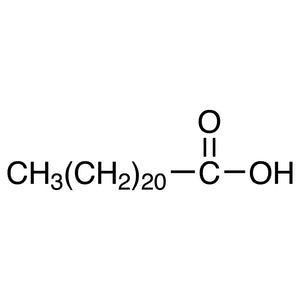
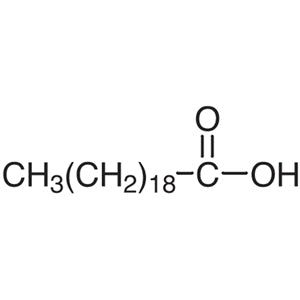
Behenic Acid, with CAS number 112-85-6, is a saturated fatty acid characterized by its long carbon chain. It is widely used as a building block in various chemical reactions, particularly in the synthesis of complex organic compounds. This compound is valued for its stability and versatility, making it a key component in laboratory research. Its molecular structure allows it to function as a binder, solvent, or structural component in multiple applications. In laboratory settings, Behenic Acid is essential for the development of new compounds or the modification of specific molecular structures.
Behenic Acid is chemically stable, with a high melting point and the ability to dissolve in organic solvents such as ethers and chloroform. These properties make it an ideal choice for reactions requiring controlled reactivity and stable conditions. Its long carbon chain also contributes to unique physical characteristics, such as high surface tension and the ability to form complex structures. These features are particularly beneficial in applications that demand precise chemical interactions and controlled environments.
In Indonesian laboratories, Behenic Acid is commonly used in chemical, pharmaceutical, and cosmetic research. It plays a vital role in educational and research programs, supporting both academic and industrial development. Its reliability and consistent performance make it a preferred material for scientists and researchers working on diverse projects. The compound's availability and compatibility with various experimental setups further enhance its utility in the laboratory setting.
TCI brochures (PDF)
- Colloidal Quantum Dot (QD) Research Reagents 2026-05-21 · p. 3
- Lipids 2025-12-17 · p. 4
- Organic synthesis: Behenic Acid is widely used in the synthesis of complex organic compounds due to its stable molecular structure and reactivity.
- Pharmaceutical research: It serves as a key building block in the development of new drugs and pharmaceutical compounds.
- Cosmetic formulation: Its long carbon chain and solubility properties make it suitable for use in cosmetic product development.
- Material science: Behenic Acid is used in the creation of specialized materials due to its ability to form complex structures.
- Educational research: It is commonly used in academic settings for teaching and experimental purposes in chemistry and related fields.
| Brand | TCI |
|---|---|
| CAS number | 112-85-6 |
| Molecular formula | — |
| Purity | — |
| Category | Chemistry > Building Blocks > Non-Heterocyclic Building Blocks |
| Pack sizes | Available in various quantities as per standard laboratory supply |
| Physical form | Solid at room temperature |
| Storage | Store in a cool, dry place away from direct sunlight and moisture |
Behenic Acid should be stored in a cool, dry environment to maintain its chemical stability. It is recommended to keep it in airtight containers to prevent exposure to moisture and air, which could affect its properties. Due to its solid form, it should be stored in a secure location away from heat sources and direct sunlight. Proper labeling of containers is essential for safe handling and identification. In laboratory settings, it is important to use appropriate personal protective equipment when handling this compound. Regular inspection of storage conditions ensures the material remains in optimal condition for use in experiments and research.
—
Product Categories
Produk Terkait
-
BehenicAcid TCI B1747
Regular price Rp 4.028.850,00Regular priceRp 2.832.900,00Sale price Rp 4.028.850,00 -
BehenicAcid TCI D0963
Regular price From Rp 530.250,00Regular priceRp 386.400,00Sale price From Rp 530.250,00 -
ArachidonicAcid TCI A0781
Regular price From Rp 2.384.550,00Regular priceRp 1.683.150,00Sale price From Rp 2.384.550,00 -
StearicAcid TCI S0163
Regular price From Rp 477.750,00Regular priceRp 333.900,00Sale price From Rp 477.750,00 -
ElaidicAcid TCI O0010
Regular price From Rp 5.352.900,00Regular priceRp 3.759.000,00Sale price From Rp 5.352.900,00 -
LinoleicAcid TCI L0124
Regular price From Rp 1.881.600,00Regular priceRp 1.331.400,00Sale price From Rp 1.881.600,00 -
LinoleicAcid TCI L0053
Regular price From Rp 1.538.250,00Regular priceRp 1.090.950,00Sale price From Rp 1.538.250,00 -
ArachidicAcid TCI E0006
Regular price From Rp 980.700,00Regular priceRp 701.400,00Sale price From Rp 980.700,00