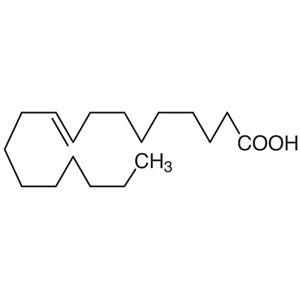
Elaidic Acid is a monounsaturated fatty acid with an 18-carbon chain and a trans-configured double bond at the ninth carbon position. It is the geometric isomer of oleic acid and one of the main trans fatty acids formed when vegetable oils are partially hydrogenated. In the laboratory, elaidic acid serves as an analytical standard for trans fat determination, a research material in nutrition and biochemistry studies, and a building block for synthesising fatty acid derivatives. Supplied by TCI, it gives analysts and researchers a dependable reference compound for work on lipid structure and composition.
The trans configuration is what makes this compound important. It makes the molecular chain straighter than the cis form found in oleic acid. As a result, elaidic acid packs more tightly and is solid at room temperature, while oleic acid is a liquid. This difference in geometry makes the two compounds an ideal comparison pair for studying how lipid structure relates to physical properties. Its carboxyl group is also reactive, so it works well in esterification and amidation reactions. TCI's consistent quality helps analysts identify the compound accurately in chromatographic analysis.
In Indonesia, elaidic acid is especially relevant to food testing laboratories that check trans fat content in margarine, shortening, and processed palm oil products. Palm oil processing is central to the national food industry, so reliable trans fat reference materials help support quality control and product labelling. University research groups in food science, nutrition, and biochemistry also use elaidic acid to compare the behaviour of cis and trans lipids. Synthetic chemistry laboratories use it as a starting material for fatty acid esters and amides.
- Trans fat analytical standard: elaidic acid is one of the main trans fatty acids formed during partial hydrogenation, so it is a suitable reference for identifying and measuring trans fats by chromatography.
- Food quality testing: laboratories that examine margarine, shortening, and processed palm oil products can use it as a reference point when checking trans fat content in finished foods.
- Nutrition and biochemistry research: its role as a major dietary trans fatty acid makes it a relevant test compound for studies of how trans lipids behave in biological systems.
- Lipid structure–property studies: because it is the trans geometric isomer of oleic acid, it pairs naturally with oleic acid in experiments that compare chain packing, physical state, and other lipid properties.
- Synthesis of fatty acid derivatives: its reactive carboxyl group allows esterification and amidation, so it can serve as a building block for preparing trans fatty acid esters, amides, and related compounds.
| Brand | TCI (product code O0010) |
|---|---|
| CAS number | 112-79-8 |
| Molecular formula | — |
| Purity | — |
| Category | Chemistry > Building Blocks > Non-Heterocyclic Building Blocks |
| Pack sizes | available in the pack sizes TCI supplies; see the product page for current options |
| Physical form | solid at room temperature |
| Storage | keep tightly closed in a cool, dry place and follow the TCI label and Safety Data Sheet |
Store Elaidic Acid in its original, tightly sealed container in a cool, dry, well-ventilated area, away from direct sunlight, heat sources, and strong oxidising agents. Because it is an unsaturated fatty acid, limiting exposure to air and light helps keep it from degrading over time. Always follow the storage conditions on the TCI label and in the Safety Data Sheet. When handling it, wear standard laboratory protection, including gloves, safety glasses, and a lab coat. Avoid creating dust or breathing it in, and avoid contact with skin and eyes. Use clean, dry spatulas and glassware to prevent contamination, especially when the material is used as an analytical standard. Reseal the container promptly after each use, and dispose of waste according to local regulations and your institution's procedures.
—
Produk Terkait
-
TCI B5774 5,10-Bis(4,4,5,5-tetramethyl-1,3,2-dioxaborolan-2-yl)naphtho[1,2-c:5,6-c']bis([1,2,5]oxadiazole)
Regular price Rp 10.255.350,00Regular price -
Dihydroiodide TCI B6569
Regular price From Rp 1.936.200,00Regular price -
Trifluoromethanesulfonate TCI B7003
Regular price From Rp 1.936.200,00Regular price
![5,10-Bis(4,4,5,5-tetramethyl-1,3,2-dioxaborolan-2-yl)naphtho[1,2-c:5,6-c']bis([1,2,5]oxadiazole) - TCI B5774 - AMI Scientific](http://amiscientific.com/cdn/shop/files/TCI2510B5774.jpg?v=1769180228&width=533)