


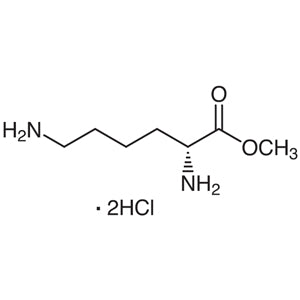
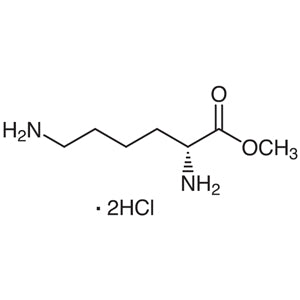
TCI L0201 D-Lysine Methyl Ester Dihydrochloride is a D-configured lysine derivative in which the carboxylate group has been esterified to a methyl ester and the molecule stabilised as a dihydrochloride salt. Two equivalents of hydrochloric acid are required because the lysine molecule carries two basic amine groups: the alpha amine and the epsilon amine at the end of its side chain. In the laboratory, this compound serves as a versatile building block for assembling peptides, amino acid-based polymers, and branched molecules that exploit those two reactive nitrogen centres.
The property that makes this material a frequent choice is the presence of two amine groups whose reactivity can be differentiated through the selection of protecting groups and the control of reaction pH. This flexibility makes it a useful intermediate for constructing branched or dendritic architectures. The dihydrochloride salt form makes the solid far easier to handle than the free base, since it does not readily absorb carbon dioxide from the air and is more stable in storage. The D configuration adds a further advantage: peptides incorporating this residue are generally digested more slowly by protease enzymes.
Within Indonesian laboratories, this reagent typically appears in peptide chemistry and chemical biology work carried out in university research groups, institutional research centres, and laboratories developing peptide-based compounds. It is ordinarily handled at the bench scale in synthesis work where a defined stereochemistry and a protected carboxyl terminus are both required, and where the salt form's resistance to atmospheric carbon dioxide simplifies weighing and routine handling under ordinary laboratory conditions.
TCI brochures (PDF)
- Amino Acids and Peptide Synthesis Reagents 2025-08-14 · p. 26
Related TCI products
- TCI L0202 26348-70-9 L-Lysine Methyl Ester Dihydrochloride
- TCI L0131 657-26-1 L-(+)-Lysine Dihydrochloride
- TCI L0130 617-68-5 DL-Lysine Dihydrochloride
- TCI H1213 4467-54-3 D-Histidine Methyl Ester Dihydrochloride
- TCI H0977 7389-87-9 L-Histidine Methyl Ester Dihydrochloride
- TCI L0228 34015-48-0 DL-Lysine Methyl Ester Dihydrochloride
- Peptide synthesis building block — the methyl ester protects the carboxyl terminus while the two amine groups remain available for controlled, sequential coupling steps during chain assembly.
- Protease-resistant peptide design — incorporating the D-configured residue yields peptides that protease enzymes generally digest more slowly, supporting work on peptide stability and longer-lived peptide structures.
- Branched and dendritic molecule construction — the alpha and epsilon amines can be differentiated by protecting group choice, giving two distinct attachment points for building branched architectures.
- Amino acid-based polymer preparation — the difunctional amine character allows lysine units to be linked into polymer backbones or side chains within amino acid-derived polymeric materials.
- Chemical biology intermediate preparation — serves as a starting material for conjugates and modified peptide structures where a defined D stereochemistry at the lysine centre is required.
| Brand | TCI (Tokyo Chemical Industry), catalogue number L0201 |
|---|---|
| CAS number | 67396-08-1 |
| Molecular formula | — |
| Purity | — |
| Category | Chemistry > Chemical Biology > Peptide Chemistry |
| Pack sizes | available in standard TCI catalogue research quantities — please confirm the currently offered pack size when ordering |
| Physical form | solid, supplied as the dihydrochloride salt |
| Storage | keep tightly closed in a cool, dry place; follow the storage conditions stated on the manufacturer's label |
Store the container tightly closed in a cool, dry area away from moisture, direct sunlight, and incompatible materials, following the conditions specified on the manufacturer's label and safety data sheet. Keep the material in its original tightly sealed container, or transfer it to a clean, dry, well-sealed glass or chemically compatible vessel with a clear label. Although the dihydrochloride salt form is less prone to absorbing carbon dioxide from the air than the free base, the solid should still be weighed promptly and the container resealed without delay to limit exposure to atmospheric moisture. Handle in a well-ventilated area or fume hood, wear appropriate personal protective equipment including safety glasses, gloves, and a laboratory coat, and avoid generating or inhaling dust. Consult the supplier's safety data sheet before use and dispose of residues according to applicable laboratory waste procedures.
—
Product Categories
Produk Terkait
-
L-LysineMethylEsterDihydrochloride TCI L0202
Regular price From Rp 1.140.300,00Regular price -
L-(+)-LysineDihydrochloride TCI L0131
Regular price Rp 1.273.650,00Regular price -
DL-LysineDihydrochloride TCI L0130
Regular price Rp 5.672.100,00Regular price -
D-HistidineMethylEsterDihydrochloride TCI H1213
Regular price From Rp 1.115.100,00Regular price -
L-HistidineMethylEsterDihydrochloride TCI H0977
Regular price Rp 955.500,00Regular price -
DL-LysineMethylEsterDihydrochloride TCI L0228
Regular price From Rp 1.298.850,00Regular price -
Nalpha,Nepsilon-Bis[(9H-fluoren-9-ylmethoxy)carbonyl]-L-lysine TCI B4931
Regular price From Rp 1.008.000,00Regular price -
Nepsilon-(tert-Butoxycarbonyl)-Nalpha-[(9H-fluoren-9-ylmethoxy)carbonyl]-L-lysine TCI B3072
Regular price Rp 1.115.100,00Regular price


![78081-87-5 Nalpha,Nepsilon-Bis[(9H-fluoren-9-ylmethoxy)carbonyl]-L-lysine - AMI Scientific](http://amiscientific.com/cdn/shop/files/TCI2510B4931.jpg?v=1769180094&width=533)
![71989-26-9 Nepsilon-(tert-Butoxycarbonyl)-Nalpha-[(9H-fluoren-9-ylmethoxy)carbonyl]-L-lysine - AMI Scientific](http://amiscientific.com/cdn/shop/files/TCI2510B3072.jpg?v=1768204181&width=533)
![71989-26-9 Nepsilon-(tert-Butoxycarbonyl)-Nalpha-[(9H-fluoren-9-ylmethoxy)carbonyl]-L-lysine - AMI Scientific](http://amiscientific.com/cdn/shop/files/TCI2510B3072_4b5e842c-a4b3-4909-8dc2-14a7d17533e7.jpg?v=1768359590&width=533)