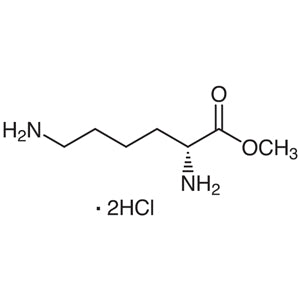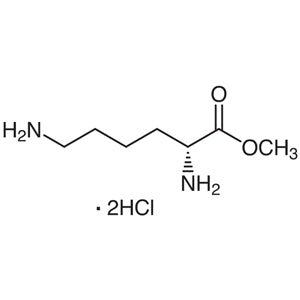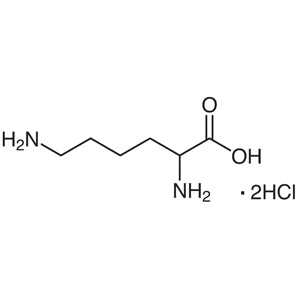
DL-Lysine Dihydrochloride is the racemic form of the amino acid lysine, containing the D- and L-enantiomers in equal proportion and stabilised as a dihydrochloride salt. In the dihydrochloride form, both amino groups of the lysine molecule — the alpha-amino group and the epsilon-amino group — have been protonated and paired with chloride ions, producing a stable crystalline solid that dissolves readily in water. In laboratory work, racemic compounds of this kind are used where enantiomeric purity is not the determining factor, or conversely where the researcher specifically requires a racemic mixture as a test substance for chiral separation studies.
The property that makes this material genuinely useful is that it exists as a controlled racemate of clearly defined composition, which makes it well suited as a test substance for validating chiral chromatography columns, resolution enzymes, and diastereomeric crystallisation methods. The dihydrochloride form offers better storage stability and higher aqueous solubility than the free base, while also producing acidic solutions that simplify the preparation of working solutions at low pH. Its crystalline solid form makes accurate weighing straightforward, and its colourless character does not interfere with spectrophotometric measurement.
In Indonesian laboratories, this material is typically encountered in peptide chemistry and chemical biology work within universities, research institutes, and analytical service laboratories. It is commonly drawn on when a method development team needs a reference racemate to characterise a newly installed chiral column, or when a group studying enzymatic resolution requires a defined starting mixture. Its ready water solubility and stable salt form suit routine bench conditions where samples are prepared fresh and used over a working day.
- Chiral chromatography column validation — the defined equal-proportion racemate provides a known two-peak challenge for confirming that a chiral stationary phase resolves enantiomers as specified.
- Enzymatic resolution studies — supplies a controlled racemic substrate so researchers can measure how selectively a resolving enzyme acts on one enantiomer relative to the other.
- Diastereomeric crystallisation method development — the racemate serves as the defined starting material for evaluating whether a chosen resolving agent separates the two enantiomers effectively.
- Peptide chemistry investigations — the protonated alpha- and epsilon-amino groups make this a useful building block where lysine side-chain reactivity is studied without requiring enantiomeric purity.
- Low-pH solution preparation — high aqueous solubility and the acidic character of the dihydrochloride salt allow convenient preparation of acidic working solutions for buffer and mobile phase studies.
| Brand | TCI |
|---|---|
| CAS number | 617-68-5 |
| Molecular formula | — |
| Purity | — |
| Category | Chemistry > Chemical Biology > Peptide Chemistry |
| Pack sizes | — |
| Physical form | colourless crystalline solid, readily soluble in water |
| Storage | keep in a tightly closed container in a cool, dry place away from moisture |
- Catalogue Code: L0130
Store the container tightly closed in a cool, dry location, protected from moisture, since the crystalline salt should be kept free-flowing for accurate weighing. Original supplier packaging or well-sealed glass or chemically compatible plastic containers with secure closures are appropriate; label any transferred material clearly with identity and date. Handle in a well-ventilated area, avoid generating dust during weighing, and wear standard laboratory personal protective equipment including a lab coat, safety glasses, and gloves. Prepared aqueous solutions are acidic, so handle them accordingly and avoid contact with skin and eyes. Wash hands thoroughly after handling and follow institutional waste disposal procedures.
—
Product Categories
Produk Terkait
-
L-(+)-LysineDihydrochloride TCI L0131
Regular price Rp 1.273.650,00Regular price -
D-Lysine TCI L0173
Regular price Rp 3.287.550,00Regular price -
L-(+)-Lysine TCI L0129
Regular price From Rp 823.200,00Regular price -
D-(-)-LysineMonohydrochloride TCI L0128
Regular price From Rp 823.200,00Regular price -
L-(+)-LysineMonohydrochloride TCI L0071
Regular price From Rp 477.750,00Regular price -
DL-LysineMonohydrochloride TCI L0070
Regular price From Rp 1.220.100,00Regular price -
L-LysineMethylEsterDihydrochloride TCI L0202
Regular price From Rp 1.140.300,00Regular price -
D-LysineMethylEsterDihydrochloride TCI L0201
Regular price From Rp 1.749.300,00Regular price