

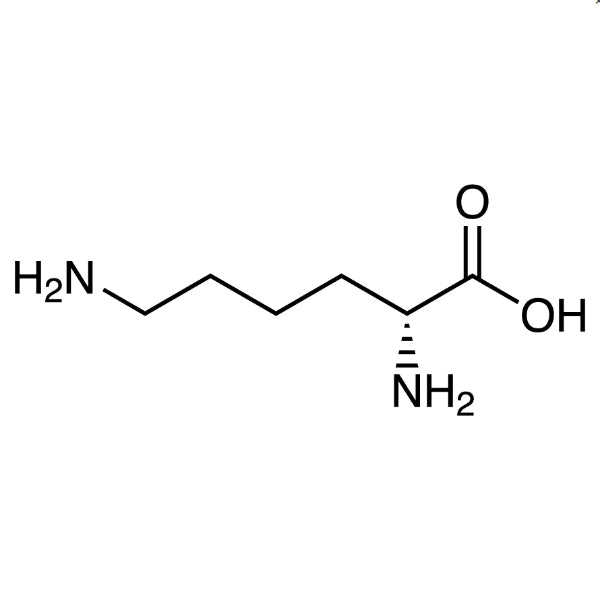
D-Lysine is the D-enantiomer of lysine, a basic amino acid whose side chain terminates in a primary amino group. Unlike L-lysine, which serves as a building block of naturally occurring proteins, the D form is rarely encountered in mammalian proteins, so its presence within a peptide creates distinctive structural and biological characteristics. In peptide chemistry, D-amino acids are deliberately employed to design molecules that are not readily recognized and cleaved by protease enzymes, giving the resulting designed peptides a longer functional lifetime in assay systems and in advanced biological studies.
The properties that make this material a preferred choice are the combination of a side chain that carries a positive charge at physiological pH and an unusual D configuration. The amino group on the side chain provides a highly useful grafting point for conjugation with dyes, biotin, polymers, or orthogonal protecting groups, while its positive charge improves solubility in water and promotes interaction with negatively charged surfaces such as bacterial cell membranes. The D configuration also influences the tendency toward secondary structure formation, making it an important tool for researchers designing synthetic peptides.
In Indonesian laboratories, this amino acid is typically used in peptide chemistry and chemical biology work groups, particularly where synthetic peptides must remain intact long enough for meaningful observation. It is handled in university research laboratories, institutional biochemistry facilities, and analytical service units that prepare modified peptide sequences, conjugates, and reference materials. Small quantities are usually weighed for synthesis or solution preparation, with the remainder of the container returned to controlled storage.
- Protease-resistant peptide design: incorporating the D configuration at selected positions produces sequences that proteolytic enzymes do not readily recognize, extending functional lifetime during biological assays.
- Peptide conjugation chemistry: the primary amino group on the side chain serves as a dependable grafting point for attaching dyes, biotin labels, polymers, or orthogonal protecting groups.
- Antimicrobial peptide studies: the positively charged side chain at physiological pH promotes interaction with negatively charged bacterial membrane surfaces, supporting membrane-directed peptide research.
- Secondary structure investigation: substituting the D form alters the tendency of a designed peptide to adopt particular secondary structures, allowing controlled study of conformational behaviour.
- Chemical biology reference work: as a non-proteinogenic amino acid, it is used to prepare defined synthetic standards that distinguish D-containing sequences from ordinary L-amino acid peptides.
| Brand | TCI |
|---|---|
| CAS number | 923-27-3 |
| Molecular formula | — |
| Purity | — |
| Category | Chemistry > Chemical Biology > Peptide Chemistry |
| Pack sizes | available in the standard research-scale pack sizes offered by TCI for this catalogue item; please confirm the current option when ordering. |
| Physical form | — |
| Storage | keep in a tightly closed original container under the conditions stated on the manufacturer's label and safety data sheet. |
- Catalogue code: L0173
Store the container tightly closed in a cool, dry, well-ventilated area away from direct sunlight, moisture, and incompatible chemicals, following the conditions printed on the manufacturer's label and safety data sheet. As a basic amino acid, the material is best kept in its original tightly sealed container or in a clean, dry, chemically compatible vessel that limits exposure to atmospheric humidity. Weigh and transfer the solid inside a fume hood or a well-ventilated weighing area, using a clean dry spatula to avoid cross-contamination of the stock. Personnel should wear a laboratory coat, safety glasses, and suitable gloves, avoid inhaling dust, and wash hands thoroughly after handling. Return the container to designated storage immediately after use, keep it clearly labelled, and dispose of residues and contaminated materials in accordance with the institution's chemical waste procedures.
—
Product Categories
Produk Terkait
-
L-(+)-LysineDihydrochloride TCI L0131
Regular price Rp 1.273.650,00Regular price -
DL-LysineDihydrochloride TCI L0130
Regular price Rp 5.672.100,00Regular price -
L-(+)-Lysine TCI L0129
Regular price From Rp 823.200,00Regular price -
D-(-)-LysineMonohydrochloride TCI L0128
Regular price From Rp 823.200,00Regular price -
L-(+)-LysineMonohydrochloride TCI L0071
Regular price From Rp 477.750,00Regular price -
DL-LysineMonohydrochloride TCI L0070
Regular price From Rp 1.220.100,00Regular price -
Nalpha,Nepsilon-Bis[(9H-fluoren-9-ylmethoxy)carbonyl]-L-lysine TCI B4931
Regular price From Rp 1.008.000,00Regular price -
Nepsilon-(tert-Butoxycarbonyl)-Nalpha-[(9H-fluoren-9-ylmethoxy)carbonyl]-L-lysine TCI B3072
Regular price Rp 1.115.100,00Regular price


![78081-87-5 Nalpha,Nepsilon-Bis[(9H-fluoren-9-ylmethoxy)carbonyl]-L-lysine - AMI Scientific](http://amiscientific.com/cdn/shop/files/TCI2510B4931.jpg?v=1769180094&width=533)
![71989-26-9 Nepsilon-(tert-Butoxycarbonyl)-Nalpha-[(9H-fluoren-9-ylmethoxy)carbonyl]-L-lysine - AMI Scientific](http://amiscientific.com/cdn/shop/files/TCI2510B3072.jpg?v=1768204181&width=533)
![71989-26-9 Nepsilon-(tert-Butoxycarbonyl)-Nalpha-[(9H-fluoren-9-ylmethoxy)carbonyl]-L-lysine - AMI Scientific](http://amiscientific.com/cdn/shop/files/TCI2510B3072_4b5e842c-a4b3-4909-8dc2-14a7d17533e7.jpg?v=1768359590&width=533)