

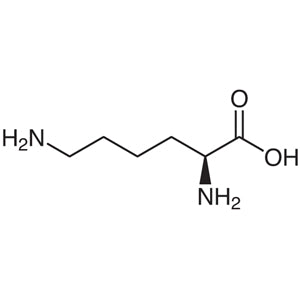
L-(+)-Lysine is an essential amino acid in the L-configuration, supplied here in its free base form, meaning the amino groups are not bound as a salt and the compound is therefore strongly basic by amino acid standards. Lysine is one of the few amino acids that the human body cannot synthesize and must obtain from the diet, which has made it an important research subject in nutrition, animal feed development, and fermentation biotechnology. In the laboratory, it serves as a peptide building block, a culture medium component, and an analytical standard in amino acid content determination.
The principal advantage of the free base form lies in the absence of additional chloride ions, giving researchers full control over the ionic composition and pH of the solutions they prepare — a consideration that matters greatly in sensitive medium and buffer formulations. The long epsilon-amino side chain carries a positive charge at physiological pH and provides a well-established cross-linking site widely exploited in enzyme immobilization and surface modification work. The material presents as a white crystalline solid with good solubility in water, and its basic character makes it straightforward to form salts with a range of acids as experimental needs dictate.
In Indonesian laboratories, L-(+)-Lysine is routinely used across university research groups, animal nutrition and feed formulation studies, fermentation and bioprocess development units, and analytical service laboratories performing amino acid profiling. Its role in culture medium preparation and peptide synthesis makes it a standing item in biochemistry and microbiology facilities, while feed and food testing laboratories rely on it as a reference material when quantifying lysine content in raw materials and finished products.
- Peptide synthesis building block — the free base form supplies lysine residues for solid-phase and solution-phase peptide assembly without introducing counter-ions that would complicate coupling chemistry or downstream purification.
- Cell culture and fermentation medium formulation — as an essential amino acid it is a defined nutrient component, and the chloride-free basis allows precise control of total ionic strength in custom media.
- Analytical standard for amino acid determination — laboratories use it to prepare calibration solutions when quantifying lysine content in feed, food, and protein hydrolysate samples.
- Enzyme immobilization and surface modification — the reactive epsilon-amino side chain serves as a cross-linking anchor point for attaching biomolecules to supports and functionalized surfaces.
- Nutrition and animal feed research — its status as a dietary-essential amino acid makes it a standard supplement and test substance in feed formulation trials and nutritional requirement studies.
| Brand | TCI |
|---|---|
| CAS number | 56-87-1 |
| Molecular formula | — |
| Purity | — |
| Category | Chemistry > Chemical Biology > Peptide Chemistry |
| Pack sizes | available in standard TCI catalogue pack sizes; please confirm the required size when ordering |
| Physical form | white crystalline solid, readily soluble in water |
| Storage | keep in a cool, dry place in a tightly closed container |
- Chemical form: free base (not a hydrochloride salt)
Store L-(+)-Lysine in a tightly closed container in a cool, dry, and well-ventilated area, protected from moisture and away from strong acids and oxidizing agents. Amber glass or high-density polyethylene bottles with secure closures are suitable; reseal promptly after each use to limit moisture uptake and atmospheric carbon dioxide absorption, as the free base is basic in character. Handle in a well-ventilated area or fume hood using a laboratory coat, nitrile gloves, and safety glasses, and avoid generating or inhaling dust. Weigh with clean, dry spatulas to prevent cross-contamination, allow the container to reach room temperature before opening if it has been refrigerated, and consult the manufacturer's safety data sheet before first use and before disposal of residues.
—
Product Categories
Produk Terkait
-
D-Lysine TCI L0173
Regular price Rp 3.287.550,00Regular price -
L-(+)-LysineDihydrochloride TCI L0131
Regular price Rp 1.273.650,00Regular price -
DL-LysineDihydrochloride TCI L0130
Regular price Rp 5.672.100,00Regular price -
D-(-)-LysineMonohydrochloride TCI L0128
Regular price From Rp 823.200,00Regular price -
L-(+)-LysineMonohydrochloride TCI L0071
Regular price From Rp 477.750,00Regular price -
DL-LysineMonohydrochloride TCI L0070
Regular price From Rp 1.220.100,00Regular price -
Nalpha,Nepsilon-Bis[(9H-fluoren-9-ylmethoxy)carbonyl]-L-lysine TCI B4931
Regular price From Rp 1.008.000,00Regular price -
Nepsilon-(tert-Butoxycarbonyl)-Nalpha-[(9H-fluoren-9-ylmethoxy)carbonyl]-L-lysine TCI B3072
Regular price Rp 1.115.100,00Regular price


![78081-87-5 Nalpha,Nepsilon-Bis[(9H-fluoren-9-ylmethoxy)carbonyl]-L-lysine - AMI Scientific](http://amiscientific.com/cdn/shop/files/TCI2510B4931.jpg?v=1769180094&width=533)
![71989-26-9 Nepsilon-(tert-Butoxycarbonyl)-Nalpha-[(9H-fluoren-9-ylmethoxy)carbonyl]-L-lysine - AMI Scientific](http://amiscientific.com/cdn/shop/files/TCI2510B3072.jpg?v=1768204181&width=533)
![71989-26-9 Nepsilon-(tert-Butoxycarbonyl)-Nalpha-[(9H-fluoren-9-ylmethoxy)carbonyl]-L-lysine - AMI Scientific](http://amiscientific.com/cdn/shop/files/TCI2510B3072_4b5e842c-a4b3-4909-8dc2-14a7d17533e7.jpg?v=1768359590&width=533)