


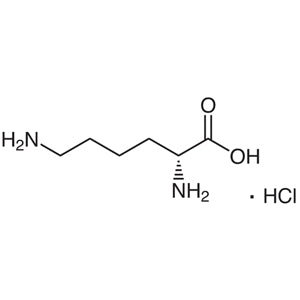
D-(-)-Lysine Monohydrochloride is the monohydrochloride salt of the D enantiomer of lysine, the mirror image of L-lysine, the amino acid commonly found in the proteins of living organisms. Because nature almost invariably uses the L configuration, the availability of the D form in well-maintained enantiomeric purity makes this compound a high-value reagent for stereochemical and biochemical research. In the laboratory it is used to assemble peptides containing D residues, to study enzyme selectivity toward substrate configuration, and to prepare chiral reference materials during analytical method development.
The properties behind its selection are the combination of stereochemical purity and the ease of handling that the salt form provides. Lysine carries two amino groups, the alpha-amino group and the epsilon-amino group on its side chain, which makes it basic in character and offers two distinct points of chemical modification with different reactivities. The monohydrochloride form is a stable crystalline solid that is easy to weigh accurately and dissolves readily in water, so the preparation of buffer solutions and stock solutions proceeds conveniently. Its D configuration renders the residue resistant to most naturally occurring proteases, a characteristic that is widely exploited in peptide design work.
In Indonesian laboratories, this reagent is typically found in university research groups, peptide chemistry and chemical biology units, and analytical laboratories that develop or validate chiral separation methods. It is commonly used alongside standard solid-phase peptide synthesis consumables, chromatographic columns, and buffer components already present in the laboratory. Because it is supplied as a water-soluble crystalline salt, it integrates easily into existing weighing, dissolution, and aliquoting routines without requiring specialized equipment.
TCI brochures (PDF)
- D-Amino Acids 2026-03-19 · p. 1
- Amino Acids and Peptide Synthesis Reagents 2025-08-14 · p. 4
- Peptide synthesis with D residues: supplied in maintained enantiomeric purity so that the D configuration is carried faithfully into the assembled sequence during solid-phase or solution-phase construction.
- Protease resistance studies: the D configuration resists most naturally occurring proteases, allowing researchers to compare degradation behavior directly against otherwise identical peptides built from L-lysine.
- Enzyme stereoselectivity investigations: serves as a defined substrate or inhibitor of known configuration for determining how strictly an enzyme discriminates between the D and L forms of its substrate.
- Chiral reference standard preparation: provides a configurationally defined comparator for developing and validating analytical separation methods that must resolve D and L amino acid pairs.
- Selective side-chain derivatization: the alpha-amino and epsilon-amino groups differ in reactivity, giving two distinct handles for conjugation, labeling, or protecting-group strategies in synthetic work.
| Brand | TCI |
|---|---|
| CAS number | 7274-88-6 |
| Molecular formula | — |
| Purity | — |
| Category | Chemistry > Chemical Biology > Peptide Chemistry |
| Pack sizes | available in the pack sizes listed for this catalogue item; please confirm the current packaging option when ordering |
| Physical form | stable crystalline solid, readily soluble in water |
| Storage | store in a closed container under the conditions stated on the manufacturer label |
- Catalogue code: L0128
Store the material in its original tightly closed container in a cool, dry place away from moisture, and follow the storage conditions printed on the manufacturer label. As a crystalline salt it is best kept in a sealed glass or chemically compatible plastic container, protected from humidity so that weighing remains accurate and the solid does not cake. Handle in a well-ventilated area or fume hood using standard laboratory personal protective equipment, including safety glasses, gloves, and a laboratory coat. Avoid generating dust, and avoid contact with skin and eyes. Use clean, dry spatulas when dispensing to prevent cross-contamination, and reseal the container promptly after use. Prepare aqueous stock solutions with appropriate purified water and label them clearly with the configuration, concentration, and preparation date. Consult the manufacturer safety data sheet before first use and dispose of waste in accordance with applicable laboratory and local regulations.
—
Product Categories
Produk Terkait
-
L-(+)-LysineMonohydrochloride TCI L0071
Regular price From Rp 530.250,00Regular priceRp 386.400,00Sale price From Rp 530.250,00 -
DL-LysineMonohydrochloride TCI L0070
Regular price From Rp 1.272.600,00Regular priceRp 905.100,00Sale price From Rp 1.272.600,00 -
D-Lysine TCI L0173
Regular price Rp 3.340.050,00Regular priceRp 2.350.950,00Sale price Rp 3.340.050,00 -
L-(+)-LysineDihydrochloride TCI L0131
Regular price Rp 1.326.150,00Regular priceRp 942.900,00Sale price Rp 1.326.150,00 -
DL-LysineDihydrochloride TCI L0130
Regular price Rp 5.724.600,00Regular priceRp 4.018.350,00Sale price Rp 5.724.600,00 -
L-(+)-Lysine TCI L0129
Regular price From Rp 875.700,00Regular priceRp 627.900,00Sale price From Rp 875.700,00 -
Nalpha,Nepsilon-Bis[(9H-fluoren-9-ylmethoxy)carbonyl]-L-lysine TCI B4931
Regular price From Rp 1.060.500,00Regular priceRp 757.050,00Sale price From Rp 1.060.500,00 -
Nepsilon-(tert-Butoxycarbonyl)-Nalpha-[(9H-fluoren-9-ylmethoxy)carbonyl]-L-lysine TCI B3072
Regular price Rp 1.167.600,00Regular priceRp 831.600,00Sale price Rp 1.167.600,00


