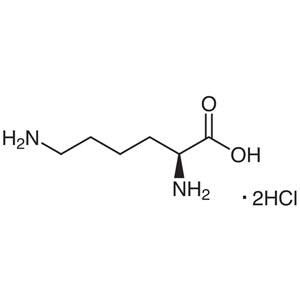
L-(+)-Lysine Dihydrochloride is the dihydrochloride salt of L-lysine, an essential amino acid in its naturally occurring configuration that serves as a protein building block in nearly all living organisms. In the dihydrochloride form, both of the amino groups on the lysine molecule are protonated and paired with chloride ions, producing a stable crystalline solid that is highly soluble in water. This format is widely chosen for analytical and biochemical work because it delivers a consistent material that is easy to weigh out and that dissolves quickly into a clear solution without requiring heating or complicated pH adjustment.
The property that makes this salt a preferred choice is its improved storage stability compared with the free base, largely because the salt form does not readily react with carbon dioxide from the surrounding air. Its high water solubility makes it straightforward to prepare concentrated stock solutions for culture media, standard solutions, or reaction mixtures. The L-configuration matches that of naturally occurring amino acids, so the material can be used directly by biological systems, while the two amino groups with their differing degrees of basicity allow selective modification once an appropriate protection strategy is applied in peptide synthesis.
In Indonesian laboratories, this material fits routine peptide chemistry and chemical biology workflows where a dependable, ready-to-dissolve amino acid source is needed. It suits academic research groups, quality control benches, and biotechnology laboratories that prepare amino acid standards, supplement culture media, or build reaction mixtures on a regular basis. Because the salt weighs out consistently and dissolves without heating, it supports reproducible preparation even in laboratories working across multiple operators and shifts.
TCI brochures (PDF)
- Amino Acids and Peptide Synthesis Reagents 2025-08-14 · p. 4
- Peptide synthesis building block: the two amino groups differ in basicity, allowing selective modification of one site once an appropriate protection strategy has been applied to the molecule.
- Culture media supplementation: the high water solubility allows concentrated stock solutions to be prepared quickly, and the natural L-configuration means biological systems can use the amino acid directly.
- Amino acid standard solution preparation: the crystalline salt is easy to weigh accurately and dissolves into a clear solution without heating, supporting consistent analytical standards.
- Biochemical reaction mixtures: the material dissolves rapidly without complicated pH adjustment, which simplifies the assembly of reaction mixtures that require a defined lysine component.
- Chemical biology research work: better storage stability than the free base gives researchers a consistent starting material across long study periods and repeated experimental runs.
| Brand | TCI |
|---|---|
| CAS number | 657-26-1 |
| Molecular formula | — |
| Purity | — |
| Category | Chemistry > Chemical Biology > Peptide Chemistry |
| Pack sizes | — |
| Physical form | crystalline solid, highly soluble in water |
| Storage | store in a closed container under normal laboratory storage conditions; pack sizes available on request |
- Catalogue number: L0131
Store L-(+)-Lysine Dihydrochloride in its original tightly closed container in a cool, dry place away from moisture, since the high water solubility of the salt means the solid readily takes up atmospheric humidity. Glass or chemically compatible plastic containers with well-sealed closures are suitable for both the bulk solid and any prepared stock solutions. The salt form is less prone to reacting with carbon dioxide from the air than the free base, but the container should still be closed promptly after each use. Handle the material with standard laboratory precautions: wear a laboratory coat, gloves, and eye protection, weigh the powder in a well-ventilated area or fume hood to avoid dust generation, and keep the weighing area clean to prevent cross-contamination between reagents. Always consult the manufacturer's safety data sheet before first use.
—
Product Categories
Produk Terkait
-
DL-LysineDihydrochloride TCI L0130
Regular price Rp 5.672.100,00Regular price -
D-Lysine TCI L0173
Regular price Rp 3.287.550,00Regular price -
L-(+)-Lysine TCI L0129
Regular price From Rp 823.200,00Regular price -
D-(-)-LysineMonohydrochloride TCI L0128
Regular price From Rp 823.200,00Regular price -
L-(+)-LysineMonohydrochloride TCI L0071
Regular price From Rp 477.750,00Regular price -
DL-LysineMonohydrochloride TCI L0070
Regular price From Rp 1.220.100,00Regular price -
L-LysineMethylEsterDihydrochloride TCI L0202
Regular price From Rp 1.140.300,00Regular price -
D-LysineMethylEsterDihydrochloride TCI L0201
Regular price From Rp 1.749.300,00Regular price