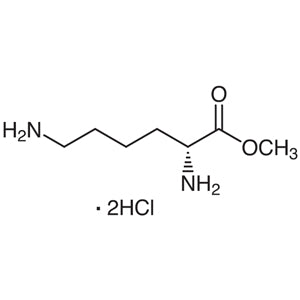
L-Lysine Methyl Ester Dihydrochloride is a chemical compound widely used in laboratory settings for its versatility in chemical and biochemical experiments. This compound plays a crucial role in peptide chemistry and biokimia research, serving as a key building block for the synthesis of various organic compounds. Its unique molecular structure, featuring an ester group and hydrochloride ions, contributes to its reactivity and stability, making it an essential reagent in many synthetic processes. Due to its chemical properties, it is frequently employed in the development of new pharmaceuticals and bioactive molecules.
The compound is favored for its solubility in organic solvents such as ethyl acetate and ethanol, which simplifies its use in chemical reactions. Its stability under various experimental conditions ensures consistent results, making it a reliable choice for researchers. Additionally, its ability to interact with other molecules as both a substrate and a catalyst enhances its applicability in diverse biochemical applications. These properties make it an indispensable tool in both academic and industrial research environments.
In Indonesian laboratories, L-Lysine Methyl Ester Dihydrochloride is commonly used in scientific research conducted at universities and research institutions. It is particularly valuable in biochemical studies and the synthesis of organic compounds. Its availability and reliability make it a preferred choice for researchers aiming to conduct precise and reproducible experiments. Its role in advancing scientific knowledge in Indonesia underscores its importance in the field of chemical and biological research.
TCI brochures (PDF)
- Amino Acids and Peptide Synthesis Reagents 2025-08-14 · p. 26
Related TCI products
- TCI L0201 67396-08-1 D-Lysine Methyl Ester Dihydrochloride
- TCI L0131 657-26-1 L-(+)-Lysine Dihydrochloride
- TCI L0130 617-68-5 DL-Lysine Dihydrochloride
- TCI H1213 4467-54-3 D-Histidine Methyl Ester Dihydrochloride
- TCI H0977 7389-87-9 L-Histidine Methyl Ester Dihydrochloride
- TCI L0228 34015-48-0 DL-Lysine Methyl Ester Dihydrochloride
- Peptide Synthesis: This compound is ideal for peptide chemistry due to its ester functionality, which facilitates coupling reactions in solid-phase peptide synthesis.
- Biochemical Research: Its reactivity and solubility make it suitable for biochemical experiments involving enzyme activity and protein modification studies.
- Organic Synthesis: The compound is widely used in the synthesis of various organic molecules due to its stability and compatibility with different reaction conditions.
- Drug Development: It serves as a precursor in the development of pharmaceutical compounds, particularly in the design of bioactive molecules.
- Analytical Chemistry: Its distinct chemical properties make it useful in analytical techniques such as HPLC and mass spectrometry for compound identification.
| Brand | TCI |
|---|---|
| CAS number | 26348-70-9 |
| Molecular formula | — |
| Purity | — |
| Category | Chemistry > Chemical Biology > Peptide Chemistry |
| Pack sizes | Available in various quantities as per supplier specifications |
| Physical form | Solid powder |
| Storage | Store in a cool, dry place away from moisture and direct sunlight |
L-Lysine Methyl Ester Dihydrochloride should be stored in a cool, dry environment to maintain its chemical integrity. It is recommended to keep the compound in a sealed container to prevent exposure to moisture and air, which can affect its stability. Suitable storage containers include glass or high-density polyethylene (HDPE) bottles with tight-fitting lids. Due to its chemical nature, it is important to handle the compound with appropriate personal protective equipment, such as gloves and safety goggles, to ensure laboratory safety. Avoid contact with incompatible substances and ensure proper ventilation in the workspace. Regular monitoring of storage conditions will help preserve the compound's quality and effectiveness for research applications.
—
Product Categories
Produk Terkait
-
D-LysineMethylEsterDihydrochloride TCI L0201
Regular price From Rp 1.801.800,00Regular priceRp 1.275.750,00Sale price From Rp 1.801.800,00 -
L-(+)-LysineDihydrochloride TCI L0131
Regular price Rp 1.326.150,00Regular priceRp 942.900,00Sale price Rp 1.326.150,00 -
DL-LysineDihydrochloride TCI L0130
Regular price Rp 5.724.600,00Regular priceRp 4.018.350,00Sale price Rp 5.724.600,00 -
D-HistidineMethylEsterDihydrochloride TCI H1213
Regular price From Rp 1.167.600,00Regular priceRp 831.600,00Sale price From Rp 1.167.600,00 -
L-HistidineMethylEsterDihydrochloride TCI H0977
Regular price Rp 1.008.000,00Regular priceRp 720.300,00Sale price Rp 1.008.000,00 -
DL-LysineMethylEsterDihydrochloride TCI L0228
Regular price From Rp 1.351.350,00Regular priceRp 960.750,00Sale price From Rp 1.351.350,00 -
Nalpha,Nepsilon-Bis[(9H-fluoren-9-ylmethoxy)carbonyl]-L-lysine TCI B4931
Regular price From Rp 1.060.500,00Regular priceRp 757.050,00Sale price From Rp 1.060.500,00 -
Nepsilon-(tert-Butoxycarbonyl)-Nalpha-[(9H-fluoren-9-ylmethoxy)carbonyl]-L-lysine TCI B3072
Regular price Rp 1.167.600,00Regular priceRp 831.600,00Sale price Rp 1.167.600,00