

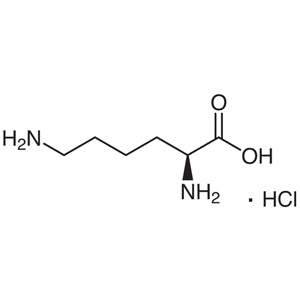
L-(+)-Lysine Monohydrochloride is a chemical compound widely used in various chemical and biochemical experiments. As an essential amino acid, it plays a crucial role in protein synthesis, drug development, and biochemical research. This compound is commonly utilized in laboratories for the production of complex substances or as a raw material in specific chemical reactions. Its chemical stability and solubility in water make it a reliable choice for a wide range of laboratory applications. Due to its non-toxic nature and low reactivity with other chemicals, it is considered safe for use in diverse laboratory conditions.
L-(+)-Lysine Monohydrochloride is known for its chemical stability, solubility in water, and non-toxic properties. These characteristics make it a preferred choice for researchers and scientists working in biochemical and pharmaceutical laboratories. Its ability to remain stable under various conditions ensures consistent results in experiments. Additionally, its solubility in water simplifies the preparation of solutions, making it convenient for use in different experimental setups. The compound’s inert nature also reduces the risk of unwanted side reactions, enhancing the reliability of laboratory procedures.
In Indonesian laboratories, L-(+)-Lysine Monohydrochloride is commonly used in life sciences, pharmaceutical, and food chemistry research. It is relied upon by research institutions and universities for experiments requiring high-quality chemical reagents. Its versatility and reliability make it an essential component in various scientific studies, supporting advancements in both academic and industrial research.
- Protein synthesis experiments benefit from this compound as it serves as a building block for constructing complex protein structures.
- Drug development research utilizes it as a key component in the formulation of pharmaceutical compounds and bioactive molecules.
- Biochemical studies rely on its stability and solubility to ensure accurate and reproducible results in enzyme and metabolic pathway analyses.
- Food chemistry applications use it as a raw material for the production of amino acid-based food additives and nutritional supplements.
- Analytical chemistry procedures incorporate it as a standard reference material for quantitative and qualitative analysis in chromatography and spectroscopy.
| Brand | TCI |
|---|---|
| CAS number | 657-27-2 |
| Molecular formula | — |
| Purity | — |
| Category | Chemistry > Chemical Biology > Peptide Chemistry |
| Pack sizes | Available in various quantities to suit different laboratory needs |
| Physical form | White crystalline powder |
| Storage | Store in a cool, dry place away from moisture and direct sunlight |
L-(+)-Lysine Monohydrochloride should be stored in a cool, dry environment to maintain its chemical stability. It is recommended to keep the compound in airtight containers to prevent moisture absorption, which could affect its solubility and purity. Due to its non-toxic nature, it is generally safe to handle, but standard laboratory precautions should still be followed, such as wearing gloves and safety goggles. It should be stored away from incompatible materials to avoid any potential chemical interactions. Proper labeling of storage containers is essential to ensure safe handling and prevent accidental misuse in the laboratory.
—
Product Categories
Produk Terkait
-
D-(-)-LysineMonohydrochloride TCI L0128
Regular price From Rp 823.200,00Regular price -
DL-LysineMonohydrochloride TCI L0070
Regular price From Rp 1.220.100,00Regular price -
D-Lysine TCI L0173
Regular price Rp 3.287.550,00Regular price -
L-(+)-LysineDihydrochloride TCI L0131
Regular price Rp 1.273.650,00Regular price -
DL-LysineDihydrochloride TCI L0130
Regular price Rp 5.672.100,00Regular price -
L-(+)-Lysine TCI L0129
Regular price From Rp 823.200,00Regular price -
Nalpha,Nepsilon-Bis[(9H-fluoren-9-ylmethoxy)carbonyl]-L-lysine TCI B4931
Regular price From Rp 1.008.000,00Regular price -
Nepsilon-(tert-Butoxycarbonyl)-Nalpha-[(9H-fluoren-9-ylmethoxy)carbonyl]-L-lysine TCI B3072
Regular price Rp 1.115.100,00Regular price


![78081-87-5 Nalpha,Nepsilon-Bis[(9H-fluoren-9-ylmethoxy)carbonyl]-L-lysine - AMI Scientific](http://amiscientific.com/cdn/shop/files/TCI2510B4931.jpg?v=1769180094&width=533)
![71989-26-9 Nepsilon-(tert-Butoxycarbonyl)-Nalpha-[(9H-fluoren-9-ylmethoxy)carbonyl]-L-lysine - AMI Scientific](http://amiscientific.com/cdn/shop/files/TCI2510B3072.jpg?v=1768204181&width=533)
![71989-26-9 Nepsilon-(tert-Butoxycarbonyl)-Nalpha-[(9H-fluoren-9-ylmethoxy)carbonyl]-L-lysine - AMI Scientific](http://amiscientific.com/cdn/shop/files/TCI2510B3072_4b5e842c-a4b3-4909-8dc2-14a7d17533e7.jpg?v=1768359590&width=533)