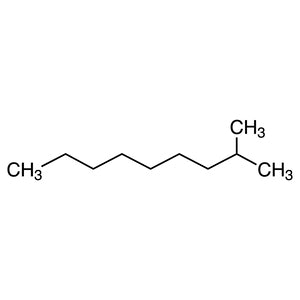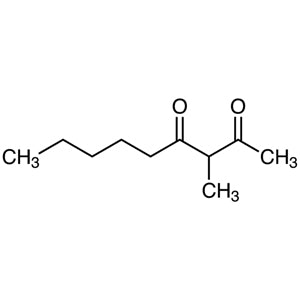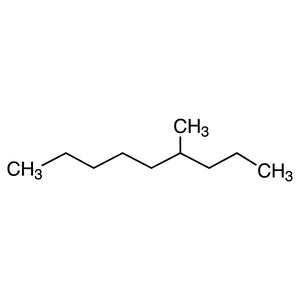
TCI M0283 is 4-Methylnonane, a branched isomer of decane carrying a methyl group on the fourth carbon atom of the chain. The compound completes the series of methylnonane isomers that laboratories use to map the retention behaviour of branched hydrocarbons. As the branch point shifts progressively toward the centre of the chain, the molecular shape becomes more compact and the way the molecule interacts with the stationary phase of a chromatographic column changes accordingly. Analysts rely on this systematic progression to read hydrocarbon mixture chromatograms more accurately and to confirm that peak assignments have not been made in error.
The property that gives this compound its value is the purity of its identity as a single, well-defined isomer. In hydrocarbon analysis, misidentification between closely related isomers is a common source of analytical error, and having a discrete standard available for each branch position directly reduces that risk. The compound is nonpolar, inert toward common reagents under ordinary laboratory conditions, insoluble in water, and readily soluble in hydrocarbon solvents. Its chemical stability means that prepared standard solutions remain usable over a reasonable working period without concern that degradation will shift the stated concentration.
In Indonesian laboratories, 4-Methylnonane is typically handled in the same workflows as the rest of the methylnonane series: preparing calibration standards, verifying column performance, and supporting hydrocarbon identification work in petroleum, environmental, and academic research settings. Because it belongs to the non-heterocyclic building block category, it also serves as a defined starting material in synthetic work where a specific branched alkane skeleton is required.
- Gas chromatography retention index work, where the compound serves as one discrete point in the methylnonane isomer series used to calibrate and interpret branched hydrocarbon retention behaviour.
- Peak identification confirmation in hydrocarbon mixture analysis, where a single-isomer standard eliminates the ambiguity that commonly arises when several branched isomers elute near one another.
- Preparation of calibration standard solutions, supported by the compound's chemical stability, which allows prepared solutions to be used over a reasonable period without concentration drift from degradation.
- Column and stationary phase evaluation, since the systematic shift in interaction as the branch position moves toward the chain centre provides a sensitive probe of separation performance.
- Non-heterocyclic building block applications in organic synthesis, where a defined branched alkane skeleton with a methyl group at the fourth carbon is required as starting material.
| Brand | TCI |
|---|---|
| CAS number | 17301-94-9 |
| Molecular formula | — |
| Purity | — |
| Category | Chemistry > Building Blocks > Non-Heterocyclic Building Blocks |
| Pack sizes | available in the standard TCI catalogue pack sizes; please confirm the required size when ordering |
| Physical form | nonpolar liquid hydrocarbon; insoluble in water, soluble in hydrocarbon solvents |
| Storage | keep tightly closed in a cool, well-ventilated area away from ignition sources |
- Product code: M0283
Store the container tightly closed in a cool, dry, and well-ventilated area, away from heat, open flame, and other sources of ignition, as branched alkanes of this type are volatile and flammable. Original manufacturer packaging or amber glass bottles with solvent-resistant closures are suitable; avoid containers that may be attacked by hydrocarbon solvents. Handle in a fume hood to limit vapour inhalation, and wear safety glasses, a laboratory coat, and chemically resistant gloves. Ground containers when transferring larger volumes to prevent static discharge, keep the compound separated from strong oxidising agents, and ensure prepared standard solutions are labelled with preparation date and concentration.
—
Produk Terkait
-
5-Methylnonane TCI M0284
Regular price Rp 16.509.150,00Regular price -
3-Methylnonane TCI M0282
Regular price Rp 11.130.000,00Regular price -
2-Methylnonane TCI M0281
Regular price Rp 3.155.250,00Regular price -
2,2,4,4,6,8,8-Heptamethylnonane TCI H0365
Regular price From Rp 823.200,00Regular price -
3-Methylnonane-2,4-dione TCI M3277
Regular price From Rp 2.279.550,00Regular price -
4-MethylnonanoicAcid TCI M2380
Regular price From Rp 1.644.300,00Regular price -
Undecylcyclohexane TCI U0037
Regular price Rp 6.599.250,00Regular price -
Undecane TCI U0002
Regular price From Rp 505.050,00Regular price