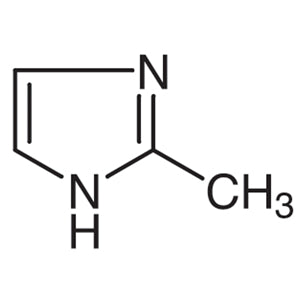
TCI M0345 2-Methylimidazole is a heterocyclic building block that occupies a special place in the modern laboratory because it is used across disciplines, from classical organic synthesis to the engineering of porous materials. The compound consists of a five-membered imidazole ring carrying a methyl group at the two position, which gives it one Lewis-basic nitrogen ready to coordinate with metal ions and one hydrogen-bearing nitrogen that can be deprotonated. It is this combination of two distinct nitrogen environments within a single small ring that makes the molecule one of the most widely used organic ligands in the preparation of metal-organic frameworks, commonly abbreviated as MOFs.
The property that makes this material so sought after is its ability to bridge metal ions at bond angles resembling those found in zeolites, producing zeolitic imidazolate frameworks such as ZIF-8 with ordered pore structures, large surface areas, and good thermal stability. The synthesis of such frameworks is comparatively straightforward and can be carried out at room temperature in methanol or aqueous media, which places the work within reach of many laboratories rather than restricting it to specialist facilities. Beyond materials science, the basic and nucleophilic character of the imidazole ring allows it to act effectively as a curing accelerator for epoxy resins and as a precursor to imidazolium salts.
In Indonesian laboratories, 2-Methylimidazole is typically encountered in university research groups and institutional laboratories working on porous materials, adsorption, catalysis, and organic synthesis. Because framework preparation using this ligand proceeds under mild conditions and ordinary solvents, it suits the equipment commonly available in teaching and research laboratories across the country. It is also used in polymer and coating laboratories where epoxy formulation work is carried out, and as a reagent held in general synthetic stock for building heterocyclic structures.
- Metal-organic framework synthesis: the molecule bridges metal ions with zeolite-like bond angles, forming ordered, thermally stable porous frameworks that are central to adsorption and separation research.
- ZIF-8 preparation: framework formation proceeds at room temperature in methanol or water, giving laboratories a reproducible route to a high-surface-area material without specialised high-pressure equipment.
- Epoxy resin curing: the basic and nucleophilic imidazole ring accelerates hardening of epoxy systems, making it useful in polymer, adhesive, and protective coating formulation work.
- Imidazolium salt preparation: the deprotonatable nitrogen and coordinating nitrogen make it a practical precursor for ionic liquids and imidazolium-based reagents used in further chemistry.
- Heterocyclic organic synthesis: as a compact building block it introduces a substituted imidazole unit into larger target molecules during classical synthetic and methodology studies.
| Brand | TCI |
|---|---|
| CAS number | 693-98-1 |
| Molecular formula | — |
| Purity | — |
| Category | Chemistry > Building Blocks > Heterocyclic Building Blocks |
| Pack sizes | available in standard TCI research-scale packaging; please confirm the size required when ordering |
| Physical form | — |
| Storage | keep in a cool, dry place in the tightly closed original container |
- Catalogue code: M0345
Store the container tightly closed in a cool, dry, and well-ventilated area, away from moisture, strong acids, and oxidising agents. The original supplier container is the most suitable vessel for long-term storage; if transferred, use a clean, chemically compatible, tightly sealing container that is clearly labelled with the substance name and CAS number. Handle the solid inside a fume hood or under adequate ventilation to avoid dust formation, and wear a laboratory coat, safety goggles, and chemically resistant gloves. Avoid contact with skin and eyes, do not inhale dust, and wash hands thoroughly after handling. Consult the manufacturer's safety data sheet before use and follow institutional procedures for chemical waste disposal.
—
Product Categories
- Organic-Inorganic Hybrid MaterialsMetal Organic Frameworks (MOF) and Their Raw MaterialsOrganic Linker Molecules [Metal Organic Frameworks (MOFs) Precursors]
- Polymer/Macromolecule ReagentsMetal Organic Frameworks (MOF) and Their Raw MaterialsOrganic Linker Molecules [Metal Organic Frameworks (MOFs) Precursors]
Produk Terkait
-
1-Benzyl-2-methylimidazole TCI B0867
Regular price Rp 2.306.850,00Regular price -
1-Methylimidazole-2-carboxaldehyde TCI M2176
Regular price From Rp 980.700,00Regular price -
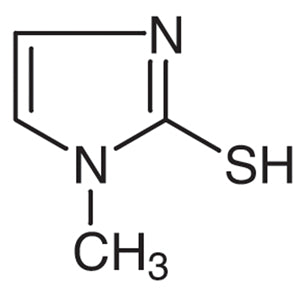
2-Mercapto-1-methylimidazole TCI M0868
Regular price Rp 2.147.250,00Regular price -
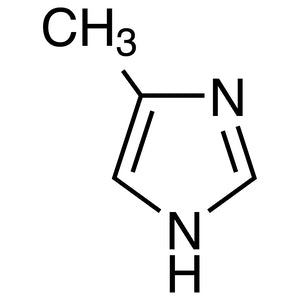
4-Methylimidazole TCI M0636
Regular price From Rp 1.060.500,00Regular price -
1-Methylimidazole TCI M0508
Regular price From Rp 505.050,00Regular price -
2-Hydroxymethyl-1-methylimidazole TCI H1370
Regular price From Rp 505.050,00Regular price -
4-Hydroxymethyl-5-methylimidazole TCI H0976
Regular price From Rp 2.121.000,00Regular price -
4-Hydroxymethyl-5-methylimidazoleHydrochloride TCI H0625
Regular price Rp 743.400,00Regular price