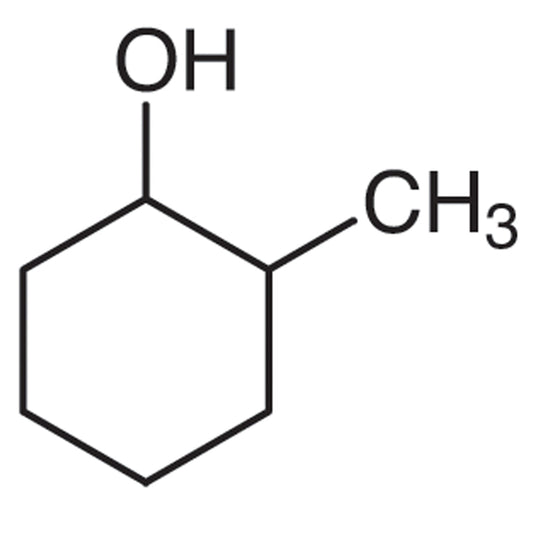
TCI M0351 cis-2-Methylcyclohexanol is a cyclohexane-based alcohol carrying a methyl group at the two position, supplied in a defined *cis* configuration. For organic chemistry laboratories, that configurational clarity is the main value: the hydroxyl group and the methyl group sit on the same face of the ring plane, which makes the compound a precise model for studying the relationship between ring geometry and reactivity. It serves as a non-heterocyclic building block, as a model substrate for reaction studies, and at the same time as a comparison standard in chromatographic analysis.
The property that drives its selection is its characteristic conformational behaviour. In the *cis* isomer, one of the two substituents always occupies an axial position in either chair conformation, so the compound experiences steric hindrance that differs from that of its *trans* counterpart. That difference shows up clearly in the rates of oxidation, esterification, and substitution reactions, as well as in the outcome of elimination reactions that demand an anti-periplanar arrangement. Because the difference is subtle yet consistent, the compound serves as an honest test tool for probing mechanistic hypotheses.
The material is a liquid at room temperature. In Indonesian laboratories it is drawn on mainly by university organic chemistry groups and research institutes, where it supports stereochemistry teaching, mechanistic investigations, and method development work. Analytical laboratories keep it on hand as a reference point when resolving isomer pairs, while synthesis groups use it where a stereochemically defined cyclohexanol scaffold is required as a starting material.
Related TCI products
- TCI M0194 583-59-5 2-Methylcyclohexanol (cis- and trans- mixture)
- TCI T2693 116-02-9 cis-3,3,5-Trimethylcyclohexanol (contains ca. 20% trans- isomer)
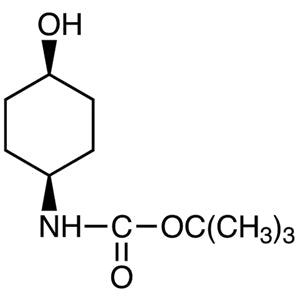
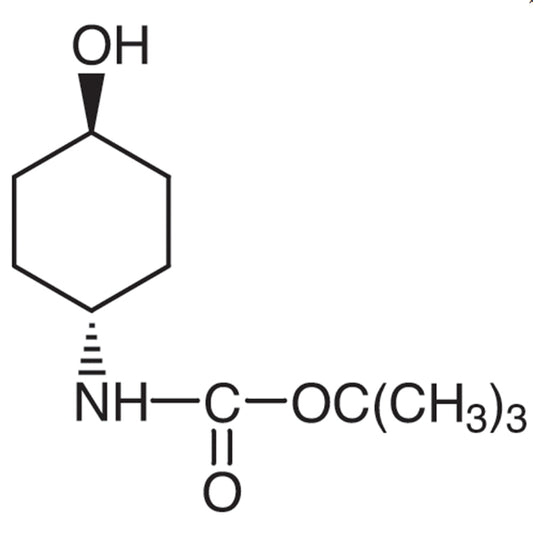
- TCI B5367 167081-25-6 cis-4-(tert-Butoxycarbonylamino)cyclohexanol
- TCI B4714 224309-64-2 4-(tert-Butoxycarbonylamino)cyclohexanol
- TCI B3564 111300-06-2 trans-4-(tert-Butoxycarbonylamino)cyclohexanol
- TCI B1930 70568-60-4 4-Butylcyclohexanol (cis- and trans- mixture)
- Stereochemistry teaching and demonstration: the defined *cis* configuration lets students observe directly how substituent orientation on a ring governs reactivity rather than reading about it abstractly.
- Mechanistic reaction studies: the fixed axial placement of one substituent produces reproducible rate differences, making the compound a reliable probe for testing proposed reaction mechanisms.
- Chromatographic reference standard: as a stereochemically defined comparison compound, it helps analysts assign and resolve closely eluting methylcyclohexanol isomer peaks with confidence.
- Non-heterocyclic building block in synthesis: the compound supplies a ready cyclohexanol scaffold with established stereochemistry for onward functionalisation in multi-step preparations.
- Oxidation, esterification, and elimination method development: its distinctive steric environment makes it a demanding substrate for evaluating how well a new procedure tolerates hindered secondary alcohols.
| Brand | TCI (Tokyo Chemical Industry) |
|---|---|
| CAS number | 7443-70-1 |
| Molecular formula | — |
| Purity | — |
| Category | Chemistry > Building Blocks > Non-Heterocyclic Building Blocks |
| Pack sizes | available in the standard TCI catalogue pack sizes; please confirm the size required when ordering |
| Physical form | liquid at room temperature |
| Storage | keep in the tightly closed original container in a cool, well-ventilated place |
- Product code: M0351
Store the container tightly closed in a cool, dry, well-ventilated area away from heat sources, open flames, and direct sunlight, and keep it separated from strong oxidising agents. The original supplier packaging is the preferred container; where transfer is necessary, use chemically compatible glassware with a secure closure and label it clearly. Handle in a fume hood and wear safety glasses, gloves, and a laboratory coat. Avoid inhaling vapours and prevent contact with skin and eyes. Close the container immediately after each use to limit evaporation and moisture uptake, and consult the manufacturer's safety data sheet before first use and for disposal guidance.
—
Produk Terkait
-
2-Methylcyclohexanol(cis-andtrans-mixture) TCI M0194
Regular price From Rp 505.050,00Regular priceRp 352.800,00Sale price From Rp 505.050,00 -
cis-3,3,5-Trimethylcyclohexanol(containsca.20%trans-isomer) TCI T2693
Regular price From Rp 637.350,00Regular priceRp 460.950,00Sale price From Rp 637.350,00 -
cis-4-(tert-Butoxycarbonylamino)cyclohexanol TCI B5367
Regular price Rp 2.199.750,00Regular priceRp 1.554.000,00Sale price Rp 2.199.750,00 -
4-(tert-Butoxycarbonylamino)cyclohexanol TCI B4714
Regular price From Rp 610.050,00Regular priceRp 442.050,00Sale price From Rp 610.050,00 -
trans-4-(tert-Butoxycarbonylamino)cyclohexanol TCI B3564
Regular price From Rp 1.881.600,00Regular priceRp 1.331.400,00Sale price From Rp 1.881.600,00 -
4-Butylcyclohexanol(cis-andtrans-mixture) TCI B1930
Regular price From Rp 3.498.600,00Regular priceRp 2.462.250,00Sale price From Rp 3.498.600,00 -
4,4'-Bicyclohexanol(mixtureofisomers) TCI B1621
Regular price From Rp 1.618.050,00Regular priceRp 1.146.600,00Sale price From Rp 1.618.050,00 -
trans-4-tert-Butylcyclohexanol TCI B1271
Regular price From Rp 4.771.200,00Regular priceRp 3.351.600,00Sale price From Rp 4.771.200,00