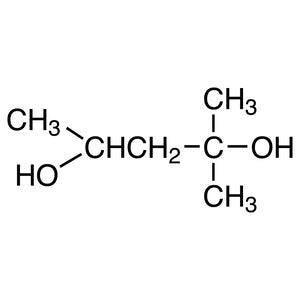
TCI M0384 2-Methylpentane-2,4-diol, more widely known as hexylene glycol or MPD, is an aliphatic diol supplied as a viscous liquid, carrying two hydroxyl groups at the 2 and 4 positions of a branched five-carbon chain. The combination of polar hydroxyl groups and a branched carbon skeleton gives the compound a dual character: it dissolves readily in water while remaining miscible with a wide range of organic solvents. In the laboratory it serves as a versatile solvent, a surface-property modifier, and — most recognisably — as a precipitating agent in protein crystallisation for structural biology work.
The characteristics that make this material a preferred choice are its amphiphilic nature, its relatively high boiling point, its moderate viscosity, and its ability to lower the water activity surrounding macromolecules in a gradual, controlled manner. In protein crystallisation, these properties allow protein molecules to reach supersaturation slowly, so that well-ordered single crystals form instead of amorphous precipitate. The compound also acts as a cryoprotectant, which means crystals can be flash-frozen directly for X-ray diffraction measurement without the formation of damaging ice. Its hygroscopic behaviour must be taken into account, since absorbed moisture affects the effective concentration of prepared solutions.
In Indonesian laboratories, this grade is typically used by structural biology and biochemistry groups running crystallisation screens, as well as by analytical and formulation laboratories that need a high-boiling, water-miscible co-solvent. It appears in academic research units, university laboratories, and institutional research facilities where reproducible screening conditions matter. Because the material is drawn from screening stocks repeatedly over long projects, laboratories generally favour a controlled supply of consistent quality rather than frequent substitution between sources.
- Protein crystallisation screening — as a precipitating agent it gradually reduces water activity around macromolecules, guiding proteins into slow supersaturation that yields ordered single crystals rather than amorphous precipitate.
- Cryoprotection of protein crystals — the compound allows harvested crystals to be flash-frozen directly for X-ray diffraction measurement without ice formation that would otherwise damage the crystal lattice and degrade diffraction quality.
- Versatile laboratory solvent work — its simultaneous solubility in water and miscibility with many organic solvents makes it useful wherever a bridging, water-miscible medium is required for preparation and dissolution steps.
- Surface-property adjustment in formulation studies — the amphiphilic structure, combining polar hydroxyl groups with a branched hydrophobic skeleton, allows it to act as a surface-active modifier in prepared laboratory systems.
- Structural biology sample preparation — as a standard component of crystallisation condition matrices, it supports reproducible screening workflows where consistent reagent behaviour across repeated experiments is essential to interpreting results.
| Brand | TCI (Tokyo Chemical Industry) |
|---|---|
| CAS number | 107-41-5 |
| Molecular formula | — |
| Purity | — |
| Category | Chemistry > Building Blocks > Non-Heterocyclic Building Blocks |
| Pack sizes | available in standard TCI catalogue pack sizes — please confirm the required size when ordering |
| Physical form | viscous liquid; aliphatic diol, water-soluble and miscible with many organic solvents |
| Storage | keep tightly closed in a cool, dry place; the material is hygroscopic |
- Catalogue number: M0384
Store the container tightly closed in a cool, dry, well-ventilated area, away from direct sunlight and sources of ignition. Because the compound is hygroscopic, moisture uptake from laboratory air will change the effective concentration of prepared solutions, so containers should be opened only briefly and resealed immediately; where possible, dispense in a low-humidity environment. Use tightly sealing glass or chemically compatible plastic containers with clear labelling of contents and date of opening. Handle in a fume hood or well-ventilated area, wearing safety glasses, gloves, and a laboratory coat. Avoid contact with skin and eyes, and consult the manufacturer's safety data sheet before first use and before disposal of residues.
—
Produk Terkait
-
2,2,4,4-Tetramethylpentane TCI T1704
Regular price From Rp 1.220.100,00Regular price -
1-Bromo-4-methylpentane TCI B1017
Regular price From Rp 4.081.350,00Regular price -
2,2,3-Trimethylpentane TCI T0689
Regular price Rp 7.817.250,00Regular price -
2,3,4-Trimethylpentane TCI T0482
Regular price Rp 6.465.900,00Regular price -
3-Methylpentane TCI M0383
Regular price From Rp 955.500,00Regular price -
2-Methylpentane TCI M0382
Regular price From Rp 928.200,00Regular price -
(Z)-3-Methylpent-2-ene TCI M0311
Regular price Rp 3.498.600,00Regular price -
3-Hydroxy-2,2,4-trimethylpentylIsobutyrate(containsca40%2,2,4-Trimethyl-1,3-pentanediol3-Monoisobutyrate) TCI I0405
Regular price From Rp 505.050,00Regular price