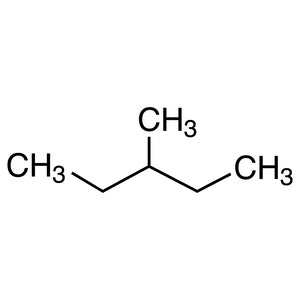
TCI M0383 3-Methylpentane is a branched saturated hydrocarbon with the molecular formula C6H14, a structural isomer of hexane in which a methyl group is attached to the third carbon atom of the main chain. This clear liquid is supplied both as a non-heterocyclic building block and as a pure hydrocarbon solvent for synthesis and analytical work. In the laboratory it serves as a highly inert non-polar solvent medium, a reference material in chromatographic measurements, and a model substrate in studies of hydrocarbon reactions such as isomerisation and catalytic cracking.
The properties that determine its selection are the combination of non-polar character, low boiling point, and a well-defined branched structure. The central position of the methyl group gives the molecule a more compact shape than n-hexane, so its intermolecular interactions differ slightly and produce a characteristic chromatographic retention time. This behaviour is particularly useful when a laboratory needs to distinguish between hexane isomers in fuel samples or petrochemical products. Maintained isomeric identity makes it an appropriate choice whenever structural certainty must be confirmed rather than assumed.
As a saturated alkane, the compound is practically unreactive toward most reagents under ordinary conditions, which is why Indonesian laboratories rely on it where an inert medium is required. It is typically found in petrochemical and fuel testing laboratories, in university research groups working on catalysis and hydrocarbon chemistry, and in analytical facilities that require a consistent reference hydrocarbon for chromatographic method development and instrument calibration work.
- Chromatographic reference standard: its distinct retention behaviour as a branched hexane isomer allows analysts to anchor peak identification and verify column performance in hydrocarbon separations.
- Non-polar solvent medium for organic synthesis: the compound dissolves non-polar substrates without participating in the reaction, keeping reaction pathways clean and interpretation straightforward for the chemist.
- Isomerisation reaction studies: as a well-defined branched alkane, it serves as a model substrate for tracking skeletal rearrangement and evaluating catalyst selectivity under controlled conditions.
- Catalytic cracking research: its simple saturated structure gives researchers a predictable starting material for examining bond cleavage patterns and product distribution over solid acid catalysts.
- Hexane isomer differentiation in fuel analysis: laboratories use it to confirm which isomer is present in gasoline fractions and petrochemical streams during quality assessment.
| Brand | TCI |
|---|---|
| CAS number | 96-14-0 |
| Molecular formula | — |
| Purity | — |
| Category | Chemistry > Building Blocks > Non-Heterocyclic Building Blocks |
| Pack sizes | available in standard TCI research and laboratory pack sizes; please confirm the packaging option required |
| Physical form | clear liquid |
| Storage | keep in a tightly closed container in a cool, well-ventilated area away from ignition sources |
Store the container tightly closed in a cool, dry, and well-ventilated area, away from heat, open flames, sparks, and other ignition sources. Use the original supplier packaging or compatible tightly sealed glass or metal containers, and keep them clearly labelled and upright to avoid leakage. All handling should take place in a fume hood, with nitrile gloves, safety goggles, and a laboratory coat worn at all times. Avoid inhaling vapour, prevent electrostatic accumulation during transfer, and keep the working area free of open flames. Consult the manufacturer's safety data sheet before first use and follow institutional chemical waste procedures for disposal.
—
Produk Terkait
-
2,2,4,4-Tetramethylpentane TCI T1704
Regular price From Rp 1.220.100,00Regular price -
2,2,3-Trimethylpentane TCI T0689
Regular price Rp 7.817.250,00Regular price -
2,3,4-Trimethylpentane TCI T0482
Regular price Rp 6.465.900,00Regular price -
2-Methylpentane TCI M0382
Regular price From Rp 928.200,00Regular price -
3-Ethyl-2-methylpentane TCI E0259
Regular price Rp 10.044.300,00Regular price -
3-Ethyl-3-methylpentane TCI E0258
Regular price Rp 5.034.750,00Regular price -
3-Ethylpentane TCI E0046
Regular price Rp 5.274.150,00Regular price -
2,2-Dimethylpentane TCI D1673
Regular price From Rp 848.400,00Regular price