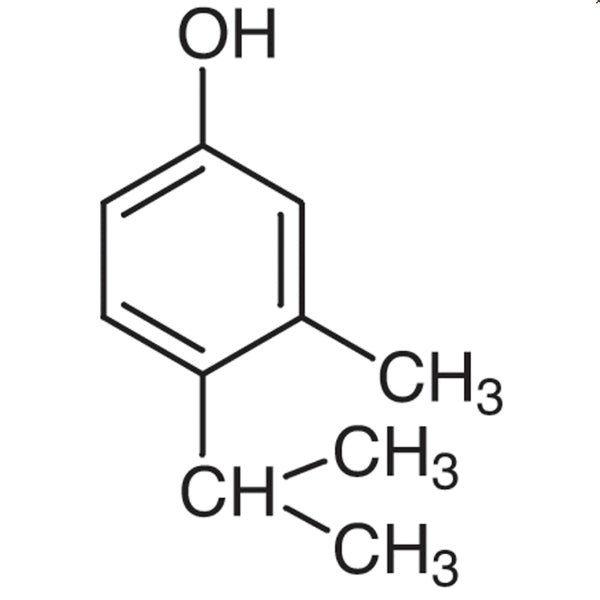
4-Isopropyl-3-methylphenol is a chemical compound widely used as a building block in various laboratory applications, particularly in the synthesis of aromatic compounds and their derivatives. This versatile reagent plays a crucial role in organic chemistry by enabling a range of chemical reactions, including substitution, oxidation, and reduction. Its presence in both industrial and research settings highlights its importance in the development of organic materials, pharmaceuticals, and food additives. Due to its structural complexity and chemical reactivity, it is a valuable tool for chemists seeking to create new compounds with specific functional groups.
The compound’s non-polar nature allows it to dissolve in organic solvents such as ethyl acetate and chloroform, making it suitable for reactions requiring specific solvent conditions. Its stable molecular structure ensures that it remains effective over extended periods, minimizing the risk of chemical degradation. This stability, combined with its reactivity, makes it a preferred choice for researchers aiming to maintain consistent results in their experiments. The compound’s ability to participate in multiple reaction types further enhances its utility in synthetic chemistry.
In Indonesian laboratories, 4-Isopropyl-3-methylphenol is commonly used in organic chemistry research, especially in the synthesis of aromatic compounds. Its availability and reliability make it a standard component in many chemical processes, supporting both academic and industrial research efforts. The compound’s widespread use underscores its importance in the chemical industry and laboratory environments across Indonesia.
- Organic synthesis of aromatic compounds due to its ability to participate in substitution and oxidation reactions.
- Development of pharmaceuticals as a building block for creating complex molecular structures.
- Production of food additives where its chemical stability and solubility in organic solvents are advantageous.
- Research in chemical engineering for creating new organic materials with specific functional groups.
- Industrial applications in the formulation of specialty chemicals requiring controlled chemical reactivity.
| Brand | TCI |
|---|---|
| CAS number | 3228-02-2 |
| Molecular formula | — |
| Purity | — |
| Category | Chemistry > Building Blocks > Non-Heterocyclic Building Blocks |
| Pack sizes | Available in various quantities as per standard laboratory supply options |
| Physical form | Liquid |
| Storage | Store in a cool, dry place away from direct sunlight |
4-Isopropyl-3-methylphenol should be stored in a cool, dry environment, away from direct sunlight and sources of heat. It is recommended to use sealed containers made of materials compatible with organic solvents to prevent evaporation and contamination. Due to its non-polar nature, it is important to handle it with appropriate personal protective equipment, such as gloves and safety goggles, to ensure safety in the laboratory. The compound should be kept in a well-ventilated area to minimize exposure to vapors. Regular monitoring of storage conditions is advised to maintain its chemical integrity and ensure safe usage in laboratory settings.
—
Produk Terkait
-
4-Chloro-2-isopropyl-5-methylphenol TCI C0294
Regular price Rp 717.150,00Regular price -
4-Triphenylmethylphenol TCI T1654
Regular price Rp 3.180.450,00Regular price -
2-Bromo-4,5-dimethylphenol TCI B5394
Regular price From Rp 3.127.950,00Regular price -
4-Bromo-3-methylphenol TCI B3658
Regular price From Rp 1.644.300,00Regular price -
4-Bromo-3,5-dimethylphenol TCI B2146
Regular price From Rp 1.087.800,00Regular price -
4-Bromo-2,6-dimethylphenol TCI B2060
Regular price From Rp 3.260.250,00Regular price -
2-tert-Butyl-4-ethylphenol TCI B1810
Regular price Rp 795.900,00Regular price -
2-Amyl-5-methylphenol TCI A2710
Regular price From Rp 1.510.950,00Regular price