

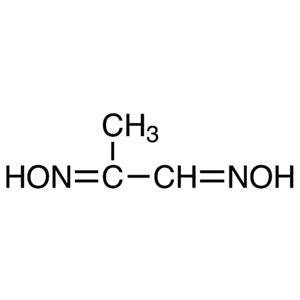
Methylglyoxime is a chemical compound widely used in laboratory settings for its versatility in organic synthesis and analytical chemistry. As a building block in the field of chemistry, it plays a crucial role in the development of complex organic molecules and metal complexes. Its simple molecular structure enables it to participate in a variety of chemical reactions, making it a valuable tool for researchers. In Indonesian laboratories, methylglyoxime is commonly used to facilitate the formation of heterocyclic compounds and metal-based complexes, contributing to both fundamental and applied research.
The chemical properties of methylglyoxime make it a preferred choice for various applications. It is known for its ability to form stable complexes with heavy metals, which is essential in quantitative and qualitative analysis. Its reactivity under different environmental conditions allows it to be used in a wide range of synthetic processes. Additionally, methylglyoxime exhibits good stability in controlled environments, ensuring consistent performance in laboratory experiments. These characteristics make it a reliable and effective reagent in both academic and industrial research settings.
In Indonesian laboratories, methylglyoxime is widely utilized in chemical research and analysis. It is commonly found in organic synthesis laboratories where it is used to construct complex molecular structures. Its role in metal complex formation also makes it a key component in analytical chemistry laboratories. Due to its stability and reactivity, methylglyoxime is an essential reagent for many experimental procedures, supporting both teaching and research activities in the chemical sciences.
- Methylglyoxime is used in organic synthesis to build complex molecular structures due to its reactivity and ability to form stable intermediates.
- It is applied in metal complex formation, where its capacity to bind with heavy metals makes it ideal for analytical and coordination chemistry experiments.
- In qualitative analysis, methylglyoxime is employed to detect and identify heavy metal ions through the formation of characteristic colored complexes.
- It is used in the synthesis of heterocyclic compounds, where its structural simplicity allows for easy integration into more complex ring systems.
- Methylglyoxime is utilized in analytical chemistry for its role in spectroscopic and chromatographic techniques, aiding in the identification of various compounds.
| Brand | TCI |
|---|---|
| CAS number | 1804-15-5 |
| Molecular formula | — |
| Purity | — |
| Category | Chemistry > Building Blocks > Non-Heterocyclic Building Blocks |
| Pack sizes | Available in various quantities as per supplier specifications |
| Physical form | Solid or liquid, depending on the specific product variant |
| Storage | Store in a cool, dry place away from direct sunlight and moisture |
Methylglyoxime should be stored in a cool, dry place, away from direct sunlight and moisture. It is recommended to keep it in a sealed container to prevent exposure to air and humidity. Due to its reactivity, it should be handled with care, using appropriate personal protective equipment such as gloves and safety goggles. Storage should be in a well-ventilated area to minimize the risk of inhalation. Avoid contact with incompatible substances, and ensure that storage conditions are consistent with standard laboratory safety protocols. Proper labeling of containers is essential to ensure safe handling and prevent accidental exposure.
—
Produk Terkait
-
DimethylglyoximeDisodiumSaltOctahydrate TCI D0730
Regular price Rp 1.908.900,00Regular price -
Dimethylglyoxime TCI D0729
Regular price From Rp 477.750,00Regular price -
Dichloro(dimethylglyoxime)(dimethylglyoximato)cobalt(III) TCI D5924
Regular price From Rp 1.829.100,00Regular price -
2-Methylglutaronitrile TCI M0331
Regular price Rp 1.167.600,00Regular price -
Dichloroglyoxime TCI D5562
Regular price From Rp 2.677.500,00Regular price


