

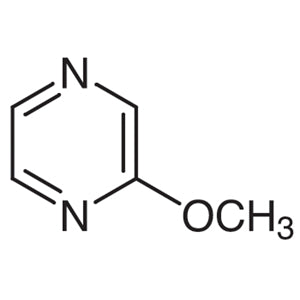
2-Methoxypyrazine is a chemical compound classified under the heterocyclic category, featuring a pyrazine ring with a methoxy group attached at a specific position. This compound plays a crucial role in laboratory settings, particularly in organic chemistry and pharmaceutical research, where it serves as a key building block for synthesizing more complex molecules. Its structural versatility allows it to participate in a wide range of chemical reactions, making it an essential tool for researchers aiming to develop new compounds with specific biological activities.
The stability and controlled reactivity of 2-Methoxypyrazine make it a preferred choice for chemical synthesis. Its ability to form stable intermediates and react selectively with various functional groups enhances its utility in the creation of diverse chemical structures. Additionally, the compound's distinct aroma can serve as a visual indicator during synthesis processes, aiding in the identification and monitoring of reactions. These properties contribute to its widespread use in both academic and industrial research environments.
In Indonesian laboratories, 2-Methoxypyrazine is commonly utilized in organic chemistry research, particularly by universities and research institutions. Its role in the development of bioactive compounds and pharmaceuticals makes it a valuable resource for scientists working on drug discovery and chemical innovation. The compound's reliability and adaptability ensure its continued relevance in the field of synthetic chemistry.
Related TCI products
- Organic synthesis: 2-Methoxypyrazine is widely used in organic synthesis due to its ability to form stable intermediates and react selectively with various functional groups.
- Pharmaceutical research: This compound is a key building block in the development of bioactive molecules, contributing to drug discovery and medicinal chemistry projects.
- Heterocyclic chemistry: Its unique structure makes it ideal for studying and synthesizing heterocyclic compounds, which are fundamental in many natural and synthetic products.
- Analytical chemistry: The distinct aroma of 2-Methoxypyrazine aids in the identification and monitoring of chemical reactions during synthesis processes.
- Educational research: It is frequently used in academic settings to teach and demonstrate the principles of chemical synthesis and functional group reactivity.
| Brand | TCI |
|---|---|
| CAS number | 3149-28-8 |
| Molecular formula | — |
| Purity | — |
| Category | Chemistry > Building Blocks > Heterocyclic Building Blocks |
| Pack sizes | Available in various quantities as per supplier specifications |
| Physical form | Solid or liquid, depending on the specific product variant |
| Storage | Store in a cool, dry place away from direct sunlight |
2-Methoxypyrazine should be stored in a cool, dry place, away from direct sunlight and sources of heat. It is recommended to use airtight containers to prevent moisture absorption and contamination. Due to its chemical nature, it should be handled in a well-ventilated area, and appropriate personal protective equipment such as gloves and safety goggles should be worn. Avoid contact with skin and eyes, and ensure proper disposal of any unused material according to local regulations. Regular monitoring of storage conditions is advised to maintain the compound's integrity and ensure safe laboratory practices.
—
Produk Terkait
-
2-sec-Butyl-3-methoxypyrazine TCI B2959
Regular price From Rp 1.060.500,00Regular price -
5-Methoxypyrazine-2-carboxylicAcid TCI M3181
Regular price From Rp 769.650,00Regular price -
2-Isopropyl-3-methoxypyrazine TCI I0577
Regular price From Rp 1.644.300,00Regular price -
2-Isobutyl-3-methoxypyrazine TCI I0331
Regular price From Rp 1.008.000,00Regular price -
2-Ethoxypyrazine TCI E0697
Regular price From Rp 505.050,00Regular price -
2-Amino-5-bromo-3-methoxypyrazine TCI A2562
Regular price Rp 1.273.650,00Regular price -
2-Methyl-3-isopropoxypyrazine TCI M0808
Regular price From Rp 795.900,00Regular price -
2-Hydroxypyrazine TCI H1580
Regular price Rp 1.485.750,00Regular price


