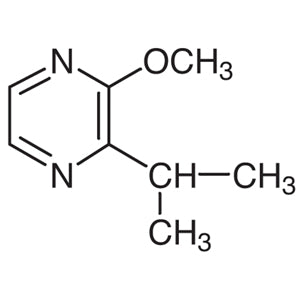
TCI I0577 2-Isopropyl-3-methoxypyrazine is a heterocyclic building block built around a pyrazine ring, a six-membered aromatic ring carrying two nitrogen atoms in opposite positions, which bears an isopropyl group and a methoxy group at adjacent positions. The compound is widely known not only as a synthetic intermediate but also as one of the most powerful naturally occurring aroma compounds, commonly associated with the smell of green vegetables, bell pepper, and green peas. In the laboratory it plays a dual role: as a reference material in aroma and flavour analysis, and as a heterocyclic scaffold for the development of new molecules.
The most prominent property, and the main reason this compound is selected, is its extremely low odour detection threshold, which allows it to be perceived by the human senses even at very small concentrations. This characteristic makes it an important marker compound in food and beverage analytical chemistry, particularly in studies of the aroma of wine, coffee, vegetables, and fermented products. From a structural standpoint, the methoxy group on the pyrazine ring is electron-donating and can be activated towards substitution, while the pyrazine ring itself is a motif that appears in many biologically relevant structures, giving synthetic chemists a reliable starting point.
In Indonesian laboratories this material is typically handled in research and quality-control settings where aroma profiling and heterocyclic synthesis are routine. It is used by food and beverage analysts preparing reference standards for chromatographic work, by university and institutional research groups exploring nitrogen heterocycles, and by product development laboratories that need a defined comparison compound. Because only very small quantities are required for sensory and analytical work, it is normally dispensed carefully from small packs.
Related TCI products
- Aroma and flavour reference standard: its very low odour detection threshold makes it a dependable comparison compound when identifying and confirming green, vegetal notes in complex sample matrices.
- Food and beverage analytical chemistry: it serves as a marker compound in studies of wine, coffee, vegetable, and fermented product aroma, where trace-level identification of characteristic notes is required.
- Heterocyclic synthesis and scaffold development: the pyrazine ring is a widely encountered motif, so the compound gives synthetic chemists a ready-made nitrogen heterocycle to elaborate further.
- Substitution chemistry on activated rings: the electron-donating methoxy group on the pyrazine ring can be activated for substitution, supporting the preparation of structurally related derivatives.
- Sensory and quality-control studies: laboratories use it as a defined comparison material when characterising green or vegetal character in raw materials and finished product batches.
| Brand | TCI (Tokyo Chemical Industry) |
|---|---|
| CAS number | 25773-40-4 |
| Molecular formula | — |
| Purity | — |
| Category | Chemistry > Building Blocks > Heterocyclic Building Blocks |
| Pack sizes | supplied in TCI catalogue pack sizes; please refer to the current listing for available options |
| Physical form | — |
| Storage | store according to the conditions stated on the manufacturer's label and safety data sheet |
- Product code: I0577
- Chemical name: 2-Isopropyl-3-methoxypyrazine
Store the container tightly closed in a cool, dry, well-ventilated area, away from heat, direct sunlight, and incompatible materials, following the conditions stated on the manufacturer's label and safety data sheet. Keep the material in its original container or in a comparable tightly sealed glass vessel, since this compound is strongly odorous and even trace amounts can contaminate surrounding work areas. Handle it in a fume hood, use gloves, safety goggles, and a laboratory coat, and dispense only the small quantities needed for the work at hand. Clean glassware and transfer tools thoroughly after use, and dispose of residues in accordance with applicable laboratory waste procedures.
—
Produk Terkait
-
2-sec-Butyl-3-methoxypyrazine TCI B2959
Regular price From Rp 1.060.500,00Regular price -
5-Methoxypyrazine-2-carboxylicAcid TCI M3181
Regular price From Rp 769.650,00Regular price -
2-Methoxypyrazine TCI M0798
Regular price Rp 1.035.300,00Regular price -
2-Isobutyl-3-methoxypyrazine TCI I0331
Regular price From Rp 1.008.000,00Regular price -
2-Ethoxypyrazine TCI E0697
Regular price From Rp 505.050,00Regular price -
2-Isopropyl-6-methylpyrimidin-4-ol TCI I1155
Regular price From Rp 664.650,00Regular price -
2-Isopropyl-4-(N-methylaminomethyl)thiazoleDihydrochloride TCI I1057
Regular price From Rp 610.050,00Regular price -
2-Isopropyl-2-oxazoline TCI I0642
Regular price Rp 3.446.100,00Regular price