TCI M0974 Benzyl Methyl Malonate is a malonic acid diester that carries two different protecting groups: a benzyl group on one carboxyl terminus and a methyl group on the other. This difference is not incidental but a deliberate design feature, because the two groups can be removed by methods that do not interfere with one another. In the organic synthesis laboratory, this material serves as a two-carbon carrier unit ready to be inserted into the framework of a target molecule, while at the same time acting as a source of nucleophilic carbon that is easily generated through deprotonation at the methylene position situated between the two ester groups.
The principal advantage of this compound lies in the orthogonality of its protecting groups. The benzyl ester can be removed by hydrogenolysis over a palladium catalyst under neutral conditions, whereas the methyl ester is conventionally hydrolysed under basic conditions. This freedom to choose the order of deprotection is precisely what makes the material so valuable in long, multi-step syntheses, particularly when a chemist needs to liberate only one carboxylate function for further reaction. The proton at the position between the two carbonyl groups is sufficiently acidic that alkylation and condensation can be carried out with relatively mild bases.
In Indonesian laboratories, Benzyl Methyl Malonate is typically encountered in university and institutional research groups working on organic synthesis, in medicinal chemistry programmes that build molecular skeletons step by step, and in method development work where selective deprotection is required. It is ordinarily handled at the bench scale in the synthesis laboratory, drawn from a small stock kept alongside other building blocks, and used by researchers who need a differentiated malonate rather than a symmetric one.
Related TCI products
- Multi-step organic synthesis: the differentiated diester allows a chemist to carry both carboxyl functions through a sequence and unmask only one of them when the route requires it.
- Selective deprotection studies: benzyl removal by palladium-catalysed hydrogenolysis under neutral conditions and methyl removal by basic hydrolysis give two independent, non-interfering exit points from the same molecule.
- Carbon chain extension: the compound acts as a two-carbon carrier unit that can be inserted into the framework of a target molecule during skeleton construction work.
- Alkylation chemistry: the acidic proton on the methylene carbon between the two ester carbonyls is readily deprotonated with relatively mild bases to generate a nucleophilic carbon centre.
- Condensation reactions: the same easily generated malonate anion serves as the nucleophilic partner in condensation chemistry, making this a practical building block for constructing larger molecules.
| Brand | TCI (Tokyo Chemical Industry) |
|---|---|
| CAS number | 52267-39-7 |
| Molecular formula | — |
| Purity | — |
| Category | Chemistry > Building Blocks > Non-Heterocyclic Building Blocks |
| Pack sizes | available in the standard TCI catalogue pack sizes; please confirm the size required when ordering |
| Physical form | — |
| Storage | keep in a cool place in the tightly closed original container |
- Catalogue Number: M0974
Store the container in a cool, dry place, well closed and protected from prolonged exposure to air and moisture. The original manufacturer's container is the most suitable vessel; if the material must be transferred, use clean, dry, chemically compatible glassware and reseal promptly. Handle in a well-ventilated area or a fume hood, wearing safety glasses, gloves and a laboratory coat, and avoid contact with skin, eyes and clothing. Keep the material away from strong bases and other incompatible reagents, since the methylene proton is acidic and the ester functions are susceptible to hydrolysis. Label all secondary containers clearly and consult the manufacturer's safety data sheet before first use.
—
Produk Terkait
-
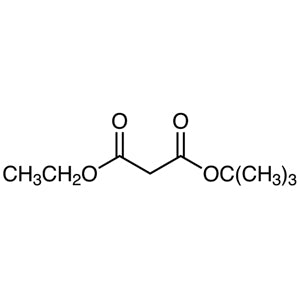
tert-ButylEthylMalonate TCI B3720
Regular price From Rp 928.200,00Regular price -
tert-ButylMethylMalonate TCI B2747
Regular price From Rp 1.670.550,00Regular price -
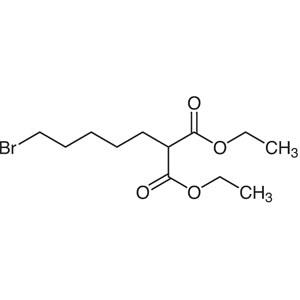
Diethyl(5-Bromopentyl)malonate TCI B2083
Regular price From Rp 2.254.350,00Regular price -
Diethyl2,2-Bis(hydroxymethyl)malonate TCI B1492
Regular price From Rp 3.021.900,00Regular price -
MonoethylMalonate TCI M2700
Regular price From Rp 1.246.350,00Regular price -
Mono-tert-butylMalonate TCI M2687
Regular price From Rp 1.193.850,00Regular price -
MonomethylPotassiumMalonate TCI M2149
Regular price From Rp 1.724.100,00Regular price -
Di-tert-butylMalonate TCI M1522
Regular price Rp 1.856.400,00Regular price