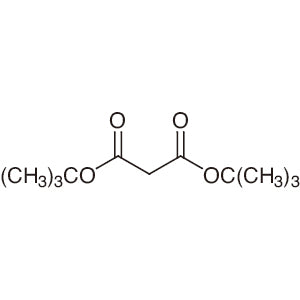
Di-tert-butyl malonate is a chemical compound widely used as a foundational building block in organic synthesis. It serves as a versatile reagent in laboratory settings, enabling the creation of complex organic molecules through various chemical reactions. Its unique molecular structure, featuring a malonate backbone flanked by tert-butyl groups, makes it a valuable tool for chemists working on synthetic pathways. This compound is particularly useful in reactions that require controlled reactivity and stability, making it a key component in modern synthetic chemistry.
One of the main reasons Di-tert-butyl malonate is preferred is its reactivity and compatibility with a range of chemical environments. It is known for its ability to participate in alkylating reactions and other synthetic transformations, allowing for the formation of more complex molecular structures. Additionally, its relatively stable nature under certain conditions ensures that it remains effective during extended storage and use. These properties make it an essential material for researchers aiming to develop new compounds with specific functional groups or structural features.
In Indonesian laboratories, Di-tert-butyl malonate is commonly used in organic chemistry research, especially in studies focused on the synthesis of new compounds. Its reliability and effectiveness in various experimental setups have made it a staple in academic and industrial research environments. The compound is particularly favored for its ease of handling and its role in creating complex organic structures, which are essential for advancing chemical research in Indonesia.
Related TCI products
- Organic synthesis applications benefit from Di-tert-butyl malonate due to its reactivity and ability to form complex molecular structures.
- It is ideal for alkylating reactions, where its structure allows for the introduction of specific functional groups into target molecules.
- The compound is frequently used in the development of heterocyclic compounds, as it provides a stable platform for ring formation.
- Its stability under controlled conditions makes it suitable for use in multi-step synthetic processes requiring consistent performance.
- Indonesian research institutions rely on this compound for the synthesis of novel organic compounds in both academic and industrial settings.
| Brand | TCI |
|---|---|
| CAS number | 541-16-2 |
| Molecular formula | — |
| Purity | — |
| Category | Chemistry > Building Blocks > Non-Heterocyclic Building Blocks |
| Pack sizes | Available in various quantities as per standard laboratory supply |
| Physical form | Liquid |
| Storage | Store in a cool, dry place away from direct sunlight and incompatible materials |
Di-tert-butyl malonate should be stored in a cool, dry environment to maintain its stability and effectiveness. It is recommended to keep the compound in a tightly sealed container to prevent exposure to air and moisture. While it is not corrosive, it is important to handle it with care to avoid any potential chemical interactions. In a laboratory setting, it should be stored separately from strong oxidizing or reducing agents to ensure safety. Proper labeling and storage conditions are essential to maintain the integrity of the compound and ensure safe handling during experiments.
—
Produk Terkait
-
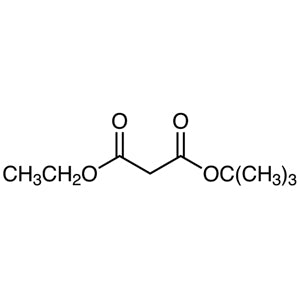
tert-ButylEthylMalonate TCI B3720
Regular price From Rp 928.200,00Regular price -
tert-ButylMethylMalonate TCI B2747
Regular price From Rp 1.670.550,00Regular price -
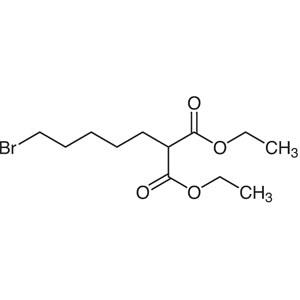
Diethyl(5-Bromopentyl)malonate TCI B2083
Regular price From Rp 2.254.350,00Regular price -
Diethyl2,2-Bis(hydroxymethyl)malonate TCI B1492
Regular price From Rp 3.021.900,00Regular price -
MonoethylMalonate TCI M2700
Regular price From Rp 1.246.350,00Regular price -
Mono-tert-butylMalonate TCI M2687
Regular price From Rp 1.193.850,00Regular price -
MonomethylPotassiumMalonate TCI M2149
Regular price From Rp 1.724.100,00Regular price -
Mono-4-nitrobenzylMalonate TCI M1177
Regular price From Rp 1.431.150,00Regular price