

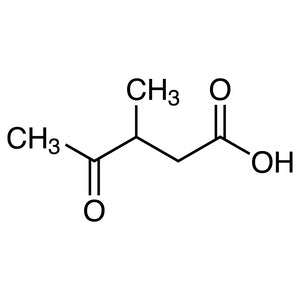
Beta-Methyllevulinic Acid (BMMA), with the CAS number 6628-79-1, is a chemical compound widely used in laboratory settings for its versatility in organic synthesis. As a building block in chemical reactions, BMMA plays a crucial role in the development of complex organic molecules. Its unique molecular structure allows it to participate in various chemical transformations, making it a valuable reagent for researchers. This compound is commonly used in both academic and industrial laboratories to create new compounds with specific functional properties.
BMMA is favored for its chemical stability under controlled conditions and its high reactivity in diverse environments. It dissolves well in organic solvents such as ethyl acetate and acetone, which simplifies its handling and integration into chemical processes. These solubility characteristics make BMMA a preferred choice for reactions requiring precise control over reactivity and solution preparation. Its ability to react under varying conditions also makes it adaptable to a wide range of experimental setups.
In Indonesian laboratories, BMMA is frequently used in scientific research and educational programs. It is a key component in both pure and applied chemistry research, supporting the development of new materials, pharmaceuticals, and photoreactive compounds. Its presence in academic and industrial research environments highlights its importance as a fundamental chemical building block in modern chemistry.
Related TCI products
- Organic Synthesis: BMMA is widely used in the synthesis of complex organic compounds due to its reactivity and solubility in organic solvents.
- Pharmaceutical Development: Its chemical structure makes it suitable for the creation of new drug compounds and medicinal formulations.
- Material Science Research: BMMA is employed in the development of organic materials with specific functional properties.
- Photoreactive Compound Preparation: Its ability to participate in photochemical reactions makes it ideal for photoreactive applications.
- Educational Research: BMMA is commonly used in academic settings to teach and demonstrate chemical reactivity and synthesis techniques.
| Brand | TCI |
|---|---|
| CAS number | 6628-79-1 |
| Molecular formula | — |
| Purity | — |
| Category | Chemistry > Building Blocks > Non-Heterocyclic Building Blocks |
| Pack sizes | Available in various quantities as per supplier specifications |
| Physical form | Solid or crystalline, depending on the batch |
| Storage | Store in a cool, dry place away from light and moisture |
BMMA should be stored in a cool, dry place, away from direct light and moisture to maintain its chemical stability. It is recommended to use airtight containers to prevent exposure to humidity and contaminants. Due to its reactivity, it should be handled in a well-ventilated area, preferably with appropriate personal protective equipment. Avoid contact with incompatible substances such as strong oxidizing agents. Proper labeling and storage conditions help ensure the compound remains effective for its intended applications in laboratory settings.
—
Produk Terkait
-
alpha-MethyllevulinicAcid TCI M1058
Regular price Rp 8.772.750,00Regular price
