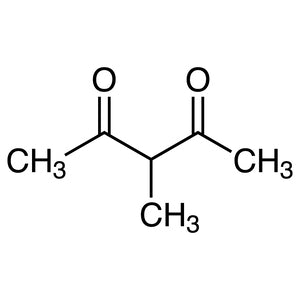
TCI M1132 3-Methyl-2,4-pentanedione is a methylated derivative of acetylacetone, a beta-diketone compound in which two carbonyl groups are separated by a single central carbon atom. What distinguishes it from ordinary acetylacetone is the additional methyl group bonded directly to that central carbon, so the position that normally serves as the reactive centre is already substituted. In the laboratory, this compound serves as a building block for constructing heterocyclic rings and as a reagent for forming metal complexes — two fields that both rely on the characteristic behaviour of the beta-dicarbonyl group.
The property that makes this material attractive comes precisely from that substitution at the central carbon. In acetylacetone, the central carbon is readily alkylated more than once, which produces mixtures of products; with the methyl group already installed, researchers obtain a singly substituted, well-defined beta-diketone framework instead. The keto-enol equilibrium and the ability to act as a bidentate ligand are both retained, so the compound can still bind metal ions to form stable chelates. It is supplied as a liquid, which makes it easy to transfer by syringe and practical for small-scale reactions.
In Indonesian laboratories, this reagent is typically found in university synthetic chemistry groups, coordination chemistry research, and institutional research facilities working on heterocyclic synthesis or metal complex preparation. Its liquid form suits the small-scale, syringe-based work that characterises much academic bench chemistry, where reagents are dispensed in modest volumes across many trial reactions. AMI Scientific supplies it as part of the TCI building block range for research and analytical use.
TCI brochures (PDF)
- Ligands 2025-12-01 · p. 18
Related TCI products
- Heterocyclic ring synthesis — the beta-dicarbonyl motif provides the two carbonyl centres required for condensation routes that close pyrazole, pyrimidine, and related ring systems.
- Metal complex preparation — the compound acts as a bidentate ligand through its enol form, binding metal ions to give stable chelate structures for coordination chemistry studies.
- Controlled mono-substituted building block work — the pre-installed methyl group avoids the multiple-alkylation product mixtures that commonly complicate reactions carried out on plain acetylacetone.
- Keto-enol equilibrium studies — the retained tautomeric behaviour, combined with a substituted central carbon, makes this a useful substrate for investigating how substitution influences enolisation.
- Small-scale exploratory synthesis — supplied as a liquid, the reagent is transferred accurately by syringe, suiting trial-scale reactions where modest and reproducible volumes are dispensed.
| Brand | TCI (Tokyo Chemical Industry) |
|---|---|
| CAS number | 815-57-6 |
| Molecular formula | — |
| Purity | — |
| Category | Chemistry > Building Blocks > Non-Heterocyclic Building Blocks |
| Pack sizes | available in standard TCI research pack sizes; please confirm the currently listed options when ordering |
| Physical form | liquid, suitable for syringe transfer |
| Storage | keep in a cool, dry place in a tightly closed container |
- Chemical name: 3-Methyl-2,4-pentanedione
Store the container in a cool, dry, well-ventilated area away from heat sources, open flames, and direct sunlight. Keep the bottle tightly closed when not in use, since the material is a volatile liquid and prolonged exposure to air is best avoided. Use the original supplier container or a compatible chemically resistant vessel with a secure closure. Handle inside a fume hood and wear appropriate personal protective equipment, including safety glasses, gloves, and a laboratory coat. For syringe transfers, ensure the needle and syringe are clean and dry, and dispose of residues and contaminated materials in accordance with your institution's chemical waste procedures. Always consult the manufacturer's safety data sheet before first use.
—
Produk Terkait
-
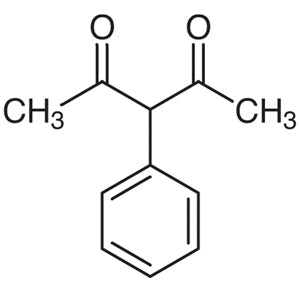
3-Phenyl-2,4-pentanedione TCI P1297
Regular price From Rp 4.479.300,00Regular price -
2,3-Pentanedione TCI P0051
Regular price From Rp 1.881.600,00Regular price -
3-Methyl-1,2-cyclopentanedione TCI M2904
Regular price Rp 2.016.000,00Regular price -
2-Methyl-1,3-cyclopentanedione TCI M0901
Regular price From Rp 1.115.100,00Regular price -
2-Ethyl-1,3-cyclopentanedione TCI E0507
Regular price Rp 1.353.450,00Regular price -
3,4-Dimethyl-1,2-cyclopentanedione TCI D3782
Regular price Rp 875.700,00Regular price -
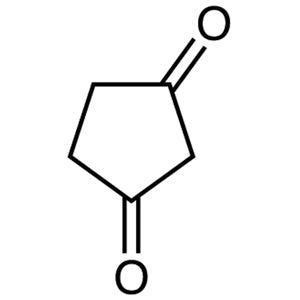
1,3-Cyclopentanedione TCI C1146
Regular price From Rp 980.700,00Regular price -
2,2,4-Trimethyl-1,3-pentanediolDiisobutyrate TCI T0997
Regular price From Rp 477.750,00Regular price