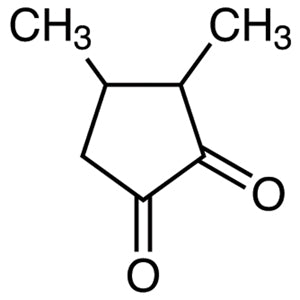
TCI D3782, 3,4-Dimethyl-1,2-cyclopentanedione with CAS number 13494-06-9, is a five-membered cyclic diketone carrying two methyl groups on its ring. As a member of the cyclopentanedione family, this compound is interesting from two angles at once: as a building block for organic synthesis, and as a compound relevant to aroma and flavour chemistry. In the laboratory, this material is used to study condensation reactions of the 1,2-dicarbonyl group, to assemble new heterocyclic frameworks, and as a reference substance in studies of aroma components formed during roasting.
The property that makes this compound a preferred choice is the characteristic reactivity of the 1,2-diketone group, which readily undergoes enolisation and is primed to react with nucleophiles bearing two reactive centres. The two adjacent carbonyl groups allow condensation with aromatic diamines to form quinoxaline systems, or with other reagents to form nitrogen- and oxygen-containing heterocycles. Its ability to chelate metals through its enol form also makes the compound attractive for coordination chemistry work, giving researchers a single reagent that serves several synthetic directions.
On the sensory side, the cyclopentanedione family is known to be associated with sweet, caramel-like aroma nuances, which makes this compound relevant to research on flavouring materials. In Indonesian laboratories, this profile suits synthetic organic chemistry groups building heterocyclic scaffolds, coordination chemistry researchers exploring enol-based metal complexes, and food and flavour science teams examining roasted aroma components in university, government, and industrial research settings.
- Heterocyclic synthesis — the adjacent 1,2-dicarbonyl groups condense cleanly with aromatic diamines to build quinoxaline systems and other new heterocyclic frameworks.
- Condensation reaction studies — the compound serves as a well-defined model substrate for investigating how 1,2-dicarbonyl groups behave with double-functional nucleophilic reagents.
- Coordination chemistry — the enol form of the diketone can chelate metal centres, making this material useful for preparing and studying metal complexes in the laboratory.
- Aroma and flavour research — as a cyclopentanedione associated with sweet, caramel-like nuances, it acts as a reference material in studies of roasted aroma components.
- Organic building block applications — the methyl-substituted cyclopentanedione ring provides a compact starting skeleton for constructing more elaborate target molecules in synthesis.
| Brand | TCI (Tokyo Chemical Industry) |
|---|---|
| CAS number | 13494-06-9 |
| Molecular formula | — |
| Purity | — |
| Category | Chemistry > Building Blocks > Non-Heterocyclic Building Blocks |
| Pack sizes | available in the standard laboratory pack sizes offered by TCI for this catalogue item |
| Physical form | — |
| Storage | store according to the conditions stated on the manufacturer's label and Safety Data Sheet |
- Product Code: D3782
Store this product in its original tightly closed container, in a cool, dry, and well-ventilated place away from direct sunlight, heat sources, and incompatible materials, following the conditions stated on the manufacturer's label and Safety Data Sheet. Keep the container sealed when not in use, since 1,2-diketones can be sensitive to prolonged exposure to air and moisture. Handle the material in a fume hood using appropriate personal protective equipment, including safety goggles, chemical-resistant gloves, and a laboratory coat. Avoid inhalation of dust or vapour and contact with skin and eyes. Review the Safety Data Sheet before first use, label all working solutions clearly, and dispose of residues and contaminated materials in accordance with applicable laboratory waste regulations.
—
Produk Terkait
-
3-Methyl-1,2-cyclopentanedione TCI M2904
Regular price Rp 2.016.000,00Regular price -
2-Methyl-1,3-cyclopentanedione TCI M0901
Regular price From Rp 1.115.100,00Regular price -
2-Ethyl-1,3-cyclopentanedione TCI E0507
Regular price Rp 1.353.450,00Regular price -
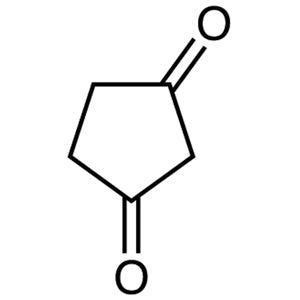
1,3-Cyclopentanedione TCI C1146
Regular price From Rp 980.700,00Regular price -
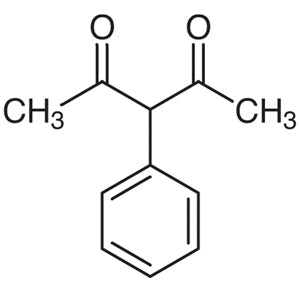
3-Phenyl-2,4-pentanedione TCI P1297
Regular price From Rp 4.479.300,00Regular price -
2,3-Pentanedione TCI P0051
Regular price From Rp 1.881.600,00Regular price -
3-Methyl-2,4-pentanedione TCI M1132
Regular price Rp 3.817.800,00Regular price -
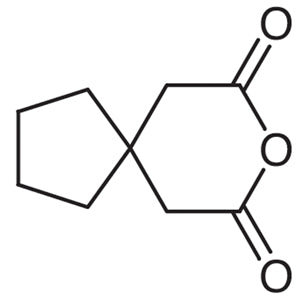
1,1-CyclopentanediaceticAnhydride TCI C0839
Regular price Rp 1.565.550,00Regular price