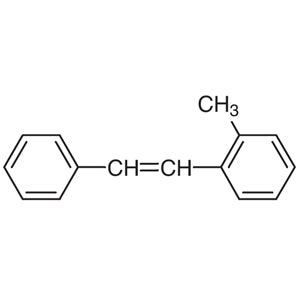
2-Methylstilbene is a chemical compound widely used as a foundational building block in the synthesis of complex organic compounds. Its aromatic structure with a methyl group substitution allows for diverse chemical reactions under various conditions. This compound plays a crucial role in organic chemistry laboratories, serving as a key component in catalytic reactions, substitution reactions, and the formation of heterocyclic compounds. Due to its stability and controlled reactivity, it is a favored material for researchers seeking reliable and consistent results in their experiments.
The compound’s unique chemical properties, including its aromatic stability and reactivity, make it a preferred choice in laboratory settings. It exhibits resistance to degradation under normal conditions, which simplifies storage and long-term use. Its ability to interact with a variety of reagents and catalysts enhances its versatility in different experimental contexts. These characteristics ensure that 2-Methylstilbene remains a valuable tool for both fundamental and applied chemical research.
In Indonesian laboratories, 2-Methylstilbene is commonly utilized in pure and applied chemical research. It is an essential component in experiments that require the synthesis of complex organic molecules. Its availability and reliability make it a standard material in both academic and industrial research environments, supporting a wide range of chemical investigations and innovations.
- Organic synthesis reactions benefit from 2-Methylstilbene due to its aromatic structure and reactivity, enabling the creation of complex molecules with high precision.
- Catalytic processes often utilize this compound as a substrate, allowing for efficient and controlled chemical transformations under various reaction conditions.
- Heterocyclic compound formation relies on 2-Methylstilbene’s ability to participate in ring-opening and condensation reactions, facilitating the synthesis of bioactive molecules.
- Substitution reactions in laboratory settings use this compound as a versatile starting material, offering multiple functional group modifications for further chemical development.
- Analytical chemistry applications leverage its stability and reactivity to test reaction mechanisms and evaluate the performance of new catalysts in controlled environments.
| Brand | TCI |
|---|---|
| CAS number | 74685-42-0 |
| Molecular formula | — |
| Purity | — |
| Category | Chemistry > Building Blocks > Non-Heterocyclic Building Blocks |
| Pack sizes | Available in various quantities as per standard laboratory supply specifications |
| Physical form | Liquid |
| Storage | Store in a cool, dry, and well-ventilated area away from direct sunlight |
2-Methylstilbene should be stored in a cool, dry, and well-ventilated area, away from direct sunlight and sources of heat. It is recommended to use sealed containers made of glass or inert plastic to prevent contamination and maintain its chemical integrity. Due to its reactivity, it should be handled with care, using appropriate personal protective equipment such as gloves and safety goggles. Avoid exposure to incompatible substances, and ensure proper ventilation when working with the compound. Regular monitoring of storage conditions is advised to maintain the compound’s stability and effectiveness in laboratory applications.
—
Produk Terkait
-
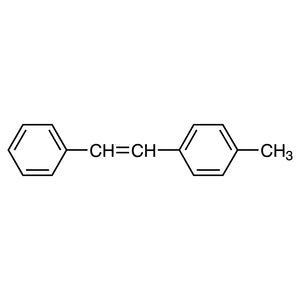
4-Methylstilbene TCI M1492
Regular price From Rp 3.498.600,00Regular price -
9-Vinylanthracene TCI V0130
Regular price From Rp 2.545.200,00Regular price -
5-Vinylbicyclo[221]hept-2-ene(stabilizedwithBHT) TCI V0062
Regular price From Rp 769.650,00Regular price -
1,3,5-Undecatriene(mixtureofisomers) TCI U0062
Regular price From Rp 3.155.250,00Regular price -
1-Undecene TCI U0052
Regular price From Rp 2.068.500,00Regular price -
1-Undecene TCI U0025
Regular price Rp 1.060.500,00Regular price -
1,10-Undecadiene TCI U0024
Regular price From Rp 2.491.650,00Regular price -
1,4,4a,5,8,8a-Hexahydro-1,4:5,8-dimethanonaphthalene(mixtureofisomers)(stabilizedwithBHT) TCI T4428
Regular price From Rp 4.056.150,00Regular price

![3048-64-4 5-Vinylbicyclo[2.2.1]hept-2-ene (stabilized with BHT) - AMI Scientific](http://amiscientific.com/cdn/shop/files/TCI2510V0062.jpg?v=1767145572&width=533)