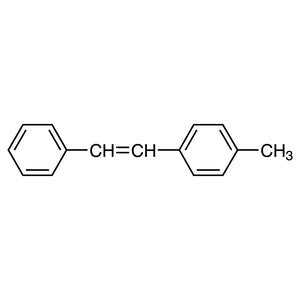
4-Methylstilbene is an organic compound widely used in chemical synthesis to produce a variety of complex molecules. It is a key building block in the field of organic chemistry, particularly in the development of more intricate molecular structures. Its aromatic structure with a methyl group at the C-4 position provides it with high reactivity, making it a valuable component in various synthetic pathways. This compound is commonly employed in laboratory settings for its versatility and ability to participate in multiple types of chemical reactions, including Diels-Alder, coupling, and substitution reactions.
One of the main reasons for its popularity is its chemical stability under controlled conditions, combined with its sensitivity to oxidation and hydrolysis. These properties make it a reliable choice for synthetic applications where precise control over reaction conditions is essential. The compound also exhibits good thermal stability due to its aromatic framework, allowing it to be used in a wide range of experimental setups. Its availability in pure form and various packaging options further enhances its utility in both academic and industrial research environments.
In Indonesian laboratories, 4-Methylstilbene is frequently utilized in organic chemistry research, especially by higher education institutions and research organizations. Its availability and reliability make it a preferred choice for researchers working on synthetic projects. Additionally, it is widely accepted in the pharmaceutical industry for its role in the development of new compounds and drug synthesis processes.
- Organic synthesis applications benefit from 4-Methylstilbene due to its reactivity and versatility in forming complex molecular structures.
- It is ideal for Diels-Alder reactions because of its ability to act as a diene or dienophile, depending on reaction conditions.
- Coupling reactions often utilize this compound as a building block for creating new carbon-carbon bonds in synthetic pathways.
- Substitution reactions in laboratory settings rely on its aromatic structure for selective functional group modifications.
- It is commonly used in pharmaceutical research for the development of new drug compounds and synthetic intermediates.
| Brand | TCI |
|---|---|
| CAS number | 4714-21-0 |
| Molecular formula | — |
| Purity | — |
| Category | Chemistry > Building Blocks > Non-Heterocyclic Building Blocks |
| Pack sizes | Available in various sizes suitable for small to medium-scale laboratory use |
| Physical form | Solid or liquid, depending on the specific product variant |
| Storage | Store in a cool, dry place away from light and moisture |
4-Methylstilbene should be stored in a cool, dry environment, away from direct light and moisture to maintain its chemical stability. It is recommended to use airtight containers to prevent exposure to air and potential oxidation. Due to its sensitivity to hydrolysis, it is important to avoid contact with water or aqueous solutions. In laboratory settings, proper ventilation should be ensured when handling the compound to minimize inhalation risks. Always use appropriate personal protective equipment, such as gloves and safety goggles, when working with this material to ensure safety and compliance with standard laboratory protocols.
—
Produk Terkait
-
2-Methylstilbene TCI M1491
Regular price Rp 2.386.650,00Regular price -
9-Vinylanthracene TCI V0130
Regular price From Rp 2.545.200,00Regular price -
5-Vinylbicyclo[221]hept-2-ene(stabilizedwithBHT) TCI V0062
Regular price From Rp 769.650,00Regular price -
1,3,5-Undecatriene(mixtureofisomers) TCI U0062
Regular price From Rp 3.155.250,00Regular price -
1-Undecene TCI U0052
Regular price From Rp 2.068.500,00Regular price -
1-Undecene TCI U0025
Regular price Rp 1.060.500,00Regular price -
1,10-Undecadiene TCI U0024
Regular price From Rp 2.491.650,00Regular price -
1,4,4a,5,8,8a-Hexahydro-1,4:5,8-dimethanonaphthalene(mixtureofisomers)(stabilizedwithBHT) TCI T4428
Regular price From Rp 4.056.150,00Regular price

![3048-64-4 5-Vinylbicyclo[2.2.1]hept-2-ene (stabilized with BHT) - AMI Scientific](http://amiscientific.com/cdn/shop/files/TCI2510V0062.jpg?v=1767145572&width=533)