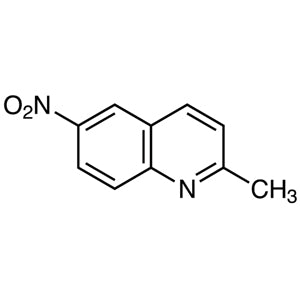
2-Methyl-6-nitroquinoline is a chemical compound widely used in synthetic laboratory reactions. It belongs to the category of heterocyclic building blocks, featuring a quinoline core with substituents at positions 2 and 6. This compound plays a crucial role in organic chemistry by serving as a versatile intermediate in the synthesis of complex molecules. Its structural characteristics make it a valuable tool for chemists seeking to explore new chemical pathways and functional group transformations.
The compound's chemical stability under controlled conditions, along with its reactivity towards acids, bases, and organic solvents, makes it a preferred choice for various synthetic applications. Its ability to participate in substitution and oxidation reactions enhances its utility in the development of pharmaceuticals, pesticides, and industrial chemicals. The molecular structure also allows for predictable chemical behavior, enabling researchers to design and execute experiments with greater precision.
In Indonesian laboratories, 2-Methyl-6-nitroquinoline is commonly used in both fundamental and applied chemical research. It is frequently employed in the synthesis of new compounds, particularly in academic and industrial settings where the creation of novel materials and drugs is a priority. Its availability and reliability make it a staple in the chemical supply chain for researchers and institutions across the country.
- Organic synthesis: This compound is ideal for creating complex molecules due to its reactive quinoline core and substituents.
- Pharmaceutical development: It serves as a building block for the synthesis of various drug compounds and medicinal agents.
- Pesticide formulation: Its chemical structure allows for the development of effective and targeted agricultural chemicals.
- Industrial chemical production: It is used in the creation of specialty chemicals for diverse industrial applications.
- Research and development: Its versatility makes it a key component in experimental studies aimed at discovering new chemical properties.
| Brand | TCI |
|---|---|
| CAS number | 613-30-9 |
| Molecular formula | — |
| Purity | — |
| Category | Chemistry > Building Blocks > Heterocyclic Building Blocks |
| Pack sizes | Available in various quantities as per standard laboratory supply requirements |
| Physical form | Solid, typically in crystalline or powder form |
| Storage | Store in a cool, dry place away from direct sunlight and moisture |
This compound should be stored in a cool, dry environment to maintain its chemical stability. It is recommended to use airtight containers made of glass or high-density polyethylene to prevent contamination and moisture ingress. Due to its reactivity with acids and bases, it should be handled in a well-ventilated area, preferably under a fume hood. Proper personal protective equipment, including gloves and safety goggles, should be worn during handling to ensure laboratory safety. Avoid exposure to heat or direct sunlight to prevent degradation of the compound. Regular monitoring of storage conditions is essential to maintain the integrity of the material for laboratory use.
—
Produk Terkait
-
TCI B5774 5,10-Bis(4,4,5,5-tetramethyl-1,3,2-dioxaborolan-2-yl)naphtho[1,2-c:5,6-c']bis([1,2,5]oxadiazole)
Regular price Rp 10.255.350,00Regular price -
Dihydroiodide TCI B6569
Regular price From Rp 1.936.200,00Regular price -
Trifluoromethanesulfonate TCI B7003
Regular price From Rp 1.936.200,00Regular price
![5,10-Bis(4,4,5,5-tetramethyl-1,3,2-dioxaborolan-2-yl)naphtho[1,2-c:5,6-c']bis([1,2,5]oxadiazole) - TCI B5774 - AMI Scientific](http://amiscientific.com/cdn/shop/files/TCI2510B5774.jpg?v=1769180228&width=533)