


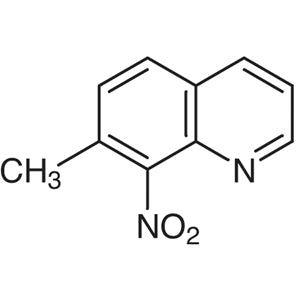
7-Methyl-8-nitroquinoline is a complex heterocyclic compound with a quinoline ring modified by a methyl and nitro group. This chemical plays a crucial role in organic synthesis as a building block for the development of compounds with specific biological activities. In laboratory settings, it is widely used in research focused on creating new molecules, particularly in pharmacology and organic chemistry. Its structural complexity and functional groups make it a versatile tool for chemists seeking to explore novel chemical reactions and molecular transformations.
The compound is known for its chemical stability and reactivity, enabling it to participate in various reactions such as substitution, reduction, and electrophilic reactions. Its high reactivity allows it to be utilized under different reaction conditions, making it a preferred choice for synthetic chemists. The presence of both the nitro and methyl groups enhances its utility in functional group transformations, offering a wide range of synthetic possibilities. These properties make it a valuable resource for researchers aiming to develop new compounds with tailored properties.
In Indonesian laboratories, 7-Methyl-8-nitroquinoline is commonly used in academic and research institutions that focus on organic synthesis. Its relevance is particularly evident in studies related to drug discovery and chemical innovation. The compound is frequently employed in experiments that require the synthesis of complex organic molecules, supporting both educational and industrial research efforts. Its availability and chemical properties make it an essential material in the chemical research landscape of Indonesia.
- Organic synthesis is a key application where 7-Methyl-8-nitroquinoline serves as a versatile building block for creating complex molecules with specific biological activities.
- Pharmacological research benefits from this compound due to its ability to participate in various chemical reactions, enabling the development of new drug candidates.
- Chemical education in Indonesian universities often incorporates this compound to teach students about heterocyclic chemistry and synthetic pathways.
- Industrial research and development in the chemical sector utilizes this material for the synthesis of specialized organic compounds.
- Environmental studies may involve this compound as a model for understanding the behavior of heterocyclic pollutants in different chemical environments.
| Brand | TCI |
|---|---|
| CAS number | 7471-63-8 |
| Molecular formula | — |
| Purity | — |
| Category | Chemistry > Building Blocks > Heterocyclic Building Blocks |
| Pack sizes | Available in standard chemical packaging sizes as per supplier specifications |
| Physical form | Solid, typically in crystalline or powder form |
| Storage | Store in a cool, dry place away from light and incompatible substances |
7-Methyl-8-nitroquinoline should be stored in a cool, dry place, away from direct sunlight and sources of heat. It is recommended to keep the compound in a sealed container to prevent moisture absorption and contamination. Due to its chemical reactivity, it should be stored separately from strong oxidizers, acids, and bases to avoid unwanted reactions. Proper ventilation is essential when handling this compound to minimize inhalation risks. Laboratory personnel should wear appropriate personal protective equipment, such as gloves and safety goggles, when working with this material. Safe storage and handling practices are crucial to ensure the integrity of the compound and the safety of laboratory staff.
—
Produk Terkait
-
2-Methyl-8-nitroquinoline TCI N0539
Regular price From Rp 2.491.650,00Regular priceRp 1.757.700,00Sale price From Rp 2.491.650,00 -
8-Nitroquinoline TCI N0345
Regular price From Rp 875.700,00Regular priceRp 627.900,00Sale price From Rp 875.700,00 -
5-Nitroquinoline TCI N0344
Regular price From Rp 1.856.400,00Regular priceRp 1.313.550,00Sale price From Rp 1.856.400,00 -
6-Nitroquinoline TCI N0252
Regular price From Rp 1.008.000,00Regular priceRp 720.300,00Sale price From Rp 1.008.000,00 -
4-NitroquinolineN-Oxide TCI N0250
Regular price From Rp 1.881.600,00Regular priceRp 1.331.400,00Sale price From Rp 1.881.600,00 -
3-Methyl-4-nitroquinoline1-Oxide TCI M3311
Regular price From Rp 1.431.150,00Regular priceRp 1.016.400,00Sale price From Rp 1.431.150,00 -
6-Methoxy-8-nitroquinoline TCI M2057
Regular price Rp 2.121.000,00Regular priceRp 1.498.350,00Sale price Rp 2.121.000,00 -
2-Methyl-6-nitroquinoline TCI M1499
Regular price Rp 1.696.800,00Regular priceRp 1.202.250,00Sale price Rp 1.696.800,00


