

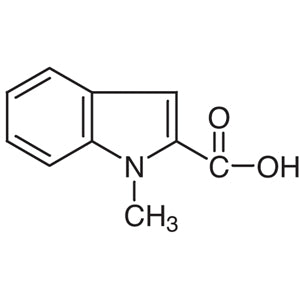
1-Methylindole-2-carboxylic Acid is a versatile chemical compound widely used in synthetic reactions to construct complex heterocyclic structures. It serves as a fundamental building block in organic chemistry, enabling the synthesis of a wide range of compounds, including pharmaceuticals, industrial chemicals, and other organic materials. Its unique molecular structure makes it an essential tool in the development of new compounds with specific functional properties. In laboratory settings, this compound is frequently employed in research aimed at modifying indole-based structures, offering a reliable foundation for further chemical transformations.
The compound's high reactivity and compatibility with various synthetic methods make it a preferred choice for chemists. It exhibits good solubility in organic solvents, which simplifies purification and isolation processes in laboratory procedures. Additionally, its stability under controlled conditions allows for long-term storage when handled properly. These properties make it suitable for a variety of chemical reactions, including substitution, reduction, and condensation, which are commonly used in organic synthesis.
In Indonesian laboratories, 1-Methylindole-2-carboxylic Acid is commonly used in organic chemistry research, particularly in academic institutions and research centers. It is a key component in the development of new compounds, supporting both educational and applied research. Its availability through suppliers like AMI Scientific ensures that researchers have access to this essential material for their experimental needs.
- Organic synthesis research utilizes this compound for constructing complex heterocyclic structures due to its reactivity and structural versatility.
- Pharmaceutical development benefits from its ability to serve as a building block for drug molecule synthesis, supporting the creation of novel therapeutic agents.
- Industrial chemical production leverages its solubility and reactivity to facilitate the synthesis of various organic compounds with specific functional groups.
- Academic research in chemistry employs it as a fundamental tool for teaching and experimental work in heterocyclic compound synthesis.
- Analytical chemistry applications use it as a reference standard for identifying and quantifying similar compounds in complex mixtures.
| Brand | TCI |
|---|---|
| CAS number | 16136-58-6 |
| Molecular formula | — |
| Purity | — |
| Category | Chemistry > Building Blocks > Heterocyclic Building Blocks |
| Pack sizes | Available in various quantities as per supplier specifications |
| Physical form | Solid (as per standard product description) |
| Storage | Store in a cool, dry place away from direct sunlight and moisture |
This compound should be stored in a cool, dry environment, away from direct sunlight and moisture to maintain its stability and reactivity. It is recommended to use airtight containers to prevent exposure to air and moisture, which could affect its chemical integrity. In laboratory settings, it should be handled with appropriate personal protective equipment, such as gloves and safety goggles, to ensure safety during use and storage. Proper labeling of containers is essential to avoid confusion and ensure safe handling. The compound should not be stored near incompatible materials, such as strong oxidizers, to prevent any potential chemical reactions. Regular inspection of storage conditions is advised to maintain optimal handling and safety standards.
—
Produk Terkait
-
2,3,3,5-Tetramethylindolenine TCI T3458
Regular price From Rp 1.803.900,00Regular price -
5-Amino-2-methylindole TCI A1539
Regular price From Rp 1.353.450,00Regular price -
2,3,3-Trimethylindolenine TCI T0766
Regular price From Rp 1.405.950,00Regular price -
4-Methylindole TCI M1745
Regular price Rp 1.298.850,00Regular price -
7-Methylindole TCI M1702
Regular price From Rp 823.200,00Regular price -
2-Methylindole-3-carboxaldehyde TCI M1485
Regular price From Rp 2.121.000,00Regular price -
6-Methylindole TCI M1430
Regular price From Rp 1.565.550,00Regular price -
3-Methoxymethylindole TCI M1305
Regular price From Rp 795.900,00Regular price


